Troubleshooting
Asko Washer Error Codes: Five Families, and How to Tell Which Is Yours
Asko washer error codes come from five separate families, and which one applies is decided by the panel rather than by the badge. The W6xxx display machines print F10, F11 and F12. The WM75 platform, which includes the W4114C, uses E-numbers from E0 up to E37. The numbered-LED machines use a short set of F1, F3, F4 and F6 whose meanings do not match the display machines. The older analog machines signal L1 to L6 — and here the trap is sharpest, because the W6022 and the W6324 assign different meanings to the same L-numbers. Finally, the premium panels skip codes entirely and print whole sentences — a water outlet message, a wash motor message — instead of a number. There is no single Asko washer code list, and a page that offers one is guessing.
The full guide
Five code families run across the Asko washers in South Florida laundry rooms. They are not versions of one another, and the model number is what tells them apart.
Which panel are you looking at?
- A numeric display that shows F10, F11 or F12 — the W6xxx display machines.
- A display that prints E-numbers, anywhere from E0 to E37 — the WM75 platform, documented on the W4114C.
- A row of numbered LEDs with F1, F3, F4 or F6 — the W6222 and W6342 generation.
- Plain indicator lights signaling L1 to L6 — the older analog machines.
- A panel that writes sentences rather than codes: Close the Door, and plain-English messages naming the water outlet, the water inlet, the wash motor or the door.
Everything after this depends on which of those five you have.
The trap that costs the most
The L-family is the one to be careful with, because two machines of the same era do not agree. On the W6022, L1 means the door is not closed, L2 is overfilling, L3 is a drainage problem and L4 is a water intake problem. On the W6324, L1 is an overflow, L2 is a water outlet problem, L3 is a water inlet problem and L4 is an imbalance that needs no action at all.
Read that again: on one machine L4 means the supply has a problem, and on the other it means the machine has already sorted itself out and carried on. Nothing but the model sticker separates them.
What the families agree about
Underneath the labels the machine is doing the same small number of things, and the free checks are the same across all five families.
Water will not go out. Empty the drum through the small drain hose behind the lower panel, then unscrew the pump filter cap and clear it. Check the hose behind the machine is not crushed and the standpipe it goes into is draining.
Water will not come in. Both taps fully open, both hoses straight, and the inlet screens at the valves clean. On this water the screens silt up faster than most people expect.
The door will not release. Drain the machine first — the lock stays engaged while there is water inside, and that is correct behavior rather than a failure. Then power off at the wall for five full minutes.
What to write down before calling
The model number from the sticker, the exact characters on the panel, and whether the machine had drained. Those three together turn five possible tables into one, and they change what goes on the van.
Why we sell an hour just for this
Establishing which platform a machine is on is real work with a real value on this make, and it is the only job on our list whose entire product is information. For anyone intending to keep the machine another decade it is the cheapest useful thing we do, and it is credited in full against a repair booked in the same visit.
If it turns out to be a repair
What this leads to, and what it costs
Every job on this site is priced the same way: an on-site diagnostic first, the figure agreed in writing before anybody starts.
-
Platform identification
The job this make needs and no other make on our list does. Three dishwasher generations, five washer code families, dryer schemes that change with the control board and two induction families that share no numbers — and from the front of the kitchen they are indistinguishable. This is the visit that settles which machine is actually in the run, records it, and gives you a code table that applies to your appliance instead of to the badge in general. For anyone who intends to keep the machine another decade it is the cheapest useful thing we sell.
- Which generation, which board, which code table — established and written down
- Turns every future number on the display into something readable
- Credited in full against a repair if it is booked in the same visit
-
Washer not draining repair
A drum still holding water when the program ends, with the machine declining to spin for it — that refusal is by design rather than a second failure. Which label it arrives under depends entirely on the panel: the display machines print a number, the numbered-LED machines show a short code from a different family, the analog ones signal with lights, and the premium panels print a sentence. All four are describing the same short path from sump to standpipe.
- Pump filter behind the lower panel first — free, and often the whole answer
- The refusal to spin is the machine protecting itself, not a second problem
- Standpipe height and the wall connection, which are usually not the machine
-
Washer error code E7
Asko washer error code E7: This make runs five separate washer code families. Which machines can raise it, what the maker publishes about it, and what to do next.
What this one means -
Washer error code L3
Asko washer error code L3: This make runs five separate washer code families. Which machines can raise it, what the maker publishes about it, and what to do next.
What this one means
Questions people ask about this
My machine shows L3. What does it mean?
It depends on which machine. On a W6022 it is a drainage problem — the water is not getting out. On a W6324 the same L3 is a water inlet problem, which is the opposite end of the machine and a completely different set of free checks. The manuals disagree with each other on purpose, because they are documenting different products. Get the model number off the sticker before acting on the letter.
There is no code at all, just a sentence.
Then you have one of the premium panels, and the sentence is the code. Read it exactly as printed and tell us the wording rather than a paraphrase: the machine is being more specific than a number would be, and the phrasing distinguishes several different problems.
Can I use a generic Asko E-code list from a repair site?
Only if it is matched to a specific model. The E-code set that circulates online matches the W4114C manual, which is real — but treating it as the Asko washer list means applying it to machines that use a different family entirely.
Troubleshooting
More guides like this one
-
An Asko Oven Showing Err and Two Digits: What the Manuals Actually Say
Six Asko oven manuals across several generations print an undecoded ErrXX and the same instruction: disconnect, reconnect, call a technician. There is no published table, and the decoded lists online do not come from Asko.
Read more -
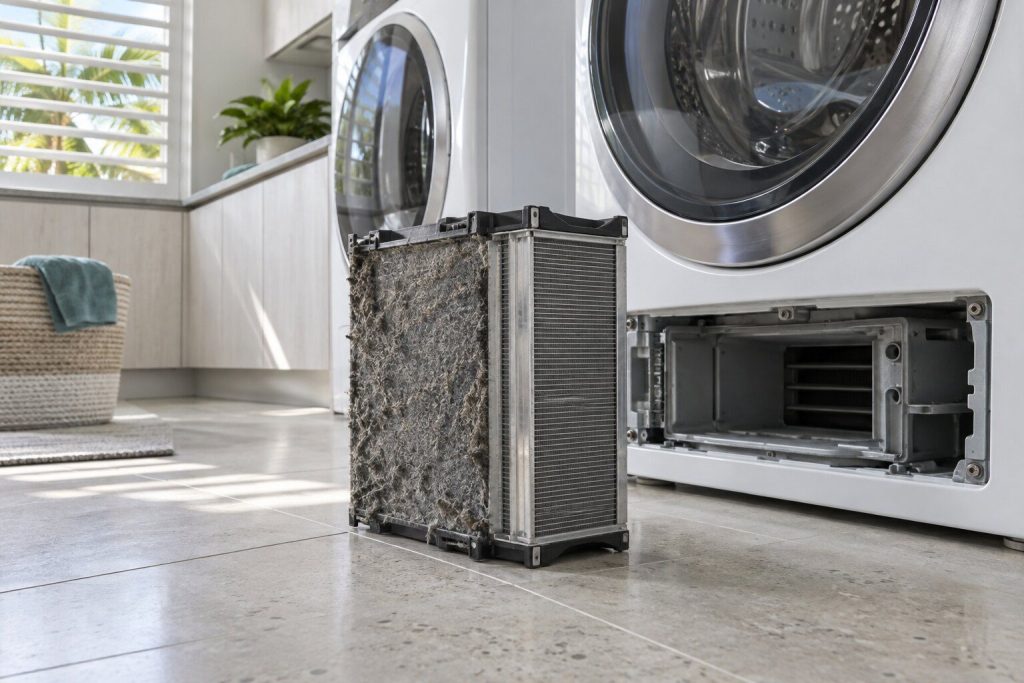
An Asko Dryer That Will Not Dry: Three Filters, In Order
Nothing is vented outside on these machines, so drying depends on three filters and a condenser staying clear. In a Miami laundry closet they load far faster than the manual assumes.
Read more -
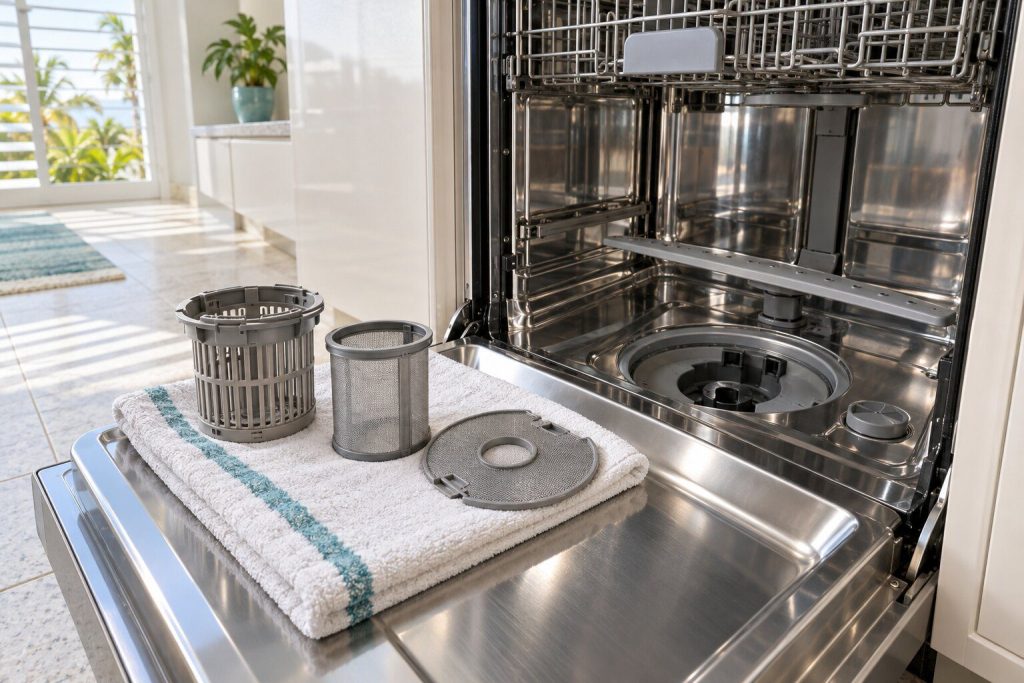
An Asko Dishwasher That Will Not Drain: Ten Minutes Before You Call
Lift the filter stack out — the whole stack, not just the top filter — rinse it, seat it properly and run a rinse program. That ends this complaint more often than any part, on all three generations.
Read more
Tell us the model number and what it is doing.
This article is based on:
- Official manufacturer documentation
- Internal repair procedures
- Technician repair history
- Company quality standards