Appliance
Asko washers
A front loader built around a steel frame rather than a plastic one, sold here as Classic, Logic and Style — the three-, five- and seven-series. What makes it awkward to write about honestly is that five different code families are in circulation across the machines still running in South Florida: the W6 display machines print F10 to F12; the WM75 platform speaks in E-numbers as far as E37; the numbered-LED machines use a short F-set whose meanings do not match the display machines; the analog LED machines signal L1 to L6 and mean different things by model; and the premium panels skip the code entirely and print a sentence. There is no single Asko washer code list, and any page that offers one is guessing.
- 5 symptoms we are called out to
- From $95 diagnostic, credited to the repair
- 59 cities and neighborhoods covered
- OEM parts available on order
The short version
What this equipment is, for a repair
Configurations
Eight US models · Classic, Logic and Style, and five different code families
Access
Planned before the visit, not discovered on arrival
Parts
OEM, available on order
Diagnostic
From $95, credited to the repair
What goes wrong with it
Symptoms we are called out to on Asko washers
Each one covers the likely causes in the order they are worth checking, and what to do in five minutes before booking anything.
-
The drum is full of water at the end of the program Washer not draining
A cycle that has finished with the water still in it, and a machine that then refuses to spin — that refusal is deliberate rather than a second failure, because spinning a full drum would put the water on the floor. How the machine says so depends entirely on the panel: the display models print a number, the numbered-LED models a short code from an unrelated family, the analog ones a letter and a light, and the premium panels write out a sentence. Behind every one of them is the same short path from sump to standpipe, and the cheap end of it ends most of these.
- The pump filter is behind the lower panel and it is free to check
- Empty the drum through the drain hose BEFORE opening the filter cap
- Five different code families describe this — the model decides which one you have
-
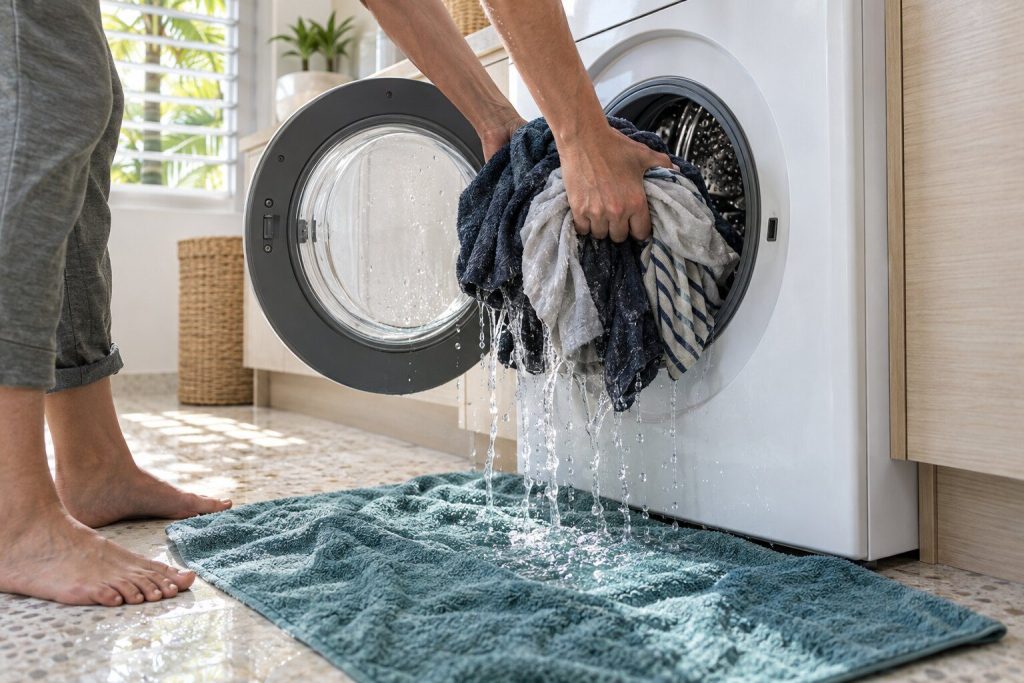
The load comes out soaked after a cycle that seemed to finish Washer not spinning
Clothes heavy with water at the end of a program that otherwise ran normally. Three free things account for most of these and all three can be settled before anybody is called: the machine has not drained, the load will not balance, or the program chosen has no spin in it. What is left after those is genuinely mechanical — the door lock the machine will not spin without, the motor and its control, or the shock absorbers that have worn far enough that the drum moves more than the balance check will allow.
- Run a spin-only program on an empty drum — it separates three causes in five minutes
- A machine holding water will never spin, by design
- Persistent imbalance on ordinary loads is worn suspension, not laundry
-
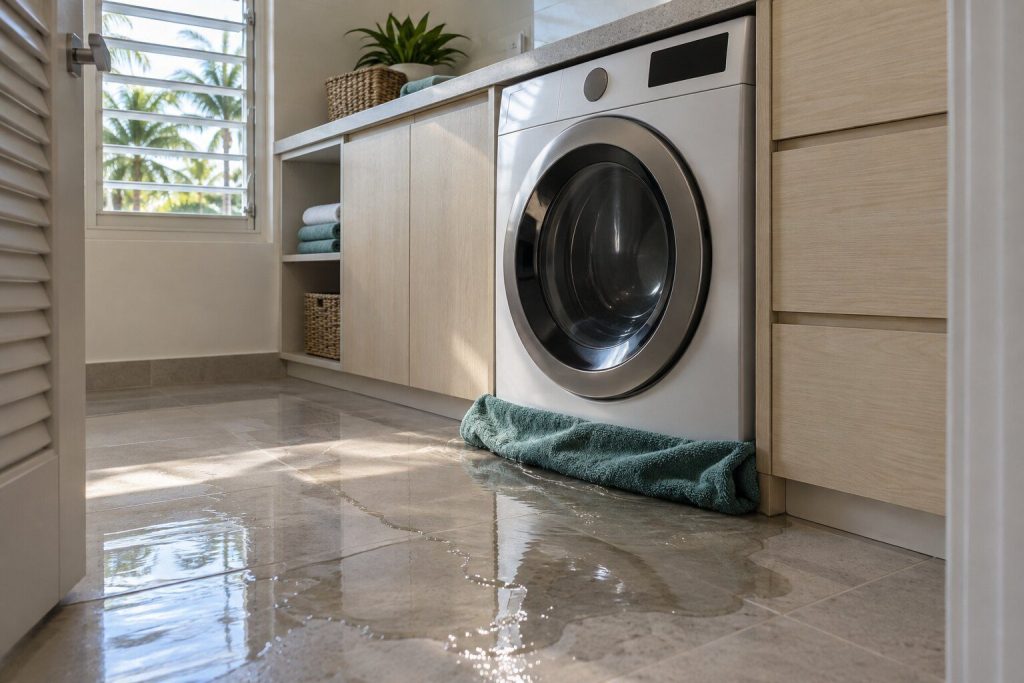
Water on the laundry floor and no obvious source Washer leaking
Water appearing under or beside the machine, and by the time it shows on the tile it has usually traveled along the frame from somewhere else. Three places account for nearly all of it: the door seal, where grit collects in the bottom fold and cuts the rubber from the inside over months; the pump filter cap, very often after somebody cleared a blockage and did not seat it; and the hose unions at the wall. In a condominium this matters further than the machine does, because water in a laundry closet reaches a floor slab and then somebody else's ceiling.
- Turn the taps off and stop using the machine — a program uses several gallons
- Check the filter cap first if anyone has cleared a blockage recently
- In a building this is a shared problem long before it is an expensive one
-
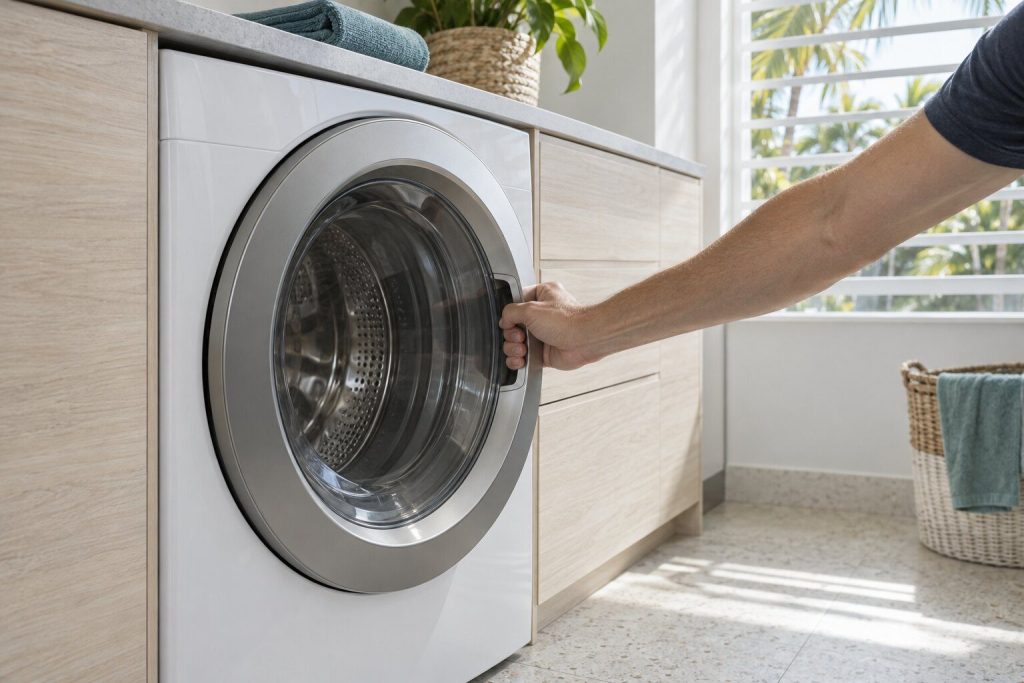
The cycle has ended and the door is still locked Washer door will not open
A finished program and a door that will not release, usually with a drum that still has water in it. Those two facts are connected: the lock stays engaged while there is water inside, which is the machine protecting the room rather than a failure. So the sequence that works is drain first, open second. Where the drum is genuinely empty and the door still will not release, the lock itself has failed — and on this make the premium panels say so in words while the numbered ones give a short code from whichever family that model belongs to.
- Drain the machine before anything else — a locked door with water in it is correct
- Do not force it: the lock is the failed part and forcing adds the handle
- Some models release after a full power-off of several minutes
-
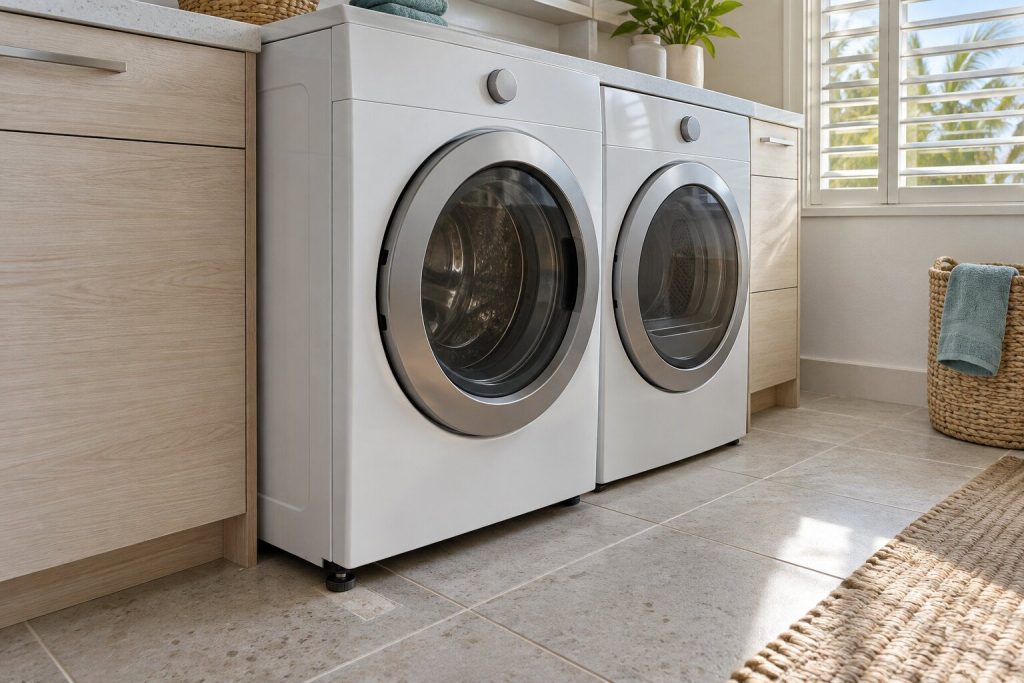
It has become noisy, and it walks Washer loud or moving on spin
A machine that has grown louder over months, or one that moves across the floor when it accelerates. Both are the suspension rather than the motor, and both are worth acting on early for a reason that has nothing to do with the noise: worn damping lets the drum travel further on every spin, and that travel is what eventually takes the drum bearing. A bearing is a day's strip-down. Shock absorbers are an afternoon. The gap between those two prices is the entire argument for calling while it is still only annoying.
- Noise that grew over months is suspension; noise that arrived suddenly is a bearing
- A machine that walks is not level, or its damping has gone — check level first
- Catching this early is what prevents the expensive repair
What we do on it
Repairs we carry out on Asko washers
Starting figures for this equipment in South Florida. The exact cost is confirmed after an on-site diagnostic — and this is not the whole list of what can go wrong, so call if your problem is not here.
-
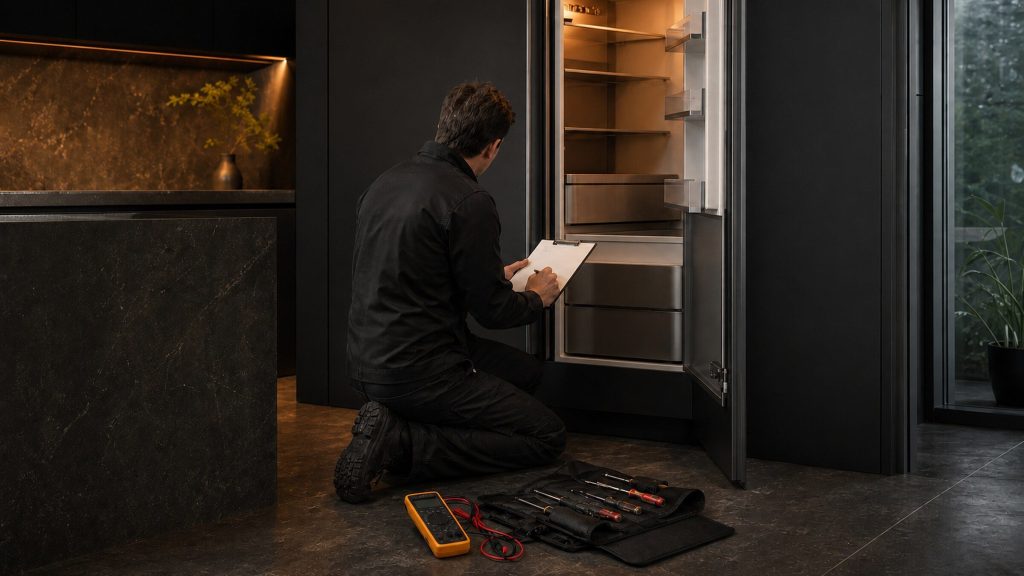
from $95 Diagnostic visit
Establishing what is actually wrong with the machine, ahead of naming or costing a part. Here one thing has to be settled before the complaint can even be read: which generation is standing in the kitchen. Digits on this badge belong to whichever board prints them, so a dishwasher, washer or dryer measured against the wrong table produces a confident answer and an incorrect part. You keep the charge against the repair when the work goes ahead; where our view is that spending money on this machine makes no sense, that view is what you have paid for and the amount stays the same.
- Generation before symptom — it settles which table the digits belong to
- The number is written down before the work, and it comes off the repair
- Where mending makes no sense we say it, instead of finding a part to sell
-
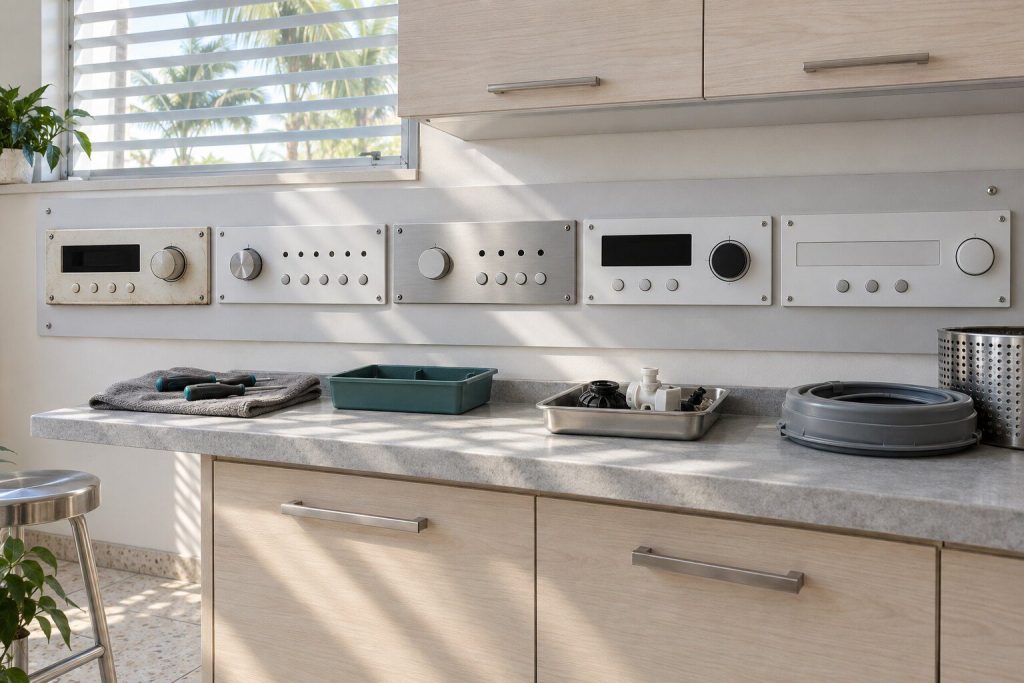
from $115 Platform identification
The job this make needs and no other make on our list does. Three dishwasher generations, five washer code families, dryer schemes that change with the control board and two induction families that share no numbers — and from the front of the kitchen they are indistinguishable. This is the visit that settles which machine is actually in the run, records it, and gives you a code table that applies to your appliance instead of to the badge in general. For anyone who intends to keep the machine another decade it is the cheapest useful thing we sell.
- Which generation, which board, which code table — established and written down
- Turns every future number on the display into something readable
- Credited in full against a repair if it is booked in the same visit
-
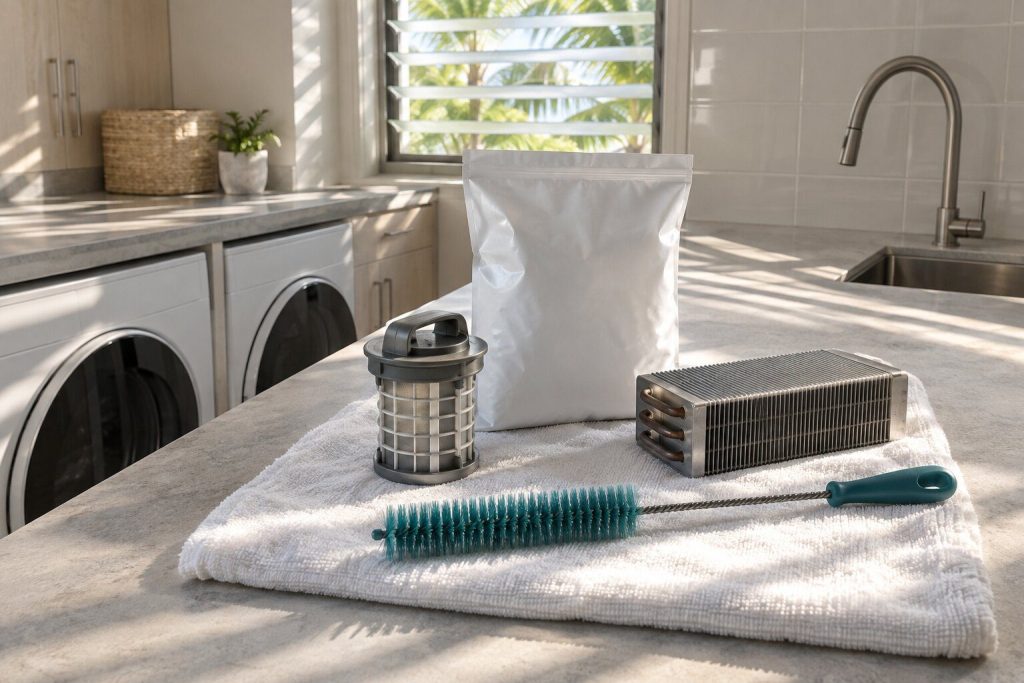
from $155 Appliance maintenance
A planned visit rather than a rescue, and on this make it pays for itself faster than on most. These are machines built to run for twenty years, which means the things that end them early are almost all maintenance items — a condenser filter packed solid in a laundry closet at eighty per cent humidity, a dishwasher filter stack nobody knew lifted out, a door seal cutting itself on grit. Every one of those is minutes of work and none of them announce themselves before they cost a part.
- Filters, seals, drains and airflow — the four that end machines early here
- One visit covers every Asko appliance in the property, not one machine
- Written record of what was found, so the next visit is not a fresh start
-
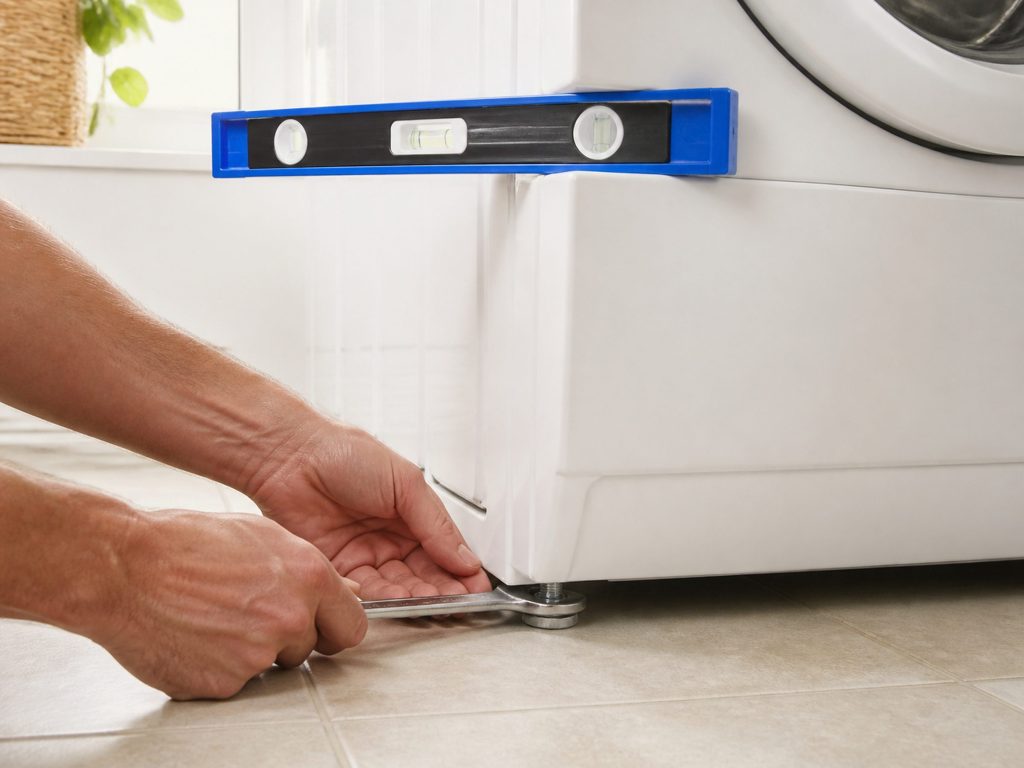
from $185 Appliance installation
Fitting a machine into a space that was drawn for another one, which in this county is most installations. On integrated equipment the appliance is the easy half: the panel, the scribe, the toe kick, the services behind and the air the machine needs to breathe are the work. We measure the opening before anything is ordered, because an integrated cabinet that does not fit is not a delivery problem, it is a joinery problem, and it is far cheaper to find out on a Tuesday with a tape measure.
- The opening measured before anything is ordered, not after it arrives
- Panel, scribe and toe kick treated as part of the job, not as somebody else's
- Air path checked and recorded — a boxed-in machine fails whatever is fitted
-
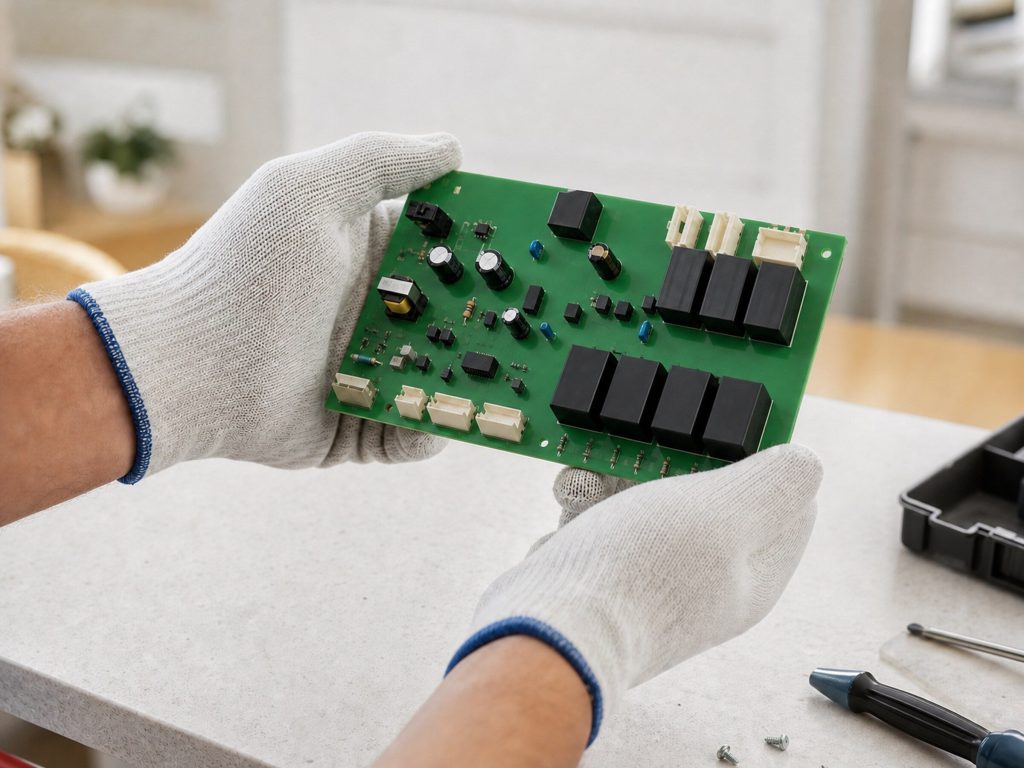
from $285 Control board repair
The repair where being honest about the supply chain matters more than being quick. Boards on this make come through a European channel, and on a machine that is no longer in the US catalog that is a real wait rather than a phrase. So the order here is fixed: prove the board is the problem, price the part with its lead time attached, and only then decide. A board fitted to cure a supply problem or a water-ingress problem will fail the same way in a season, and we would rather find the water.
- Proven, not assumed — the board is the last suspect, never the first
- Lead time is quoted with the price, because on this make it is part of the answer
- Water ingress and supply errors found first, or the new board follows the old one
-
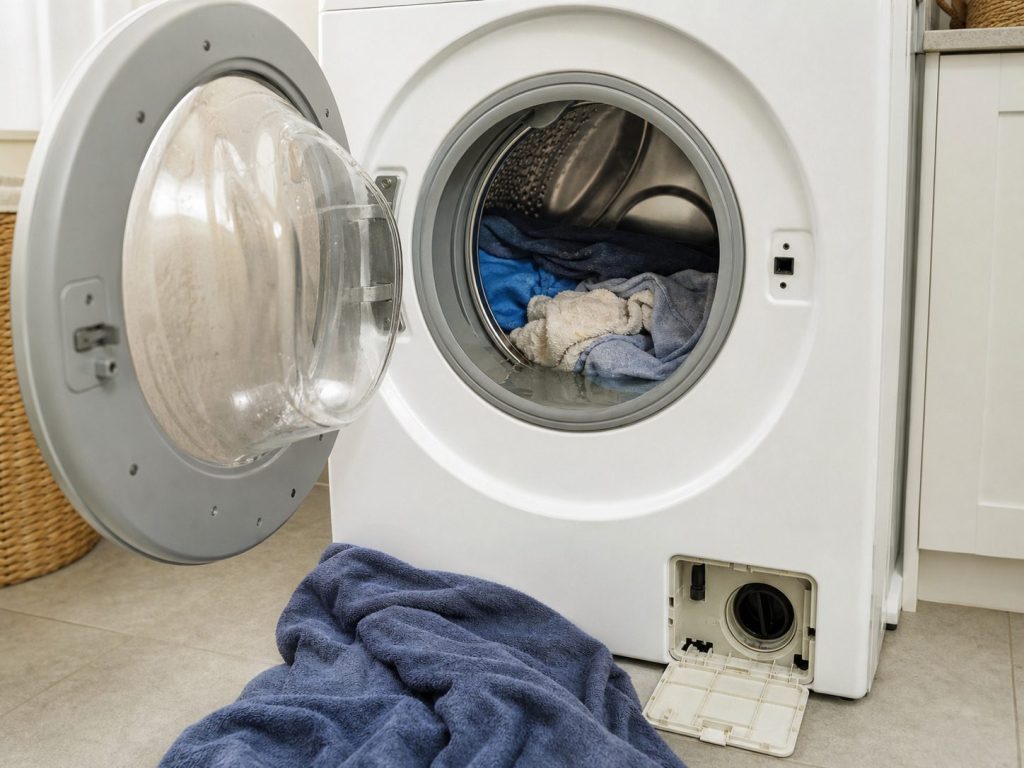
from $155 Washer not draining repair
A drum still holding water when the program ends, with the machine declining to spin for it — that refusal is by design rather than a second failure. Which label it arrives under depends entirely on the panel: the display machines print a number, the numbered-LED machines show a short code from a different family, the analog ones signal with lights, and the premium panels print a sentence. All four are describing the same short path from sump to standpipe.
- Pump filter behind the lower panel first — free, and often the whole answer
- The refusal to spin is the machine protecting itself, not a second problem
- Standpipe height and the wall connection, which are usually not the machine
-
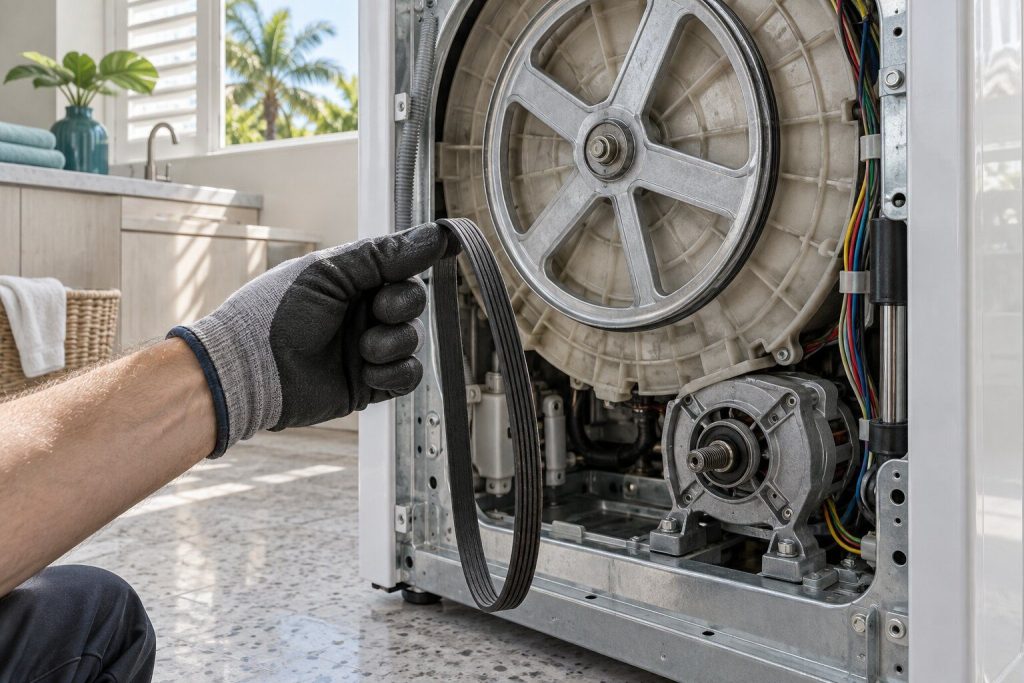
from $165 Washer not spinning repair
A load that comes out soaked after a cycle that appeared to finish. Before anything is priced, three free things are eliminated because they account for most of these: the machine has not drained, the load will not balance, or a cycle was chosen with no spin in it. What is left is genuinely mechanical — the motor and its control, the belt where fitted, the door lock the machine will not spin without, or the shock absorbers that let the drum move enough for the balance sensor to give up.
- Drain, balance and program eliminated before anything mechanical is opened
- The door lock is a spin interlock — a worn one stops the machine dead
- Shock absorbers and suspension, which fail slowly and look like electronics
-
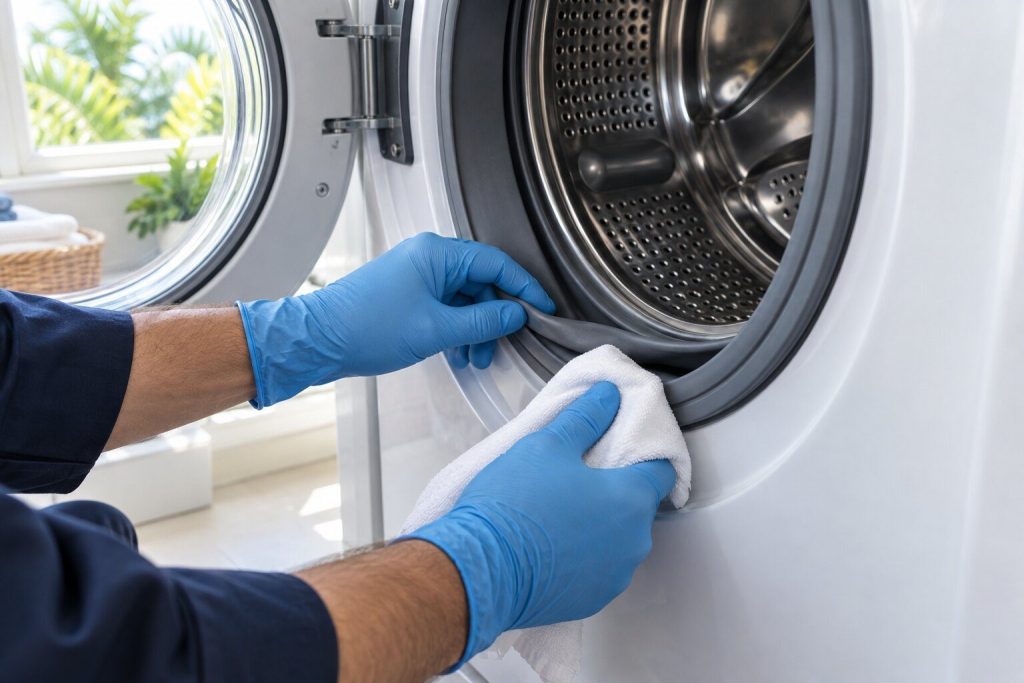
from $175 Washer door seal replacement
The single most common part we replace on this make, and the one where waiting costs the most. Grit collects in the bottom fold of the bellows, works into the rubber and cuts it from the inside, so the seal is usually failing for months before water reaches the floor. In a condominium that matters more than the part does: water from a laundry closet reaches the slab and then somebody else's ceiling, and a seal is a fraction of what that costs to put right.
- Grit in the bottom fold is the cause — the seal is the symptom
- Caught early it is a part; caught late it is a floor slab and a neighbor
- Clamp and drain path renewed with it, or the new seal goes the same way
-
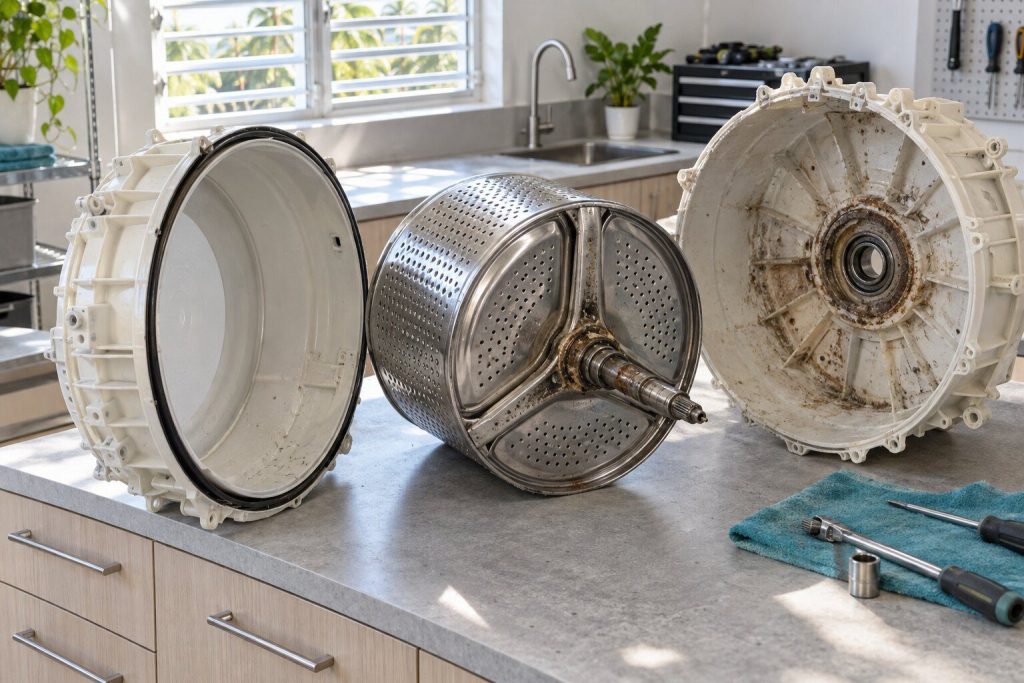
from $395 Washer drum bearing replacement
The big job, and the one where we say plainly whether it is worth doing. A bearing going is a rumble on spin that grows over months and eventually a drum that can be moved by hand. On most makes at this age the answer is to replace the machine; on a steel-framed Asko it frequently is not, because everything around the bearing is still sound. The figure here is honest about the labor: this is a strip-down, and it takes the day.
- A day's strip-down, priced as one rather than discovered halfway
- Worth doing on this make more often than on most — and we say when it is not
- Seal, shocks and springs renewed with it, because they are already out
-
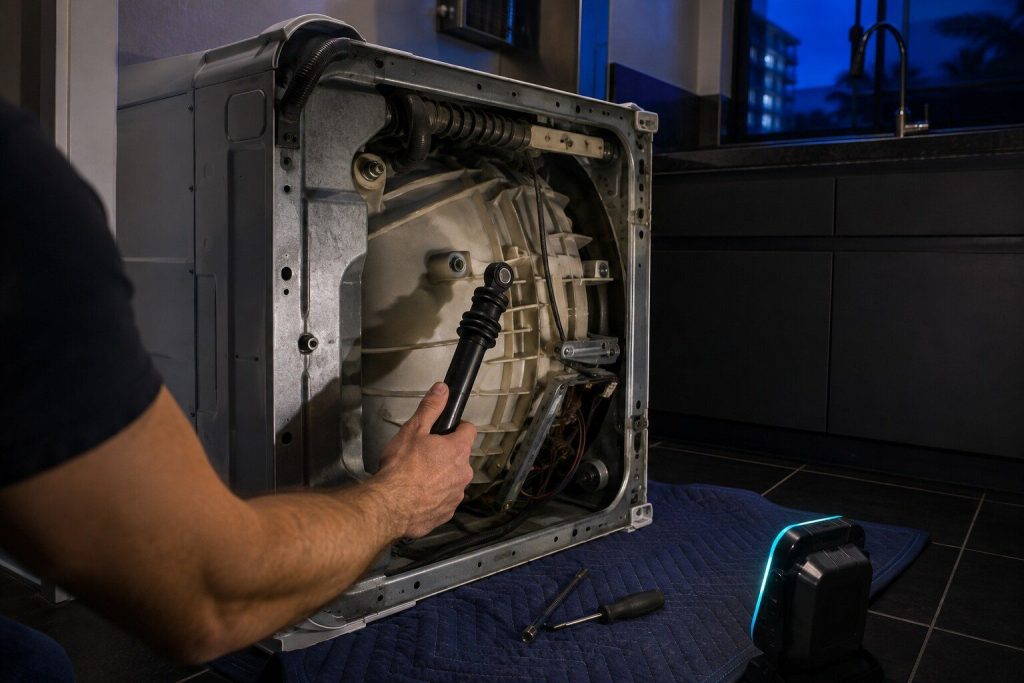
from $165 Washer shock absorber service
The repair that prevents the previous one. Shock absorbers wear gradually, and as they go the drum is allowed to move further on every spin — which loads the bearing, unbalances the machine and eventually walks it across the floor. Nothing on the panel reports it. What reports it is the noise and the movement, and a machine caught at this stage is hundreds of dollars cheaper than the same machine six months later.
- Nothing on the display reports this — the machine tells you by moving
- Replaced as a set, because one new absorber against three worn ones is worse
- The cheapest way to protect a drum bearing on these machines
-
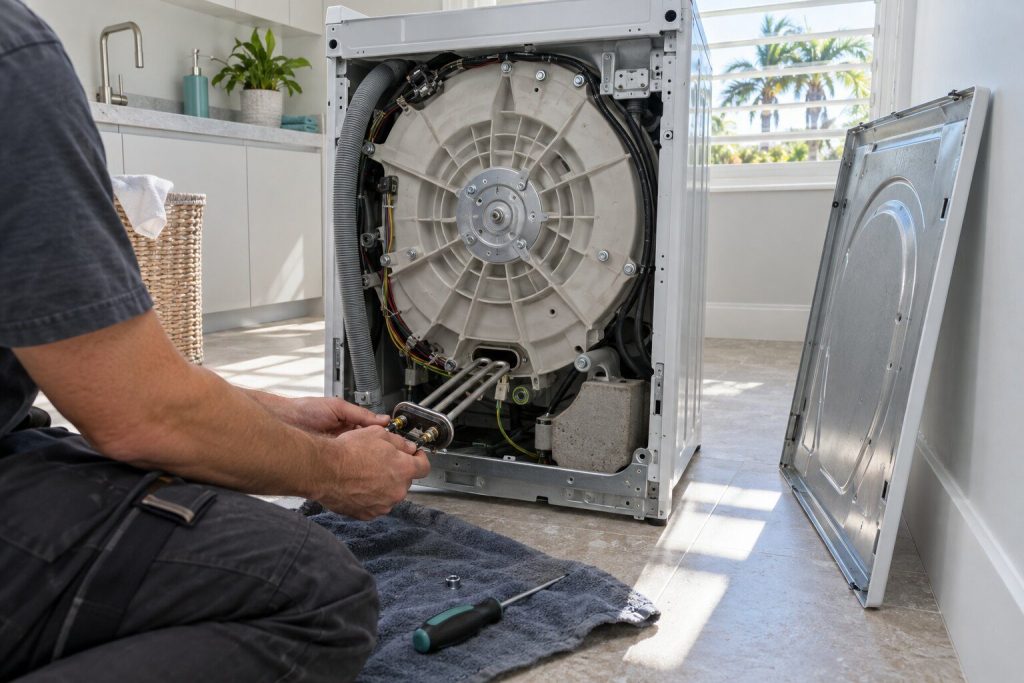
from $159 Washer heater and thermostat repair
Cold washes on a program that should be hot, or cycles that run far past their stated time. The machine will not move on until the water reaches temperature, so a heating problem shows up as a clock problem first and people rarely connect the two. On the display generations this arrives with a code; on the analog machines it arrives as a wash that took four hours. The element itself is a straightforward part — the thermistor in front of it is the one that fools people.
- A cycle that never ends is usually a heating problem, not a timer problem
- Thermistor before element: a wrong reading makes a good element look dead
- Scale on this water shortens element life, and we say so at the visit
-
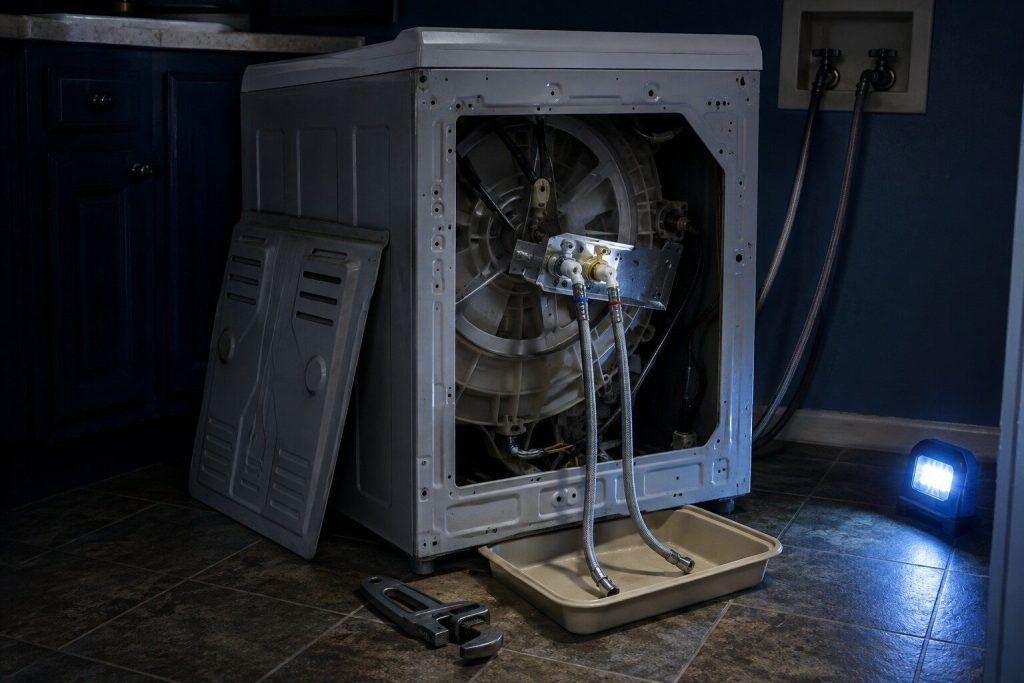
from $135 Washer inlet and hose service
Nothing about this visit is interesting, and it heads off the costliest thing that can happen in a laundry closet. Inlet hoses perish, valves stick part-open, and screens silt up on this supply. A machine that fills slowly is an annoyance; a hose that lets go while nobody is home is a claim on a building. On any machine over five years old in a condominium we recommend the hoses replaced whether or not that is what we were called for, and we say why rather than adding it to an invoice.
- Perished hoses are a building's risk, not just a machine's
- Inlet screens silt up on this water and are a five-minute clean
- A valve that seeps while off is a different failure from one that will not open
In more detail
About Asko washers
Five code families, one steel frame
Eight machines in the current catalog, sold as Classic, Logic and Style, and five separate code families across the machines still running here. Display panels print F10 to F12; the WM75 platform speaks in E-numbers; the numbered-LED machines use a short F-set with different meanings; the analog machines signal L1 to L6 and two models of the same generation disagree about what those letters mean; the premium panels write sentences instead.
Why these are worth keeping
Steel frame, steel drum, built to a twenty-year test. What fails at ten years is a seal, a pump, a set of shock absorbers or a heater — parts rather than platforms — and the rest of the machine is usually still sound around them.
This article is based on:
- Official manufacturer documentation
- Internal repair procedures
- Technician repair history
- Company quality standards
Before you book
Questions about Asko washers
No spin, and nothing on the display.
On the panels that print sentences instead of numbers, no code is the normal state and the sentence is the code — read it exactly, because the wording is the diagnosis. On the analog machines a silent refusal to spin is usually a load the machine could not balance, and it is worth a free try: open, redistribute, close, run a spin alone. If it fails on an empty drum the question moves to the drain — a machine that has not emptied will not spin, by design, and the pump filter behind the lower panel is the first thing anybody should look at.
What does E-something mean?
It means the machine is on the WM75 platform, which is useful information by itself. That family runs from E0 up into the thirties and it does not share meanings with the F-numbers on the display machines — the same problem has a different label depending on which board is behind the panel. Give us the model code plus the exact string — noting whether that character is a zero or a letter O — and reading it is simple. Tell us only the number and we would be choosing between five tables.
Is it worth repairing a fifteen-year-old one?
More often than on most makes, and that is the honest reason people buy this brand twice. These are steel-framed machines built to a twenty-year test, and the parts that fail at that age — a door seal, a pump, a set of shock absorbers, a heater — are parts rather than platforms. What changes the answer is the drum bearing: that is a strip-down, and on a machine of that age we will say plainly whether the rest of it is worth the afternoon.
Water is on the floor and I cannot see where from.
Stop the machine and unplug it before anything else. The three places we find it are the door seal, where a folded edge holds grit and eventually cuts; the pump filter cap, which is a common find after somebody cleared a blockage and did not seat it; and the inlet hose union at the wall. Water tracks along the frame before it appears, so where it shows on the tile is rarely where it started — that is a thing to see rather than to diagnose over the phone.
Where we do it
Across Miami-Dade, Broward, and Palm Beach
Same terms everywhere we go: an on-site diagnostic first, the price agreed in writing, and the exact figure confirmed once we have seen the unit.
Neighborhoods people ask for by name