
AskoRepair Miami

51 jobs · 11 appliances

What we actually do to an Asko, job by job rather than by the hour.

Each page says what the work involves, what moves the figure, and what the visit looks like on a machine that was fitted into cabinetry rather than pushed into a gap. Starting figures are on the page for the job, not behind a form.

  • 51 jobs written up
  • 11 kinds of machine
  • from $95 diagnostic, credited to the repair
  • Every one is a from, never a final price

Every job we list

All 51 of them

Sorted by the appliance they belong to. Each page carries its own starting figure.

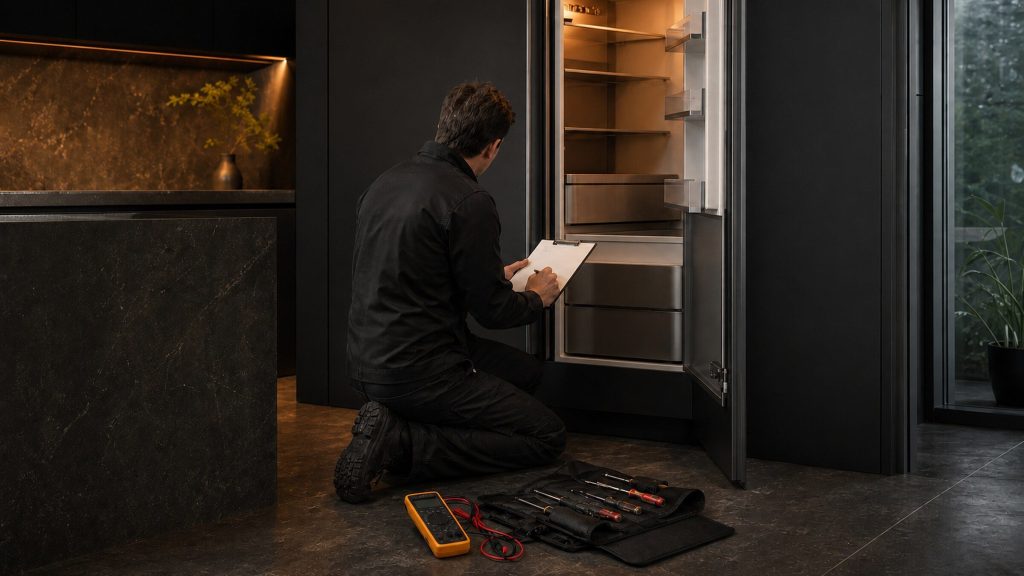
  • A technician kneeling beside a tall integrated refrigerator in a dark kitchen, writing on a clipboard, a multimeter resting on the floor beside an open tool roll.
    from $95

    Diagnostic visit

    Establishing what is actually wrong with the machine, ahead of naming or costing a part. Here one thing has to be settled before the complaint can even be read: which generation is standing in the kitchen. Digits on this badge belong to whichever board prints them, so a dishwasher, washer or dryer measured against the wrong table produces a confident answer and an incorrect part. You keep the charge against the repair when the work goes ahead; where our view is that spending money on this machine makes no sense, that view is what you have paid for and the amount stays the same.

    • Generation before symptom — it settles which table the digits belong to
    • The number is written down before the work, and it comes off the repair
    • Where mending makes no sense we say it, instead of finding a part to sell
    What this involves
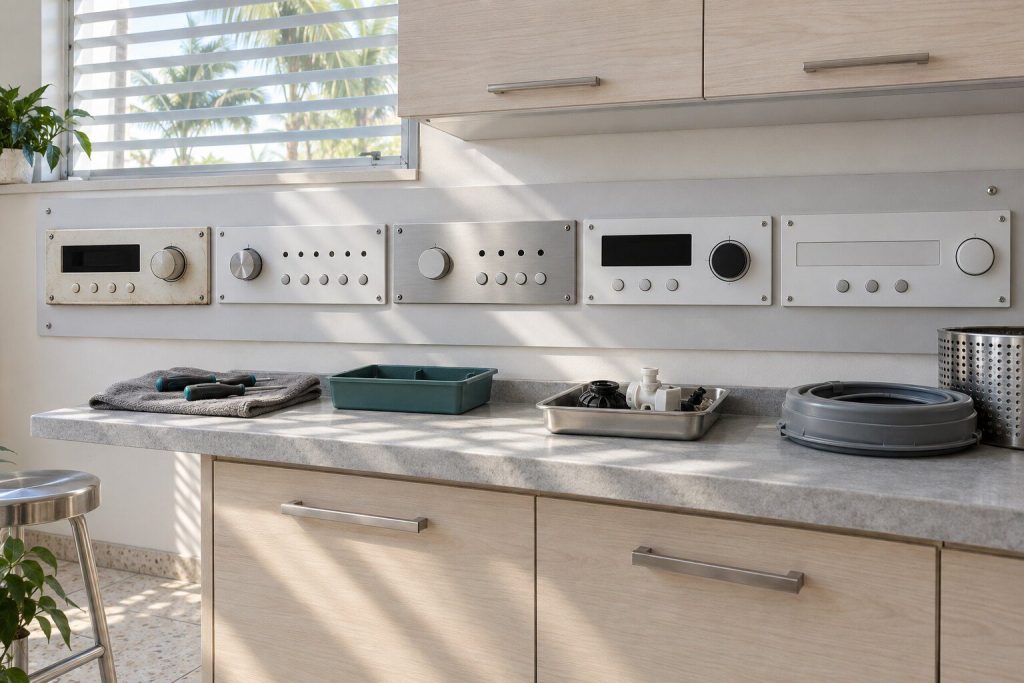
  • Five washer control panels of different generations photographed side by side on a workshop wall board — a numeric display, a row of numbered indicator lights, a row of plain lights, an E-number display and a blank text strip — nothing legible on any of them.
    from $115

    Platform identification

    The job this make needs and no other make on our list does. Three dishwasher generations, five washer code families, dryer schemes that change with the control board and two induction families that share no numbers — and from the front of the kitchen they are indistinguishable. This is the visit that settles which machine is actually in the run, records it, and gives you a code table that applies to your appliance instead of to the badge in general. For anyone who intends to keep the machine another decade it is the cheapest useful thing we sell.

    • Which generation, which board, which code table — established and written down
    • Turns every future number on the display into something readable
    • Credited in full against a repair if it is booked in the same visit
    What this involves
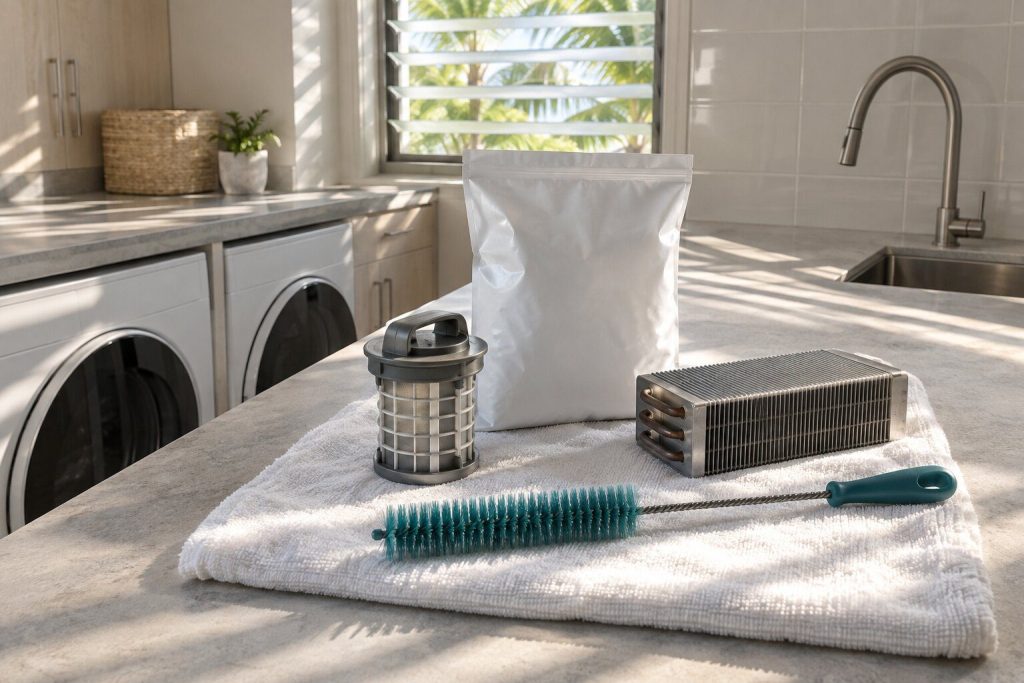
  • A pump filter, a dishwasher salt pack, a condenser block and a coil brush laid out together on a folded white towel on the worktop of a tiled laundry closet.
    from $155

    Appliance maintenance

    A planned visit rather than a rescue, and on this make it pays for itself faster than on most. These are machines built to run for twenty years, which means the things that end them early are almost all maintenance items — a condenser filter packed solid in a laundry closet at eighty per cent humidity, a dishwasher filter stack nobody knew lifted out, a door seal cutting itself on grit. Every one of those is minutes of work and none of them announce themselves before they cost a part.

    • Filters, seals, drains and airflow — the four that end machines early here
    • One visit covers every Asko appliance in the property, not one machine
    • Written record of what was found, so the next visit is not a fresh start
    What this involves
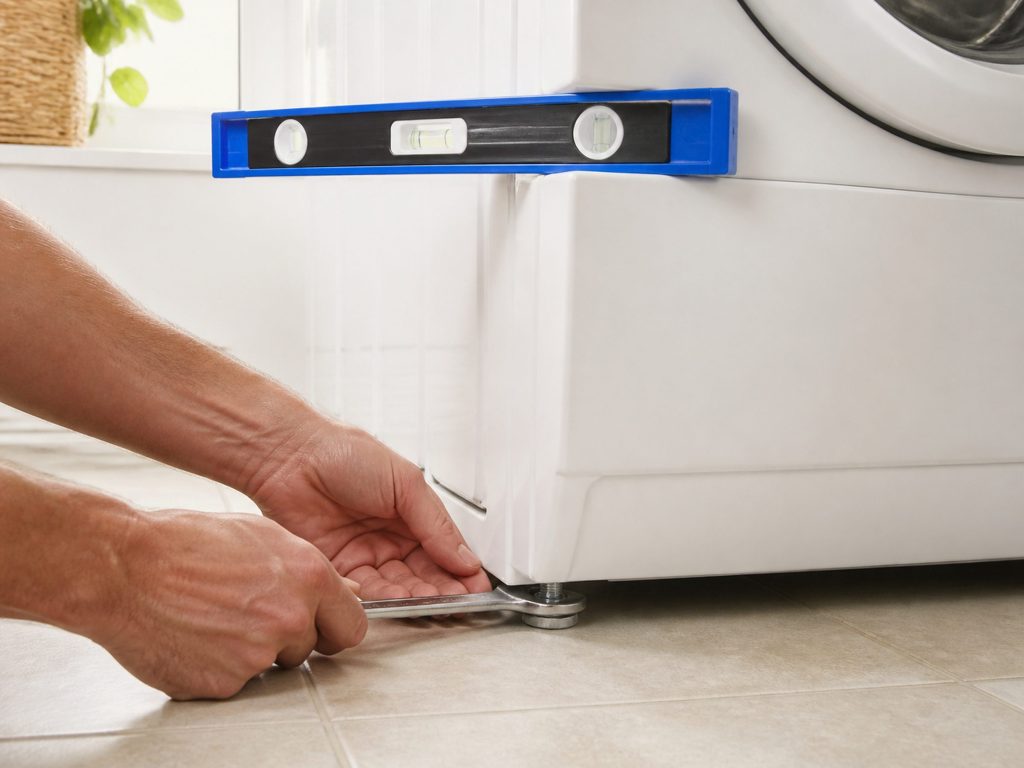
  • Two hands leveling the front foot of a white appliance with a wrench, a spirit level lying on top of the machine, pale tile floor, bright room.
    from $185

    Appliance installation

    Fitting a machine into a space that was drawn for another one, which in this county is most installations. On integrated equipment the appliance is the easy half: the panel, the scribe, the toe kick, the services behind and the air the machine needs to breathe are the work. We measure the opening before anything is ordered, because an integrated cabinet that does not fit is not a delivery problem, it is a joinery problem, and it is far cheaper to find out on a Tuesday with a tape measure.

    • The opening measured before anything is ordered, not after it arrives
    • Panel, scribe and toe kick treated as part of the job, not as somebody else's
    • Air path checked and recorded — a boxed-in machine fails whatever is fitted
    What this involves
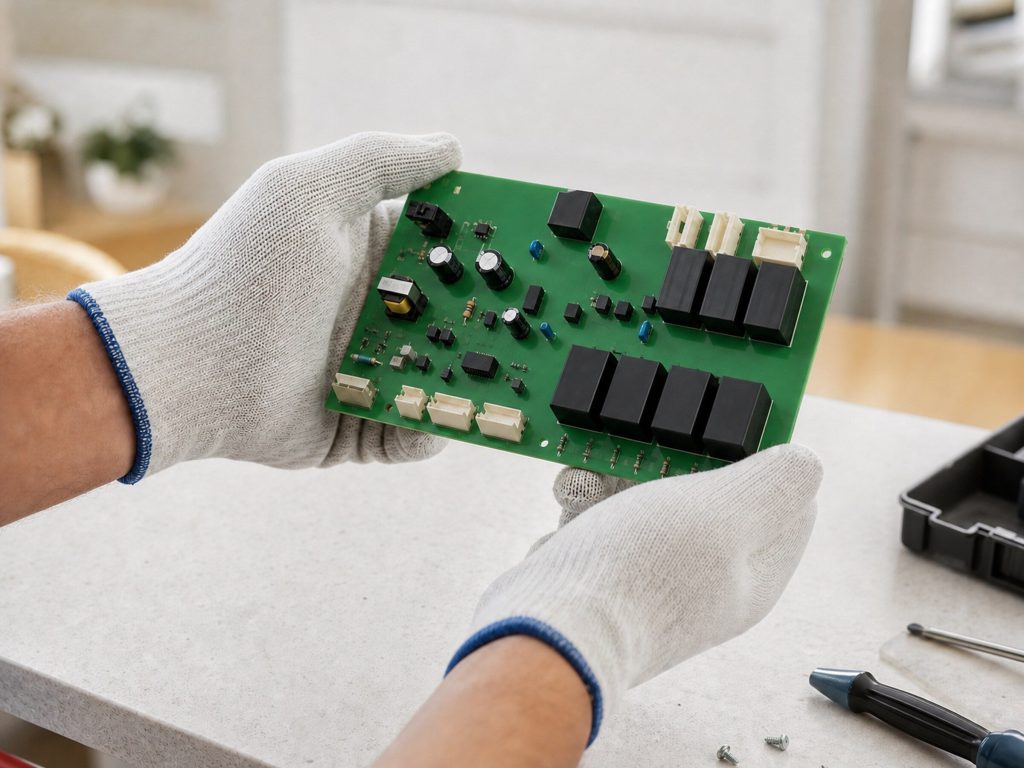
  • An appliance control board held in two gloved hands over a workbench, its plain green surface and relays visible, no markings legible
    from $285

    Control board repair

    The repair where being honest about the supply chain matters more than being quick. Boards on this make come through a European channel, and on a machine that is no longer in the US catalog that is a real wait rather than a phrase. So the order here is fixed: prove the board is the problem, price the part with its lead time attached, and only then decide. A board fitted to cure a supply problem or a water-ingress problem will fail the same way in a season, and we would rather find the water.

    • Proven, not assumed — the board is the last suspect, never the first
    • Lead time is quoted with the price, because on this make it is part of the answer
    • Water ingress and supply errors found first, or the new board follows the old one
    What this involves
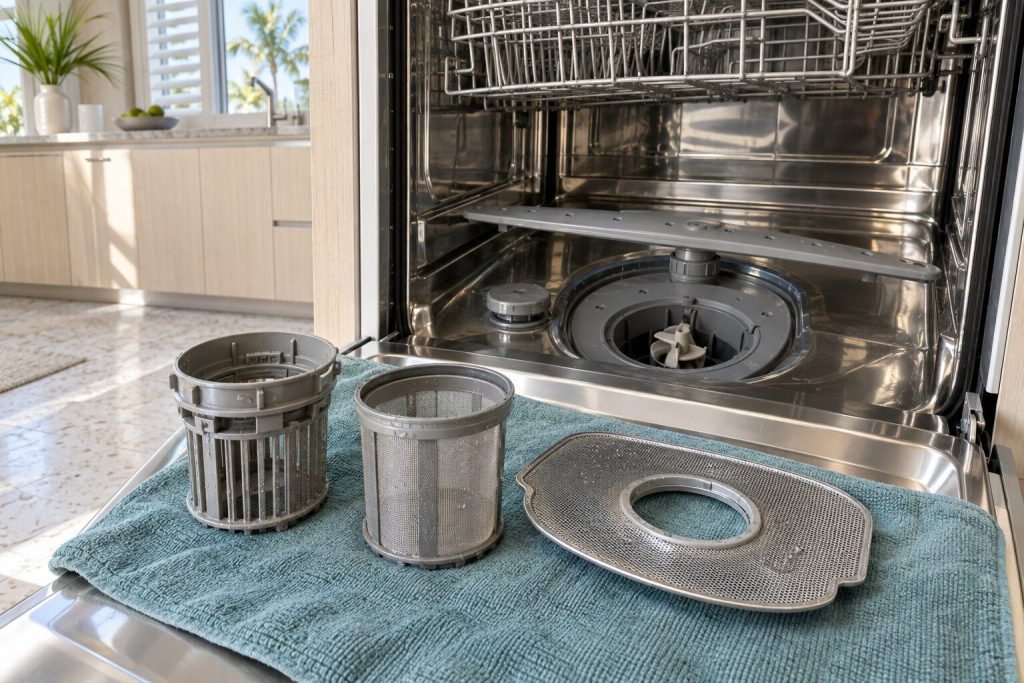
  • The three-piece filter stack lifted out of the floor of a dishwasher tub and standing apart on a cloth, the empty sump well and the drain pump impeller visible in the tub behind.
    from $165

    Dishwasher drain and pump repair

    A pool left in the sump when the program ends — which this make announces in three unrelated ways, depending on the generation. The current display machines print it as a printed code; the legacy boards blink it through the program lights; the Outdoor door prints its own string that belongs to neither table. Underneath all three the machine is the same: a filter stack, a drain pump, a hose and an air gap, and the water has stopped at one of them.

    • Filter stack first — it is free, and it ends this call more often than a pump does
    • Drain hose and the air gap at the sink, which are somebody else's install
    • The pump proved on a meter before it is replaced, not diagnosed by elimination
    What this involves
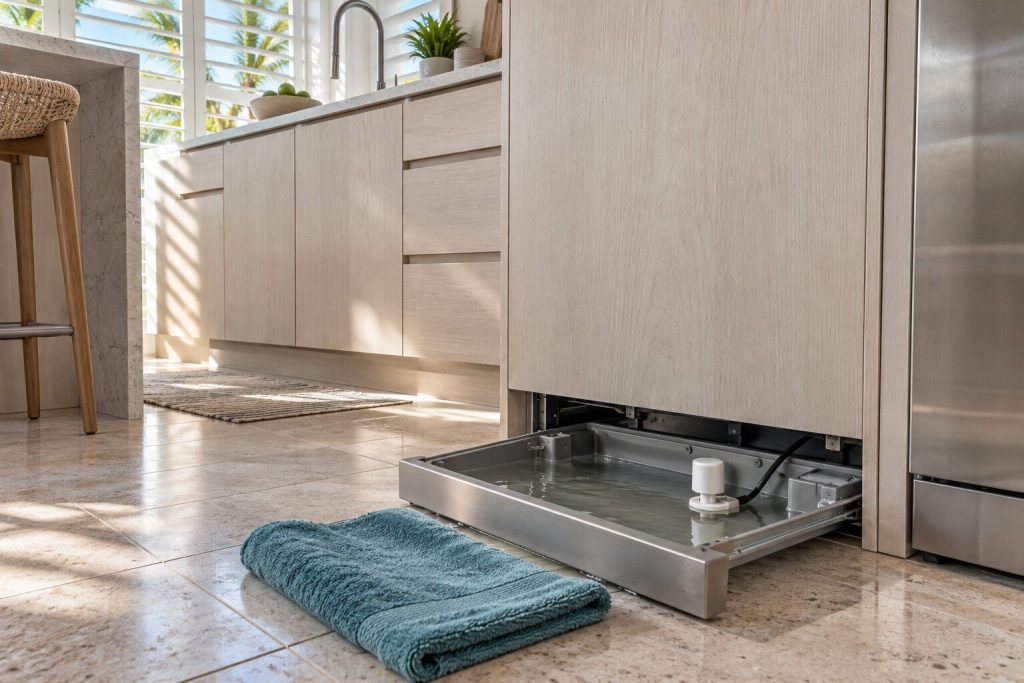
  • A shallow base tray drawn out from under a panel-ready dishwasher with a float switch sitting in an inch of water, a folded towel on the tiled floor in front of it.
    from $159

    Dishwasher leak repair

    Water on the floor of a kitchen where the machine is behind a custom panel, which means the leak has been running longer than anybody realized — it tracks along the frame and appears at the toe kick rather than where it started. On integrated machines the order of work is not optional: the panel comes off, the machine comes forward, and only then can anybody honestly say where the water is from. Guessing at it from the front is how a door seal gets replaced on a machine leaking at the sump.

    • The panel off and the machine out — a leak is not diagnosed from the front
    • Door seal, sump, hose unions and the inlet, in that order of likelihood
    • Cabinet floor and joinery checked for what the water has already reached
    What this involves
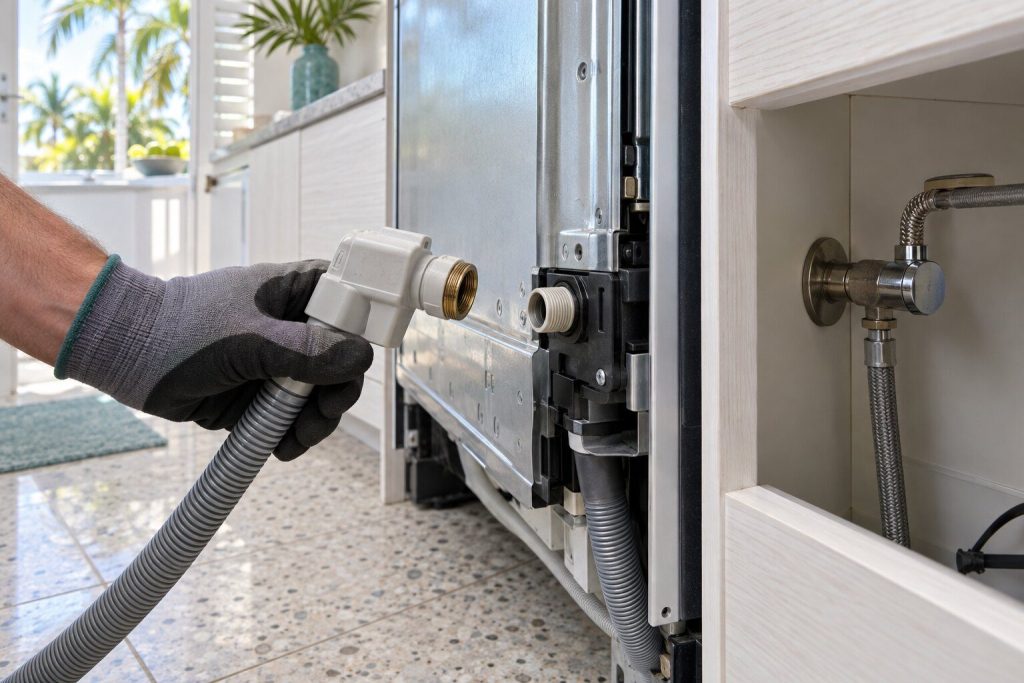
  • An aquastop inlet hose unscrewed from the back of a dishwasher and held clear, its solenoid head in a gloved hand, the tap behind it closed.
    from $155

    Dishwasher water inlet repair

    The machine will not fill, fills too slowly, or fills when it should not — three complaints with one circuit behind them. On the current generation this is the family of codes around water inlet and inlet valve leakage; on the legacy boards it is a blink pattern for a pulse count never reached; and on both the first suspect is outside the machine altogether, at a service valve under the sink that somebody closed most of the way during other work.

    • The service valve under the sink before the machine, every time
    • Inlet valve, flow meter and the hose screen, which is a five-minute clean
    • A valve that leaks when off is a different problem from one that will not open
    What this involves
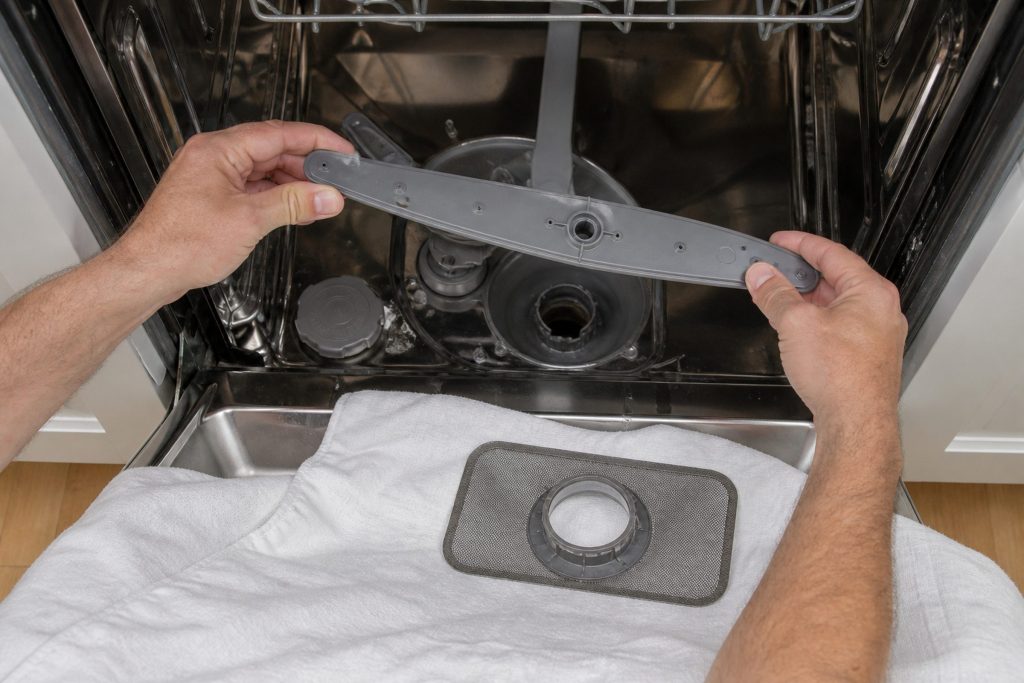
  • The lower spray arm of a dishwasher unclipped and lifted a few inches clear of its hub by two hands, the fine mesh screen already lying on a cloth on the open door beside it, the empty sump visible below.
    from $139

    Dishwasher wash performance service

    Everything runs, nothing errors, and the dishes come out gritty or filmed. This is the call with no code behind it on any of the three generations, and it is nearly always four ordinary things rather than one broken one: spray arms whose jets have limed shut, a filter that has been rinsed but never lifted, a water hardness setting nobody adjusted when the machine arrived on this supply, and a detergent dose meant for softer water than we have.

    • No code, no failure — this is a performance call and it is priced as one
    • Spray arms, filter, hardness setting and dose, which is the whole list
    • Water hardness set to this supply, not to the number it left the factory with
    What this involves
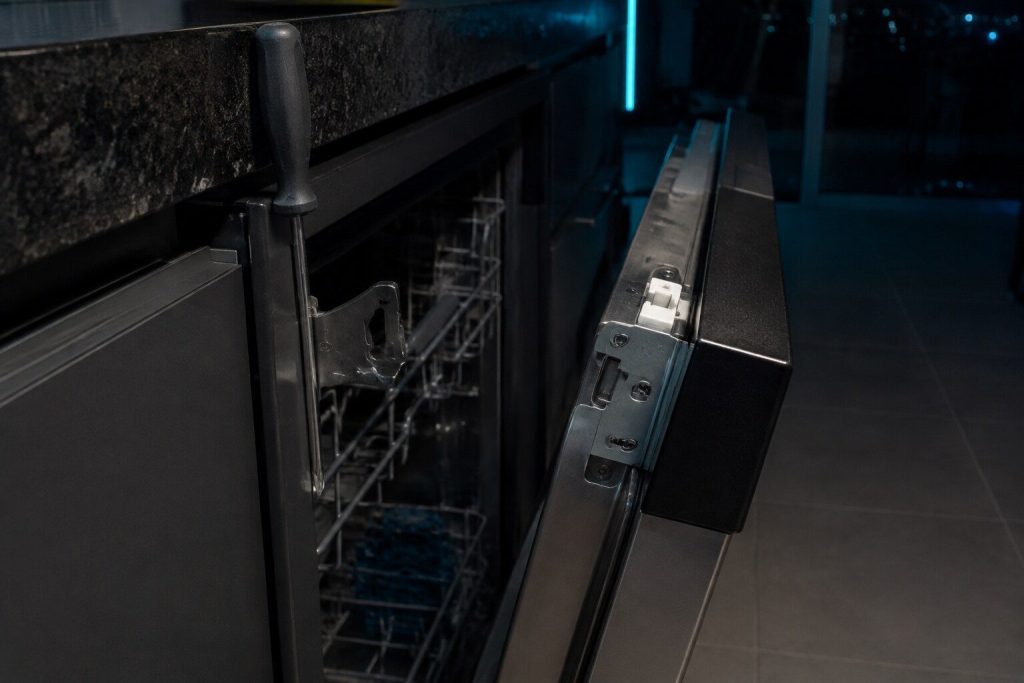
  • The latch at the top of a dishwasher door and the strike it closes into, the door held an inch open so both halves read.
    from $135

    Dishwasher door and latch repair

    A door that has to be pushed to start, drops open on its own, or will not release at the end of a program. On integrated machines this is more often the panel than the appliance: a custom door adds weight the springs were tensioned for at installation, and joinery settles. So the springs get set to the door that is actually hanging there rather than to a factory figure, and the latch and its switch are checked as the pair they are.

    • Springs tensioned to the panel that is actually on the machine
    • Latch and door switch treated as one circuit, because that is how they fail
    • Hinge wear on integrated doors, which carries more weight than a plain one
    What this involves
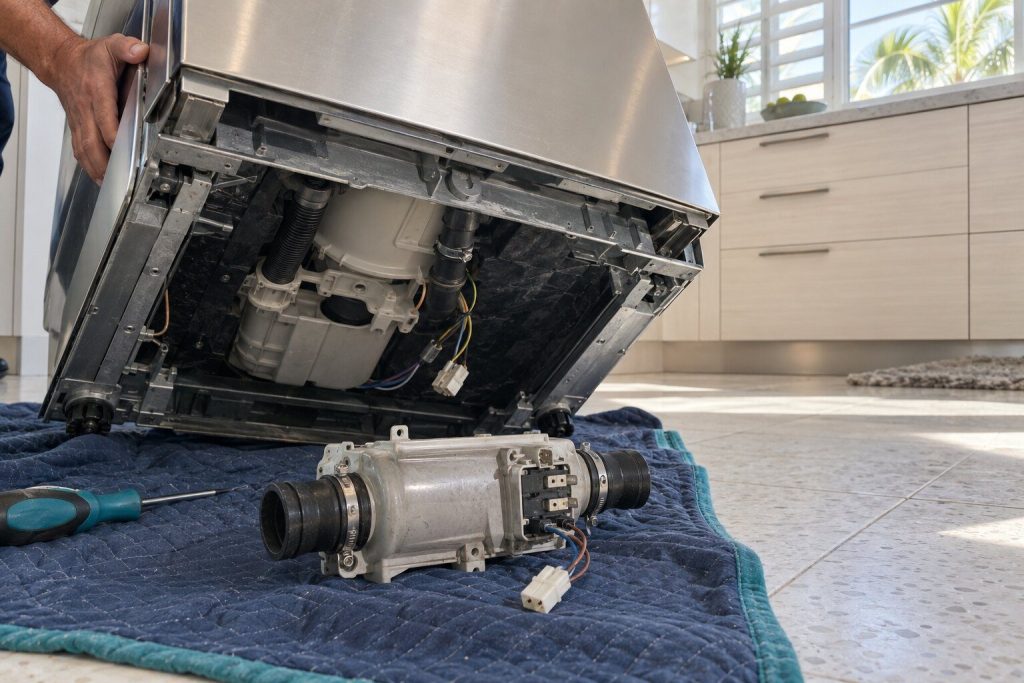
  • The flow-through heater block unclipped from the underside of a dishwasher with the machine tipped back on a blanket, its two hose stubs and terminals showing.
    from $155

    Dishwasher heating and drying repair

    Dishes coming out wet, or a program that runs cold and takes forever. On this make the two are one circuit and the diagnosis splits early: a heater that has failed outright shows in the water temperature and, on the newer boards, in a heating code; a machine that heats correctly but dries badly is a condensing and airflow question and the heater is innocent. The turbo drying models add a fan to that list, and it is a separate part with a separate failure.

    • Heating and drying separated before anything is priced
    • Heater, thermistor and the control that decides between them
    • On turbo drying models the fan is its own part and its own repair
    What this involves
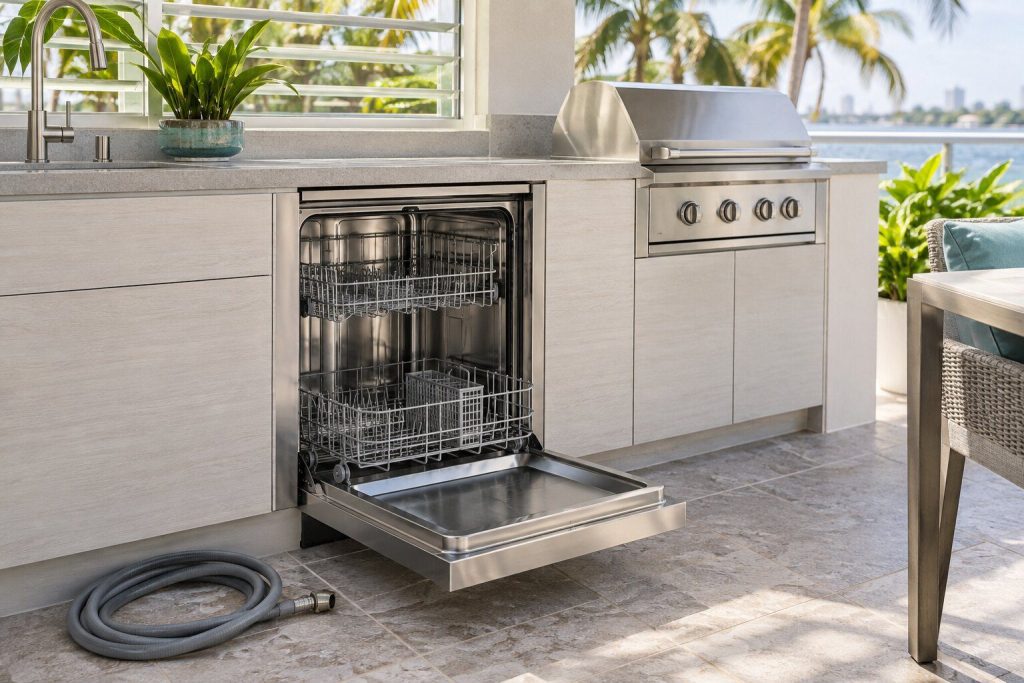
  • A stainless outdoor dishwasher built into a masonry summer-kitchen run on a terrace, its door open, salt haze dulling the panel and a hose coiled on the tile beside it.
    from $195

    Outdoor dishwasher service

    The terrace machine, and on this coast it is a different appliance from the same model indoors. It has its own service scheme — written with a colon, and clashing with the indoor generation's numbers — its own stainless specification and its own door seal part. What actually ends these is not the electronics but the environment: salt at the hinges and fasteners, rain finding the top edge of a cabinet that never dries, and a machine asked to work at outdoor humidity for eleven months a year.

    • Its own code scheme, which clashes with the indoor machines' numbers
    • Salt at hinges, fasteners and the door seal — the real failure path here
    • Cabinet drainage and the top edge, which is usually the joinery's problem
    What this involves
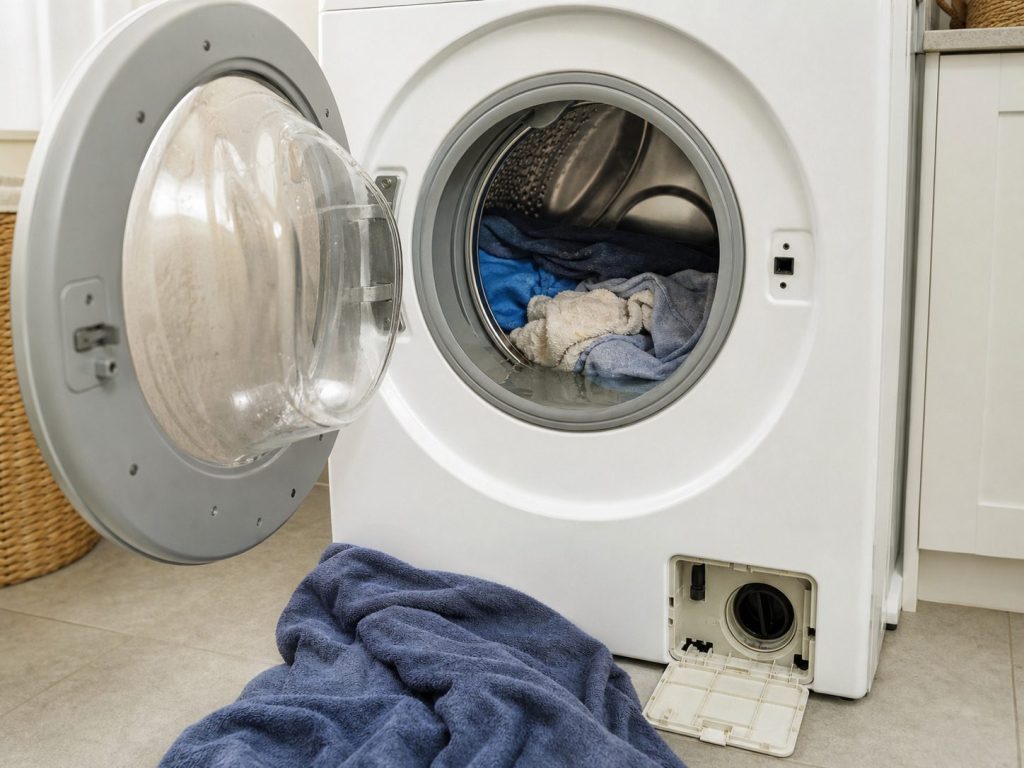
  • An open front-loading washing machine door with wet clothes sitting in a drum still holding water, a towel on the floor in front of it, the small pump filter access panel open at the bottom right.
    from $155

    Washer not draining repair

    A drum still holding water when the program ends, with the machine declining to spin for it — that refusal is by design rather than a second failure. Which label it arrives under depends entirely on the panel: the display machines print a number, the numbered-LED machines show a short code from a different family, the analog ones signal with lights, and the premium panels print a sentence. All four are describing the same short path from sump to standpipe.

    • Pump filter behind the lower panel first — free, and often the whole answer
    • The refusal to spin is the machine protecting itself, not a second problem
    • Standpipe height and the wall connection, which are usually not the machine
    What this involves
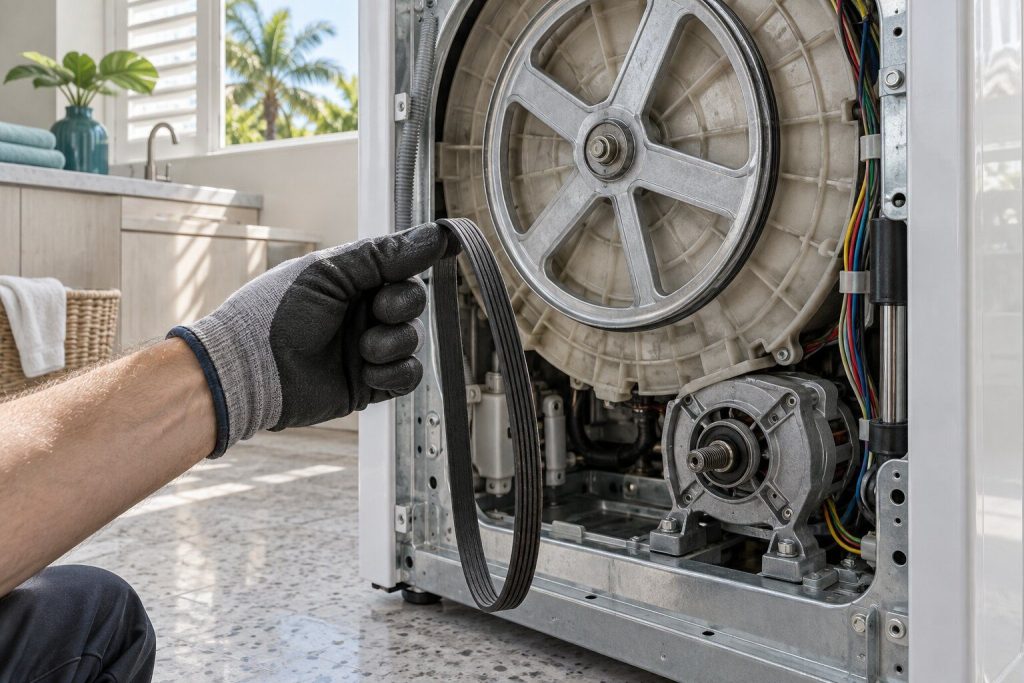
  • A washer drive belt lifted off the motor pulley and hanging on a gloved finger, the large drum pulley and the empty motor shaft behind it, the rear panel off.
    from $165

    Washer not spinning repair

    A load that comes out soaked after a cycle that appeared to finish. Before anything is priced, three free things are eliminated because they account for most of these: the machine has not drained, the load will not balance, or a cycle was chosen with no spin in it. What is left is genuinely mechanical — the motor and its control, the belt where fitted, the door lock the machine will not spin without, or the shock absorbers that let the drum move enough for the balance sensor to give up.

    • Drain, balance and program eliminated before anything mechanical is opened
    • The door lock is a spin interlock — a worn one stops the machine dead
    • Shock absorbers and suspension, which fail slowly and look like electronics
    What this involves
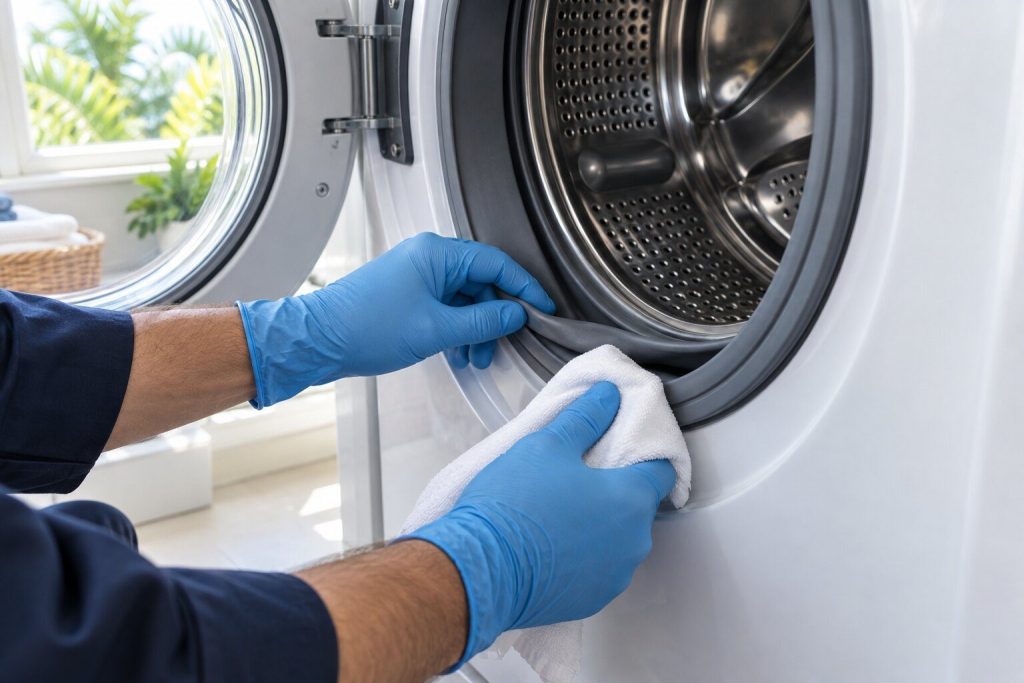
  • Gloved fingers pulling open the fold at the bottom of a front-load washer door gasket, a cloth in the other hand
    from $175

    Washer door seal replacement

    The single most common part we replace on this make, and the one where waiting costs the most. Grit collects in the bottom fold of the bellows, works into the rubber and cuts it from the inside, so the seal is usually failing for months before water reaches the floor. In a condominium that matters more than the part does: water from a laundry closet reaches the slab and then somebody else's ceiling, and a seal is a fraction of what that costs to put right.

    • Grit in the bottom fold is the cause — the seal is the symptom
    • Caught early it is a part; caught late it is a floor slab and a neighbor
    • Clamp and drain path renewed with it, or the new seal goes the same way
    What this involves
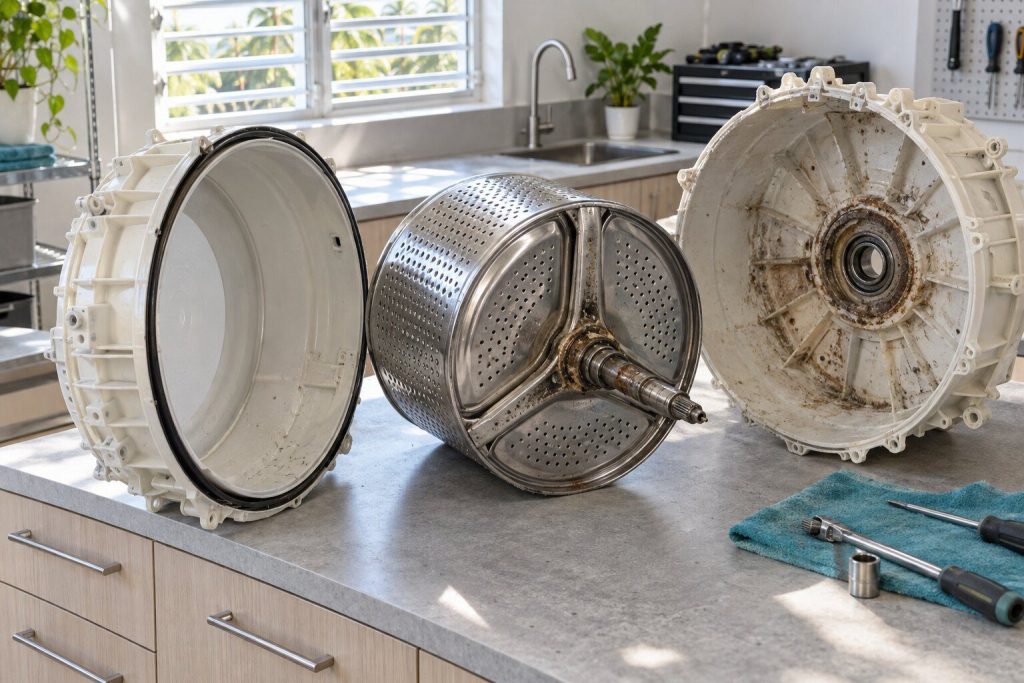
  • A washer outer tub split into its two halves on a workshop bench with the drum and shaft lying between them, the failed bearing race visible in the rear half.
    from $395

    Washer drum bearing replacement

    The big job, and the one where we say plainly whether it is worth doing. A bearing going is a rumble on spin that grows over months and eventually a drum that can be moved by hand. On most makes at this age the answer is to replace the machine; on a steel-framed Asko it frequently is not, because everything around the bearing is still sound. The figure here is honest about the labor: this is a strip-down, and it takes the day.

    • A day's strip-down, priced as one rather than discovered halfway
    • Worth doing on this make more often than on most — and we say when it is not
    • Seal, shocks and springs renewed with it, because they are already out
    What this involves
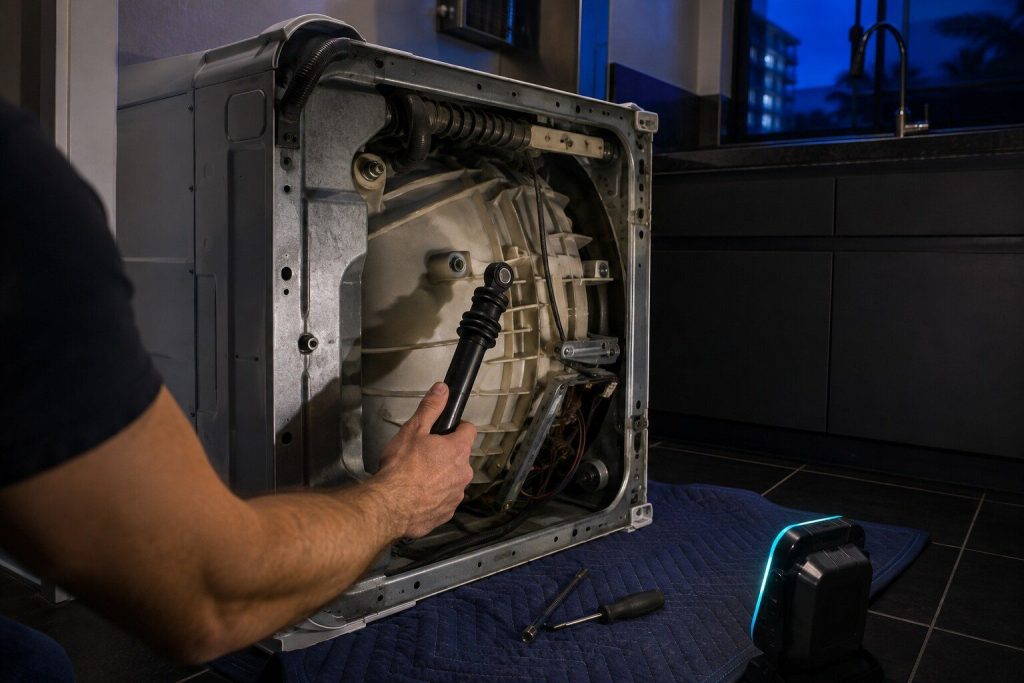
  • A suspension damper unbolted from the outer tub of a washing machine and held clear of its bracket, the machine on its side on a blanket.
    from $165

    Washer shock absorber service

    The repair that prevents the previous one. Shock absorbers wear gradually, and as they go the drum is allowed to move further on every spin — which loads the bearing, unbalances the machine and eventually walks it across the floor. Nothing on the panel reports it. What reports it is the noise and the movement, and a machine caught at this stage is hundreds of dollars cheaper than the same machine six months later.

    • Nothing on the display reports this — the machine tells you by moving
    • Replaced as a set, because one new absorber against three worn ones is worse
    • The cheapest way to protect a drum bearing on these machines
    What this involves
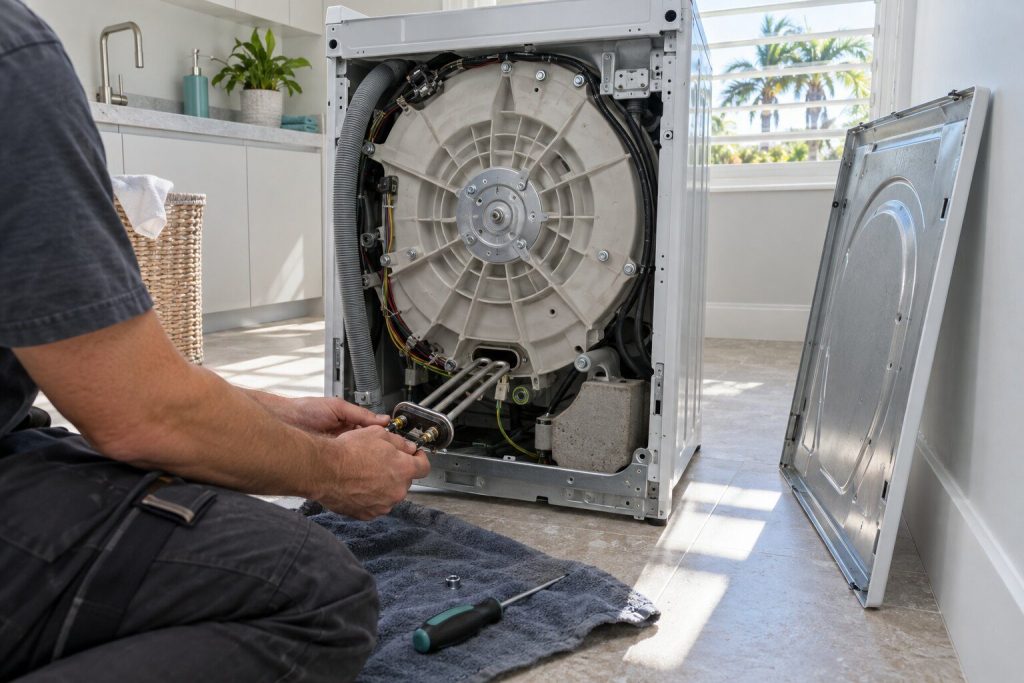
  • The heating element withdrawn from its port under the drum at the back of a washer, its clamp nut loosened and its two terminals visible, the rear panel leaning against the wall.
    from $159

    Washer heater and thermostat repair

    Cold washes on a program that should be hot, or cycles that run far past their stated time. The machine will not move on until the water reaches temperature, so a heating problem shows up as a clock problem first and people rarely connect the two. On the display generations this arrives with a code; on the analog machines it arrives as a wash that took four hours. The element itself is a straightforward part — the thermistor in front of it is the one that fools people.

    • A cycle that never ends is usually a heating problem, not a timer problem
    • Thermistor before element: a wrong reading makes a good element look dead
    • Scale on this water shortens element life, and we say so at the visit
    What this involves
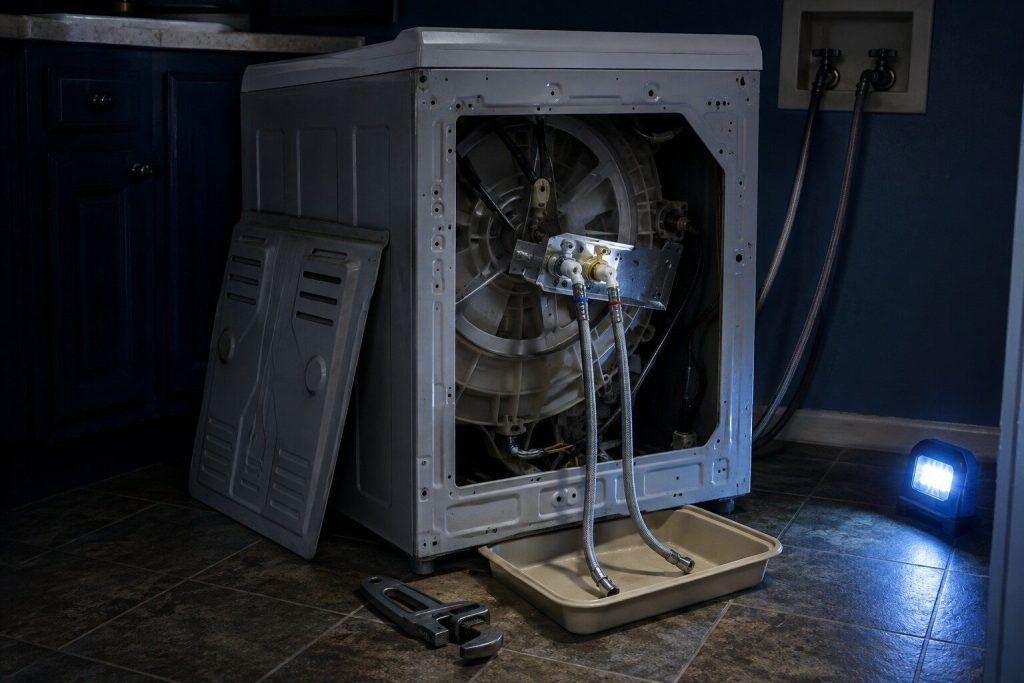
  • A washer pulled out with its upper rear panel off, the inlet valve on its bracket with both braided hoses
    from $135

    Washer inlet and hose service

    Nothing about this visit is interesting, and it heads off the costliest thing that can happen in a laundry closet. Inlet hoses perish, valves stick part-open, and screens silt up on this supply. A machine that fills slowly is an annoyance; a hose that lets go while nobody is home is a claim on a building. On any machine over five years old in a condominium we recommend the hoses replaced whether or not that is what we were called for, and we say why rather than adding it to an invoice.

    • Perished hoses are a building's risk, not just a machine's
    • Inlet screens silt up on this water and are a five-minute clean
    • A valve that seeps while off is a different failure from one that will not open
    What this involves
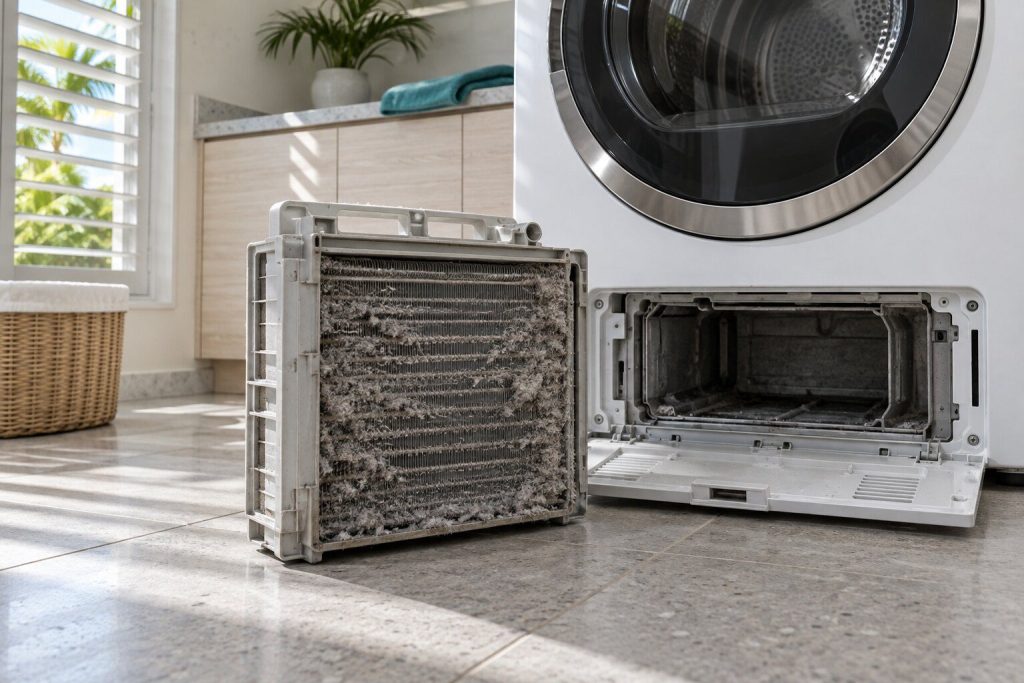
  • The condenser block drawn out of the plinth at the foot of a heat-pump dryer and standing on the tiles, its fins packed gray with lint, the empty bay behind it.
    from $155

    Dryer not drying repair

    A program that finishes with the load still damp, which on a condenser or heat pump machine is almost never about heat. Nothing is vented outside: moisture is condensed and collected, so the machine depends on three filters and a condenser being clear, and in a South Florida laundry closet those load far faster than the manual assumes. Three of the checks cost nothing and end this call more often than any part does.

    • Container, door filter, condenser filter — three free checks, in that order
    • This is airflow before heat on every condenser and heat pump machine
    • The sensor bars only matter once the air path is proved clear
    What this involves
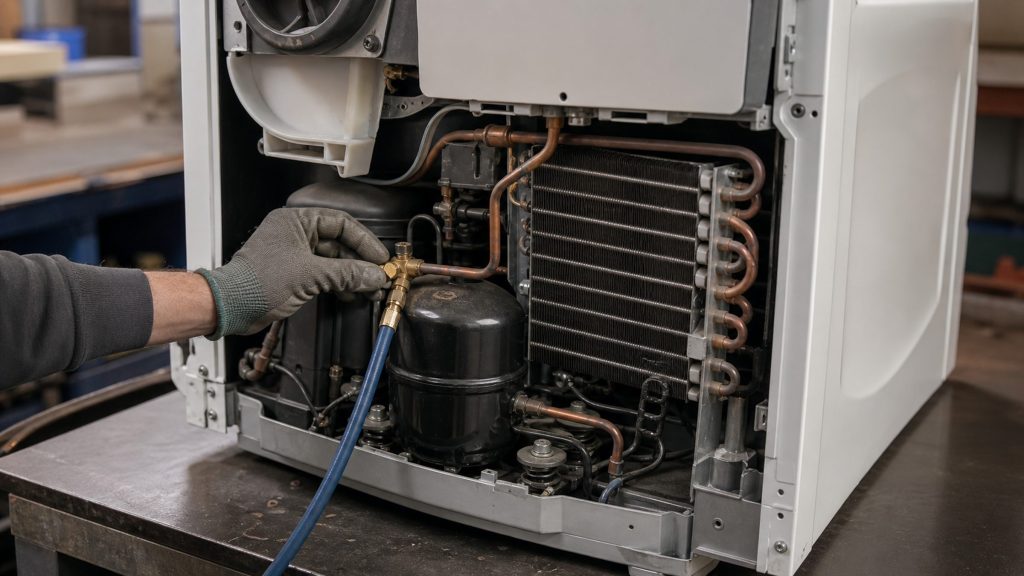
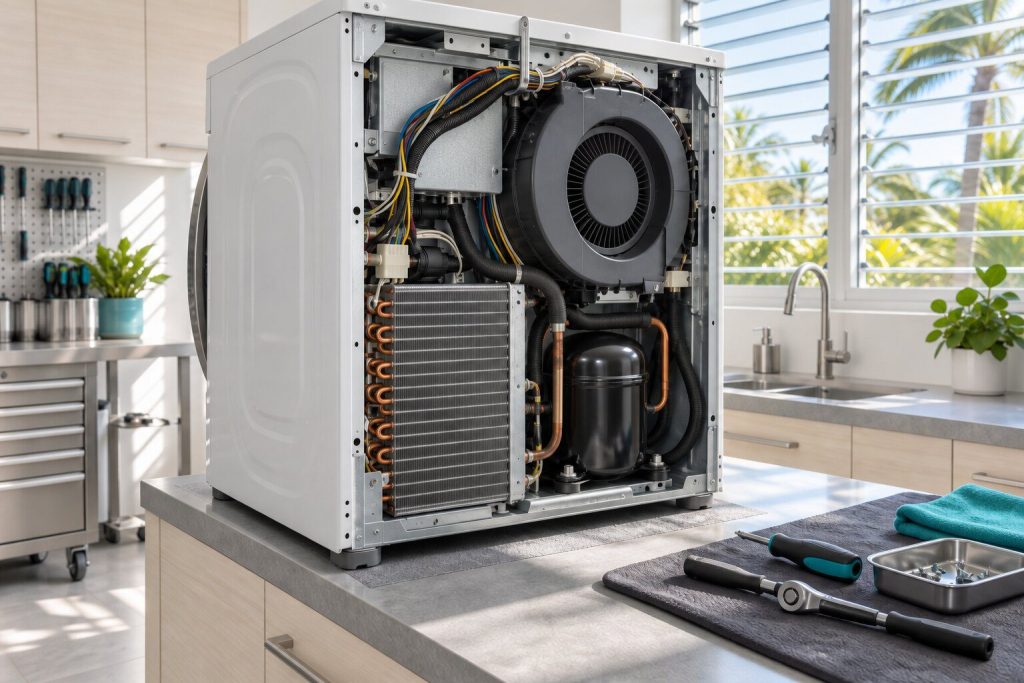
  • The back of a dryer open on the bench: compressor, finned heat exchanger, copper tubing and the blower housing, a blue charging hose on a brass fitting.
    from $145

    Condenser dryer service

    The maintenance visit these machines need on a schedule and rarely get. A condenser dryer works by pulling moisture out of air and giving the heat back, and it is being asked to do that in a closet that may sit at eighty per cent humidity for half the year. Nothing about that is a failure — it is a shorter interval. The machines that reach fifteen years here are the ones where somebody cleared the condenser twice a year instead of waiting for a cycle that never ended.

    • A schedule, not a rescue — and the interval here is shorter than the manual's
    • Condenser block washed out properly rather than tapped clear
    • Cycle times recorded, so the next visit can see whether it is drifting
    What this involves
  • The rear of a heat-pump dryer open on a workshop bench showing the compressor, the finned evaporator and the blower housing, a wire loom lifted clear on a hook.
    from $215

    Heat pump dryer repair

    The newest platform here and the one with its own economics. A heat pump dryer is a sealed refrigeration circuit as well as a dryer, which makes it cheaper to run and more expensive to be wrong about: a compressor is not a heating element. So the order of work is strict — everything ordinary is eliminated first, and only then does the sealed side become the answer. These machines report in their own scheme, spelling out ERROR and a digit rather than using the older short codes.

    • Sealed circuit last, always — the ordinary causes look identical from outside
    • Its own code scheme: ERROR_0 to ERROR_5, not the older L or F numbers
    • The evaporator behind the plinth needs clearing, and almost nobody knows it is there
    What this involves
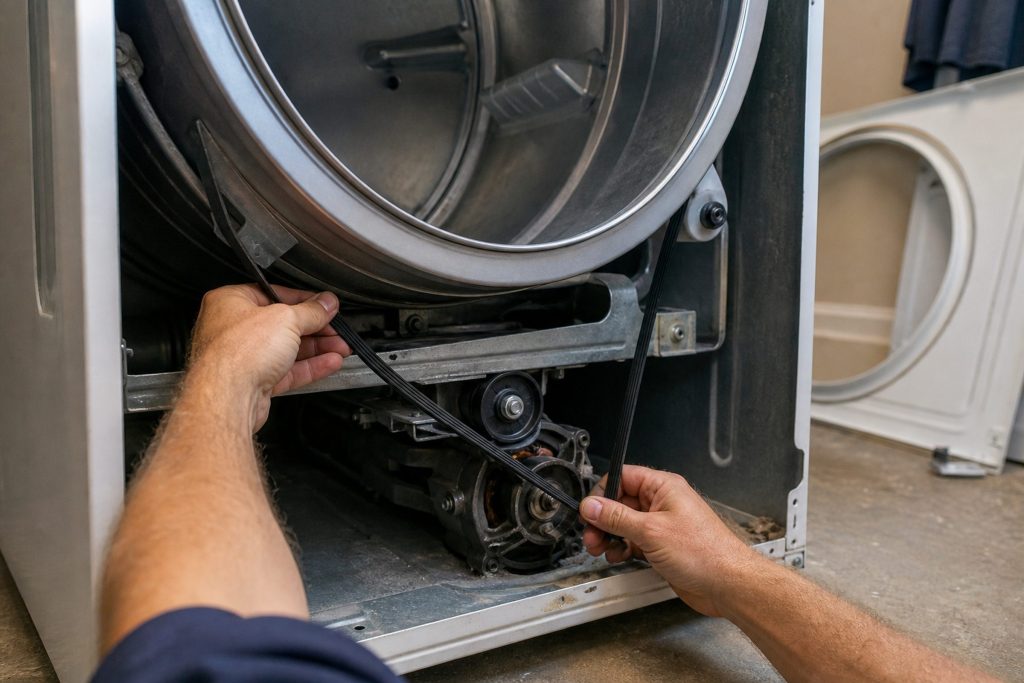
  • Drum rollers and the belt off a dryer.
    from $165

    Dryer drum, belt and roller repair

    A drum that has stopped turning, or turns while rumbling or squealing worse each week. Nine times in ten the belt is the answer and it is an easy part; what matters is the reason the belt went is the part worth finding, because a seized roller or a tired idler will eat the next one just as fast. On a machine that has spent a decade in a hot closet the bearings and felts are usually ready too, and doing them together saves the second visit.

    • The belt is the symptom — the roller or idler that killed it is the repair
    • Rollers, idler and felts checked as a set while the machine is open
    • A squeal that has been growing is a bearing, and it will not improve
    What this involves
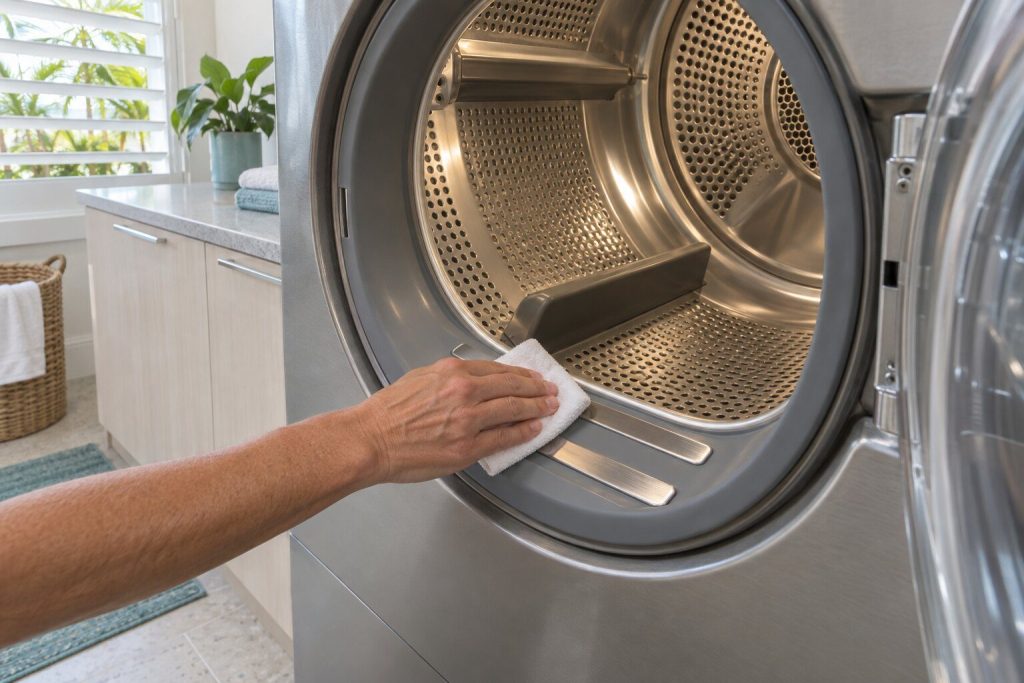
  • Two metal moisture-sensor strips inside the drum opening of a dryer being wiped with a pad, the drum lit from inside.
    from $149

    Dryer sensor and thermostat service

    Cycles that stop after ten minutes with a dry load, or cycles that run hot and long with a damp one — both are the machine believing something untrue about the laundry. The moisture sensor bars inside the drum read conductivity, and softener residue films them over until they report a dry load every time. Where a thermostat is to blame the machine usually says so in whichever code family its board belongs to, and reading it against the right family is half of the diagnosis.

    • Sensor bars filmed with softener residue are the commonest cause by far
    • The code family depends on the control board, and we identify it first
    • A cycle that ends too early is the same circuit as one that never ends
    What this involves
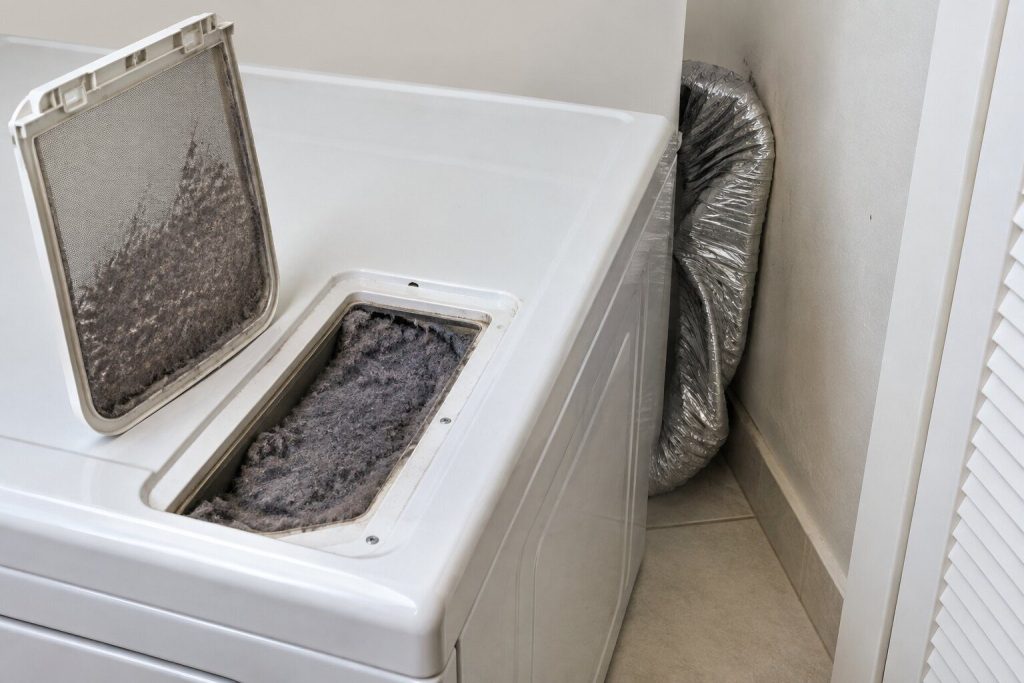
  • A dryer's lint screen lifted clear of its slot and standing to one side, the housing below it visibly packed with gray lint, and a flexible foil duct crushed flat where the machine has been pushed back to the wall.
    from $119

    Dryer lint and airflow service

    The cheapest visit on this list and the one we would most like people to book. Lint that gets past a filter collects inside the cabinet, around the fan and against the heat exchanger, where it lengthens every cycle, raises the running temperature and — on any dryer, of any make — is what turns an appliance into a fire. There is no code for it and no warning light. There is only a machine that takes longer than it used to, which everybody puts down to age.

    • No code, no light — the only symptom is a cycle that has quietly got longer
    • Lint inside the cabinet, not in the filter, is what matters here
    • Booked with the washer service, it is one visit for the whole laundry closet
    What this involves
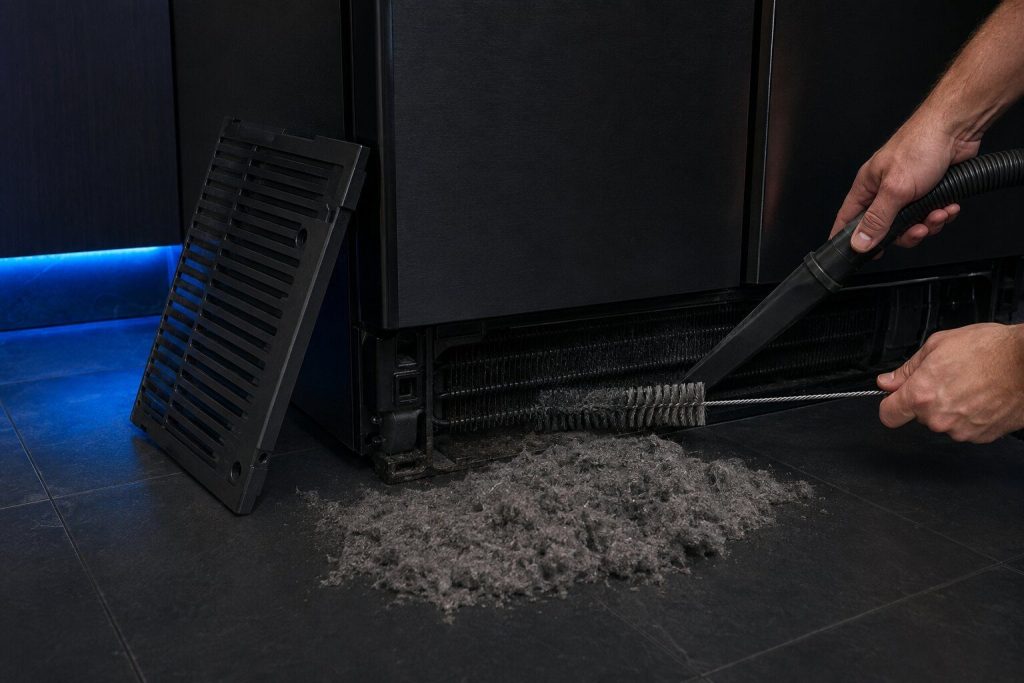
  • The base grille of a refrigerator removed and leaning against the cabinet, a coil brush and a vacuum nozzle worked in among the black condenser fins behind it, a grey mat of dust drawn out onto near-black tile.
    from $185

    Refrigerator not cooling repair

    A complaint that arrives without a code, since refrigeration on this badge publishes none — its manuals stop at symptom, cause and remedy. Everything is therefore read off behavior: which compartment has gone wrong, whether the compressor is running, the position of the frost, and how much heat the back of the cabinet is giving off. First of all, though, the grille. Dust packed into the condenser of an integrated cabinet imitates a failing compressor exactly, on a machine with nothing whatever wrong with it.

    • No published code exists for this — its absence tells you nothing
    • The grille and the condenser before the sealed system, every time
    • Which compartment is wrong is the diagnosis, not the complaint
    What this involves
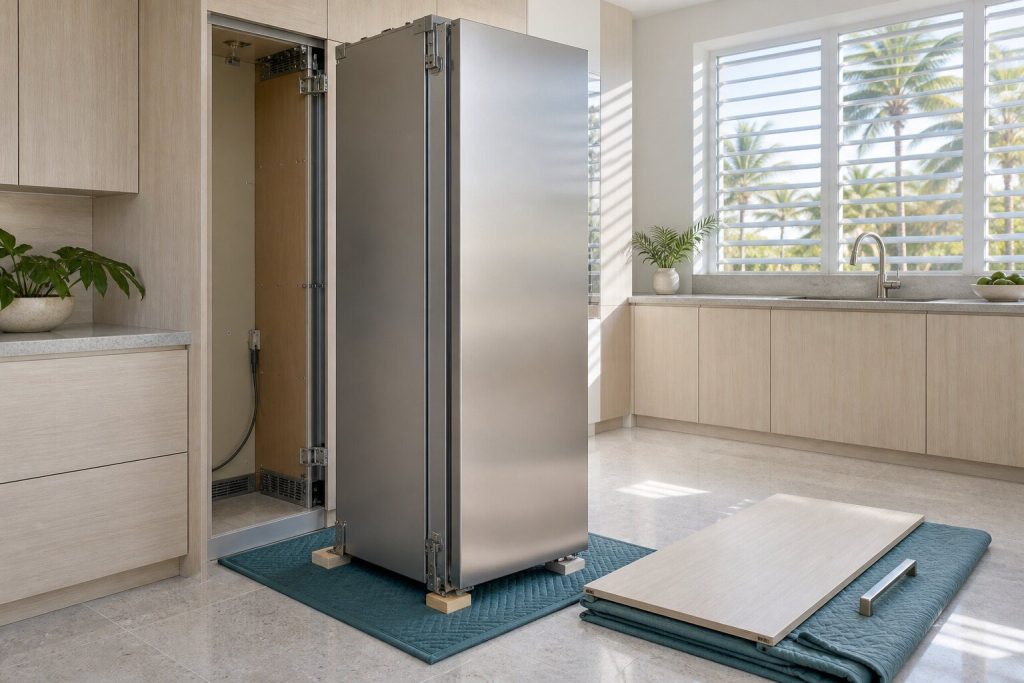
  • A tall integrated refrigerator column eased forward out of its joinery onto a protective mat, its oak cabinet panel and handle laid on a folded blanket beside it, shims at the base.
    from $185

    Integrated column access

    A service of its own on this make, because almost every cabinet here is flush in joinery that was drawn around it. Getting to the machine means the door panel, the handle, the trim and sometimes a fixed plinth, and doing that without marking a cabinet run is a skill rather than a step. It is quoted separately so nobody is surprised: on an integrated column the getting-in is frequently longer than the repair, and pretending otherwise makes every estimate wrong.

    • Priced separately because it is genuinely the longer half of the visit
    • Panels, handles and trim removed and refitted without marking the run
    • The air gap the fitter left is recorded, because it explains repeat failures
    What this involves
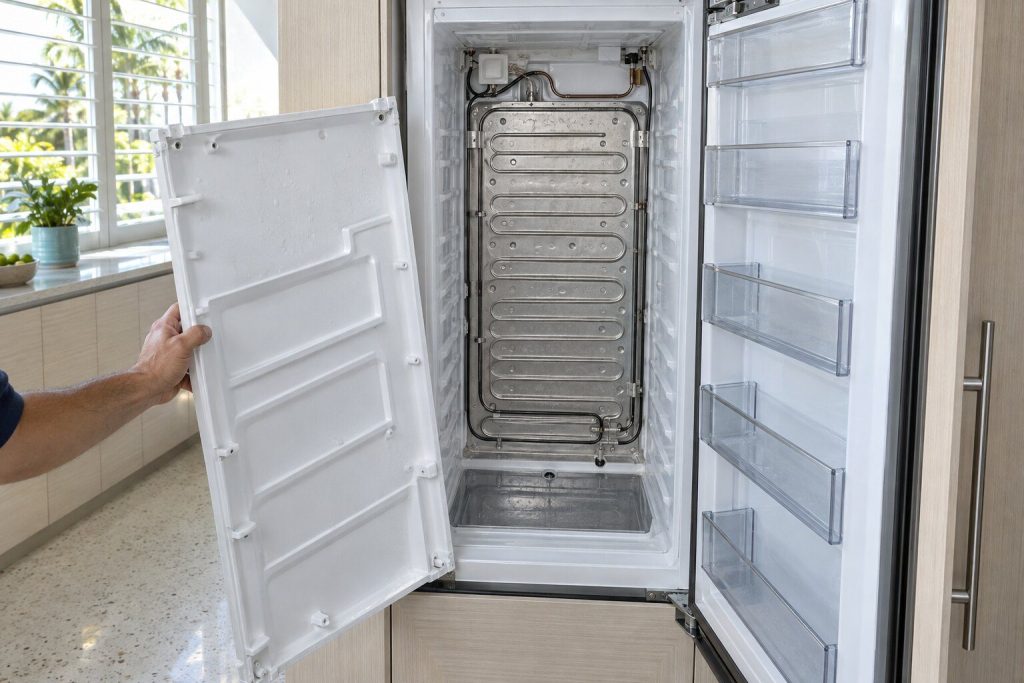
  • The evaporator behind an opened freezer panel — the first thing opened on a warm refrigerator.
    from $175

    Defrost system repair

    Ice building where air should move — on the back wall of a compartment, around a fan, or as a slab under a drawer. The circuit is small and predictable: a heater, a sensor, a control and a drain path, and which of the four it is can usually be told from how fast the ice comes back after it is cleared. That question is worth asking before the visit, because it changes what we bring.

    • How quickly the ice returns after clearing tells us which part it is
    • Heater, sensor, control and drain — a short list, worked through in order
    • A door left ajar produces identical ice and is not a repair
    What this involves
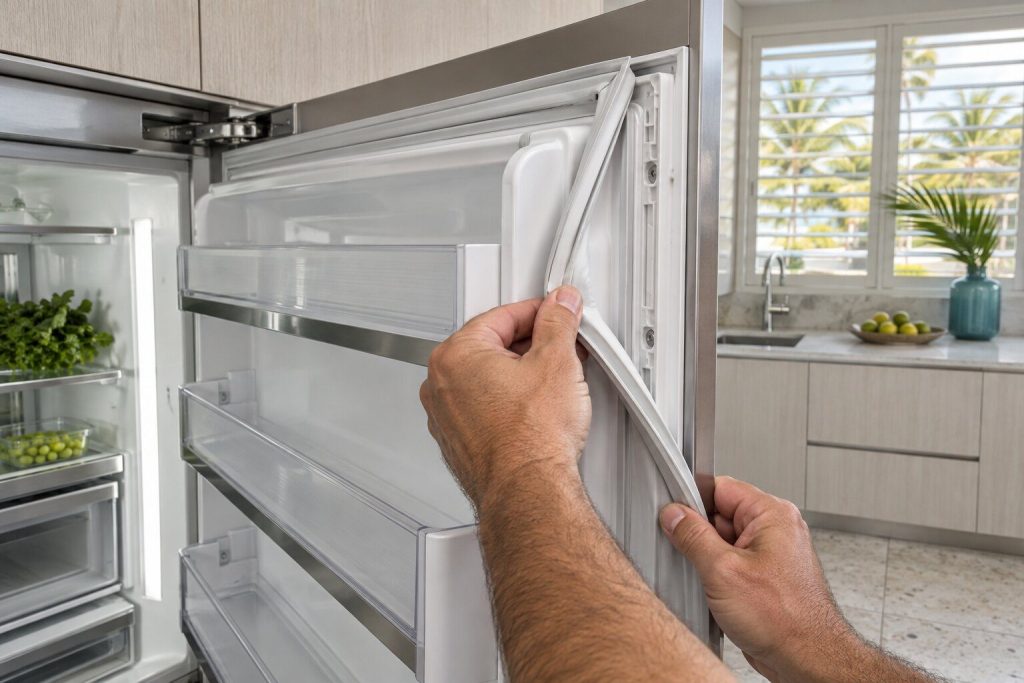
  • A magnetic door gasket pulled back out of its channel along one edge of an open integrated refrigerator door, the empty channel and the retaining lip visible.
    from $165

    Refrigerator door seal replacement

    A seal that has taken a set, or one cut where the door has dropped, and in this climate it costs more than it looks. Every hour of eighty-per-cent air leaking into a cabinet is moisture the defrost circuit then has to deal with, so a tired gasket shows up as ice, long run times and a compressor that never stops long before anybody notices the rubber. On integrated doors the extra weight of a custom panel is usually what pulled the door out of true in the first place.

    • A leaking seal shows as ice and long running before it shows as a draft
    • On integrated doors the panel's weight is usually the real cause
    • Hinge and alignment corrected with it, or the new seal sets the same way
    What this involves
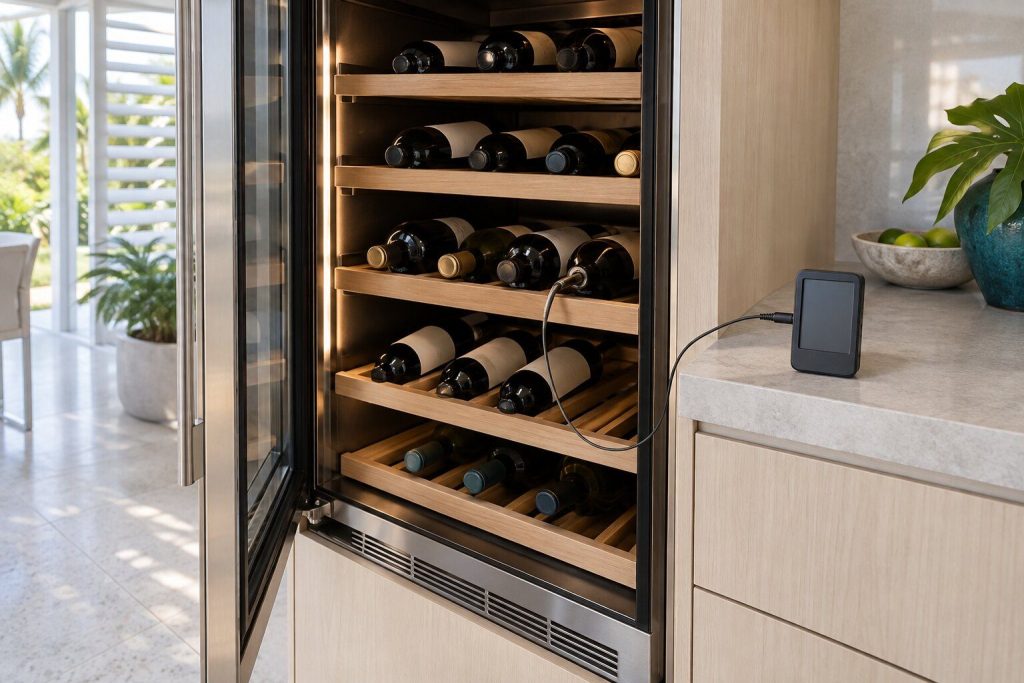
  • A slim probe lead resting among the bottles on a wooden rack inside an open wine cabinet, a data logger standing on the counter beside it.
    from $175

    Wine cabinet service

    The one refrigeration product still in this make's US catalog, and a different machine from a refrigerator in every way that matters to its owner. It is asked to hold a narrow band rather than a low temperature, to do it without vibration, and to do it while built into a run where its exhaust has nowhere obliging to go. Its usual complaint is not failure but drift, and drift is measured over days rather than diagnosed in an afternoon.

    • Drift, not failure — measured over days with a logger rather than guessed
    • Vibration is a specification here, so a fan bearing is a real problem
    • Exhaust path in the joinery, which is what most drift comes down to
    What this involves
  • The rear liner panel unscrewed inside an integrated freezer column and lifted out, the evaporator plate and the defrost heater loop behind it, ice cleared from the tray.
    from $185

    Freezer not freezing repair

    A cabinet running constantly and still soft inside, and in this county that has to be separated from a cabinet losing an argument with the room around it. A freezer in an unconditioned garage or utility room in August is being asked to work far outside what it was specified for; it may be perfectly healthy and simply losing. Telling that apart from a real failure is most of this visit, and there is no code on this make to help — the manuals carry problem, cause and solution rows and nothing else.

    • Start with the room — an unconditioned space in August changes the machine
    • Frost pattern is the reading — where it forms says which of four things it is
    • No published codes on this make, so behavior is the whole diagnosis
    What this involves
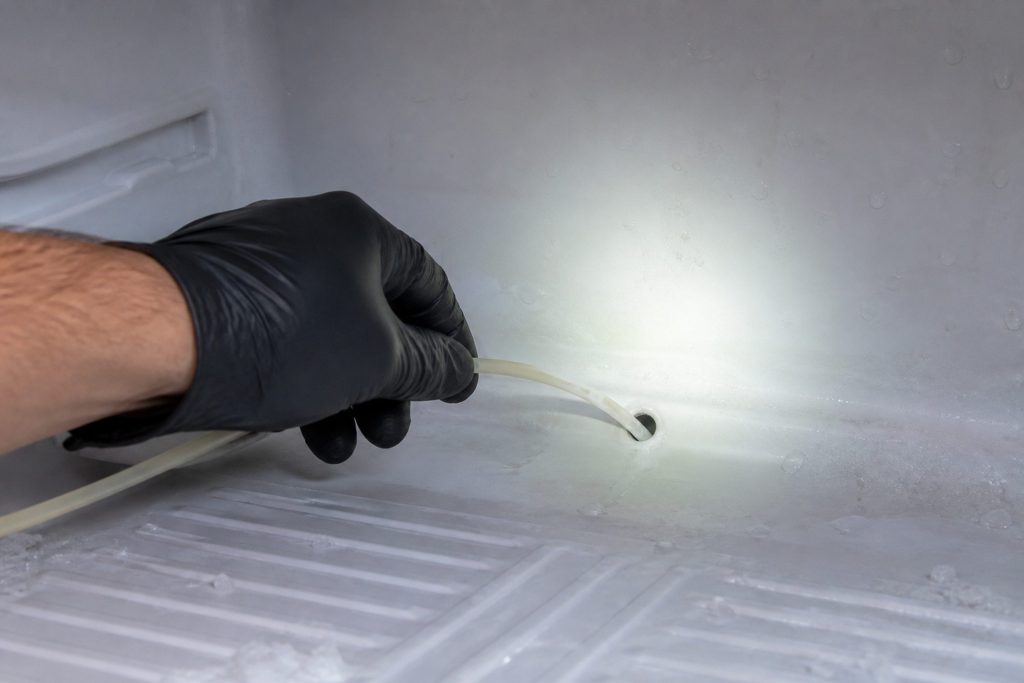
  • A gloved hand feeding a slim flexible tube into a small drain hole at the back of a freezer compartment, ice cleared away around it.
    from $139

    Freezer drain and ice service

    Ice under the drawers, water on the joinery floor, or a drawer that has frozen into its runners — three complaints with one blocked channel behind them. It is among the few things genuinely worth trying yourself first, and we say so: warm water down the drain channel at the back of the compartment clears most of them. What brings us out is the one that comes back, because that is the drain heater or the path itself rather than debris.

    • Worth trying yourself first, and we will say how rather than sell a visit
    • The one that comes back within a week is the heater, not the blockage
    • On integrated cabinets the water reaches the joinery before you see it inside
    What this involves
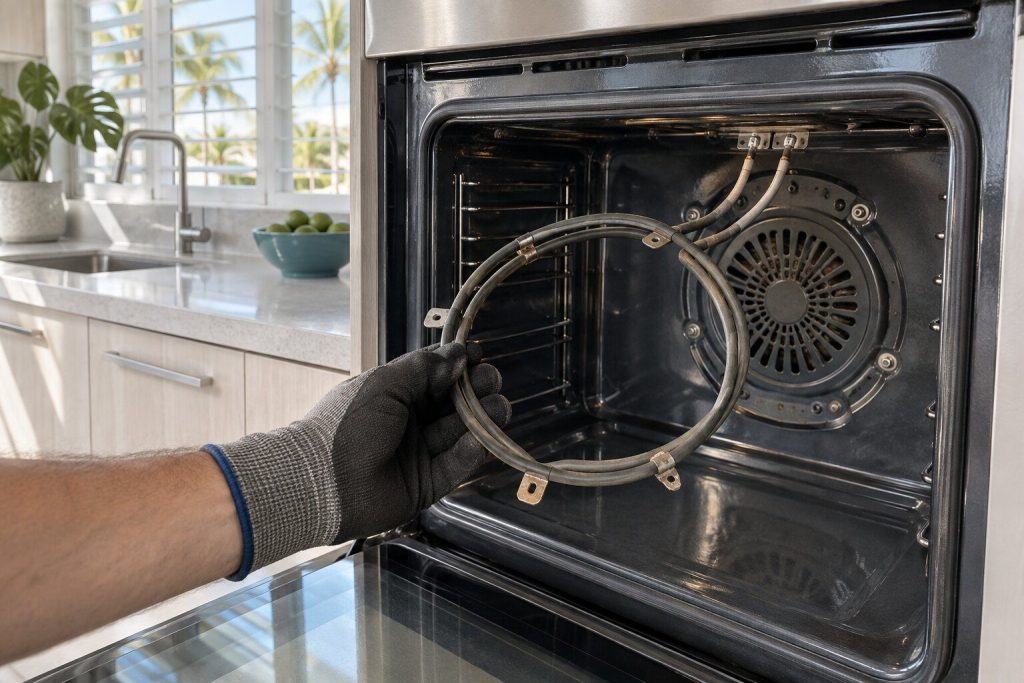
  • A fan oven element unbolted from the rear wall of an oven cavity and drawn forward on its leads in a gloved hand, the circular fan cover behind it.
    from $175

    Oven not heating repair

    A cavity that never warms up, or one where some functions heat and others do not — and on make the display will not help. When these stop they show ErrXX and no published document decodes those digits: three separate manuals say only to disconnect, reconnect and call somebody. So the work is conventional and thorough. Which functions still work is the most useful thing anybody can tell us on the phone, because a grill that heats while the bake element does not has already halved the diagnosis.

    • ErrXX is undecoded in every published manual — the digits are for a service tool
    • Which functions still work is the single most useful thing to tell us
    • Element, thermostat, thermal cut-out and the board, tested in that order
    What this involves
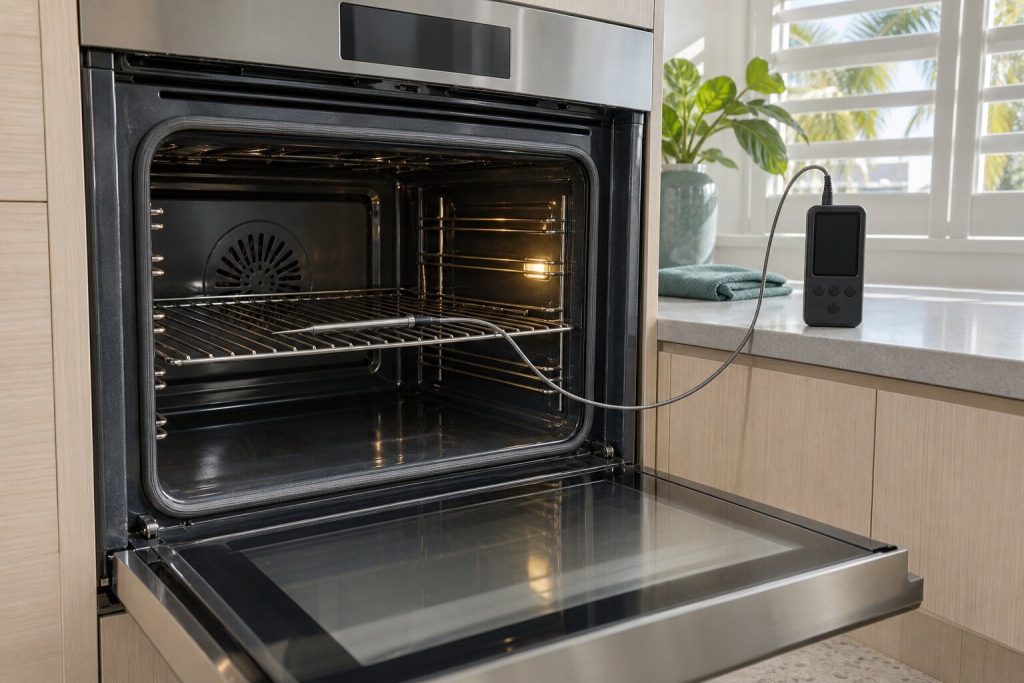
  • A thermocouple probe laid on the center shelf of an empty oven with its lead run out past the door seal to a hand-held meter standing on the worktop.
    from $149

    Oven temperature calibration

    Everything works and nothing is right — cakes pale, roasts overdone, a machine that has drifted rather than broken. On a European oven fitted into an American kitchen this comes up more than it should, and it splits into two quite different things: an oven whose sensor now reads a few degrees out, and an oven perfectly accurate at its own sensor while being wildly uneven inside. The second is airflow or a door seal, and no amount of calibration fixes it.

    • Accuracy and evenness are different problems with different repairs
    • Measured with an independent probe at several points, not at one
    • A door seal that has set is the commonest cause of uneven, not the sensor
    What this involves
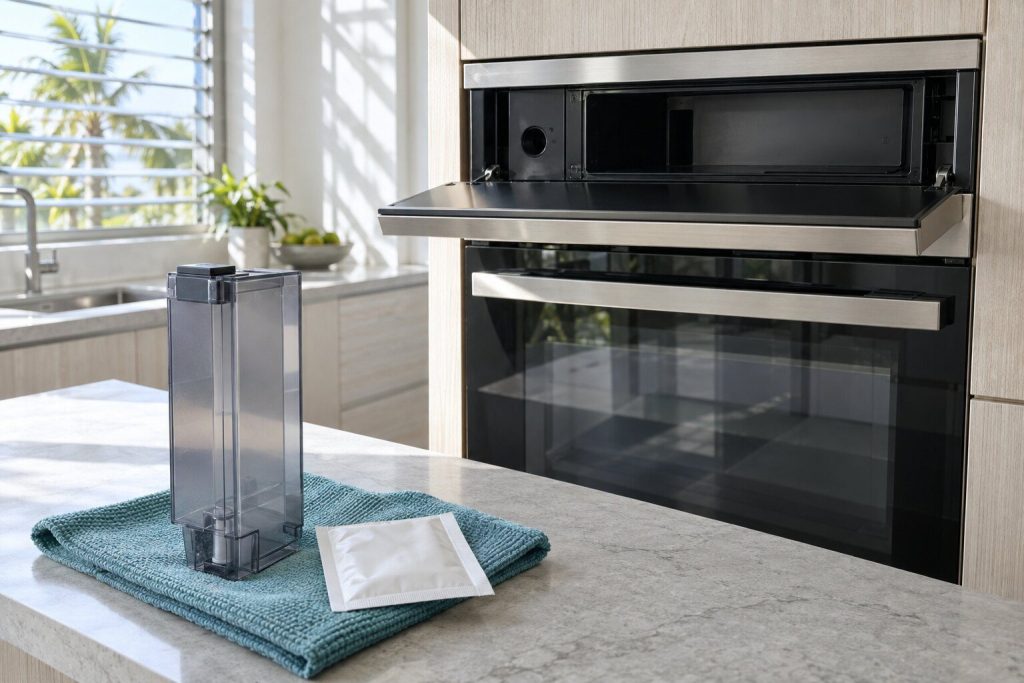
  • The water reservoir of a steam oven drawn out of its housing behind the control panel and standing on a cloth, a descaling sachet beside it.
    from $175

    Steam oven water system service

    The combi-steam cavities need a service the plain ovens do not, and on this water they need it more often than the manual suggests. Scale forms in the generator, the level sensor reads through it, and the machine starts refusing steam programs or leaving water standing in the cavity overnight. Descaling is genuinely the first thing to try and we will tell you how rather than charge for it; what brings us out is the machine that refuses after a proper descale.

    • Descale first — we will say how, rather than sell a visit for it
    • Standing water the next morning is a drain path or a level sensor
    • This supply scales a generator faster than the service interval assumes
    What this involves
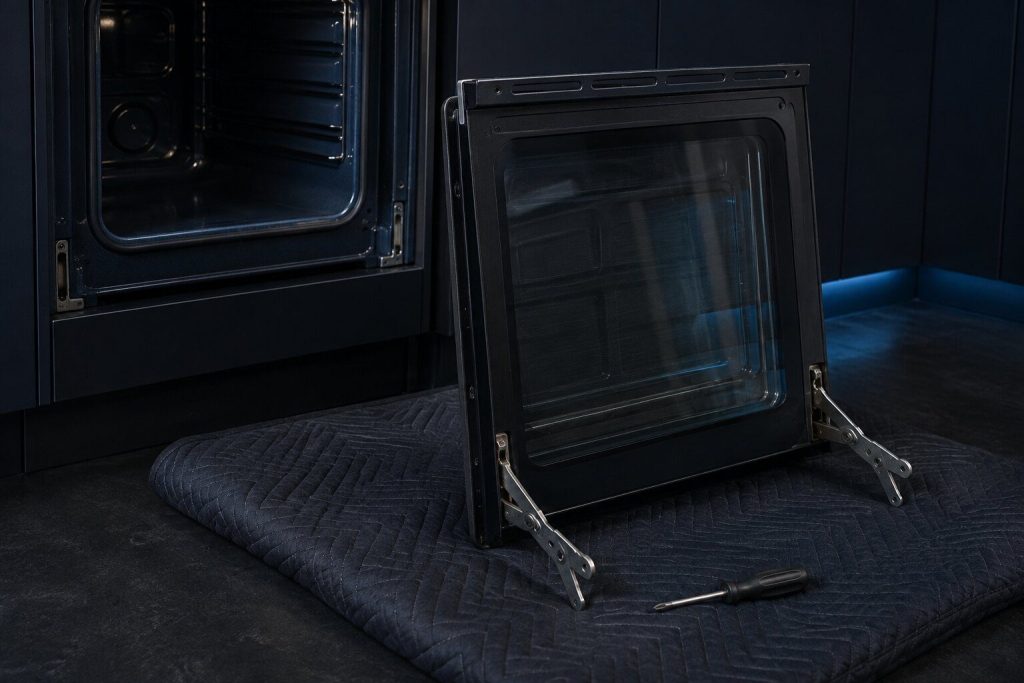
  • An oven door off and lying on a blanket with its hinges locked open
    from $169

    Oven door and hinge repair

    A door that will not close on its seal, sags at one corner, or has lost the glass panel between its layers. It is worth taking seriously beyond the annoyance: a door that does not seal changes every temperature in the cavity and puts heat into the cabinet around it, which is a joinery problem waiting to happen in a tall run. Hinges on these are sprung and under tension, and taking them apart without releasing them properly is how people get hurt.

    • A door that will not seal changes cooking and heats the cabinetry around it
    • Sprung hinges under tension — released properly, not levered
    • Inner glass and seal renewed together, because they wear from the same heat
    What this involves
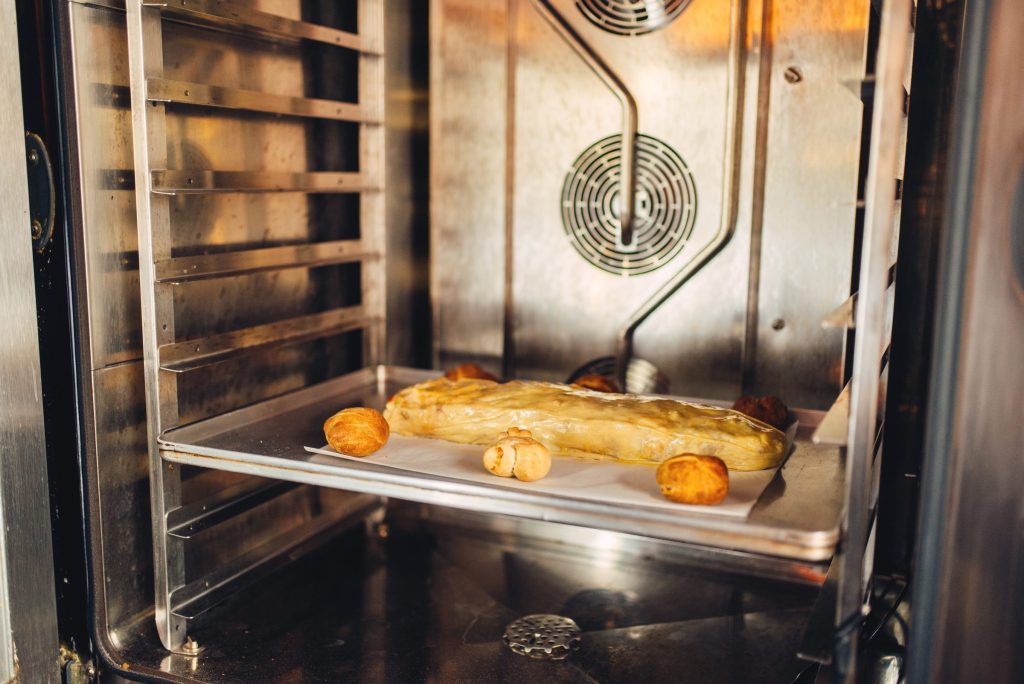
  • Looking into an open oven at a tray of part-baked pastries with the bake element visible at the back
    from $165

    Oven element replacement

    The straightforward half of an oven that has stopped heating, and the honest thing to say about it here is the timing. The part itself is ordinary; the supply channel is European, so the answer to when depends on the model rather than on the day of the week. We say that at the diagnostic and not afterwards. Where an element has failed early, the reason is worth finding too — a thermostat holding the oven above its setting will take the next one just as quickly.

    • The part is ordinary; the lead time is the part of the answer that varies
    • An element that failed early was killed by something, usually a thermostat
    • Terminals and the harness renewed with it where heat has reached them
    What this involves
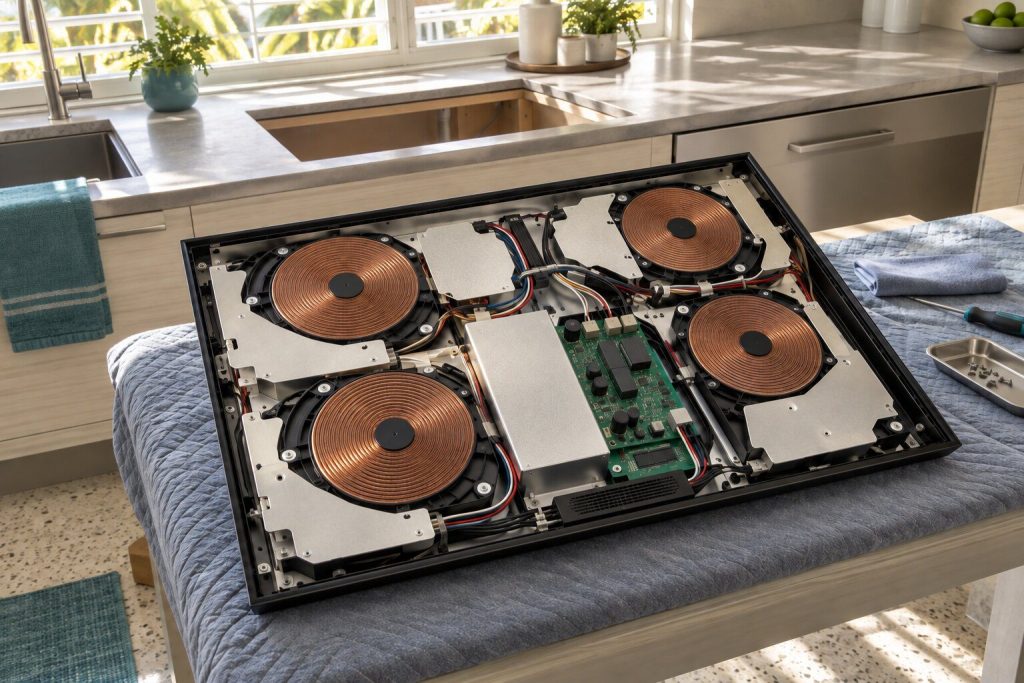
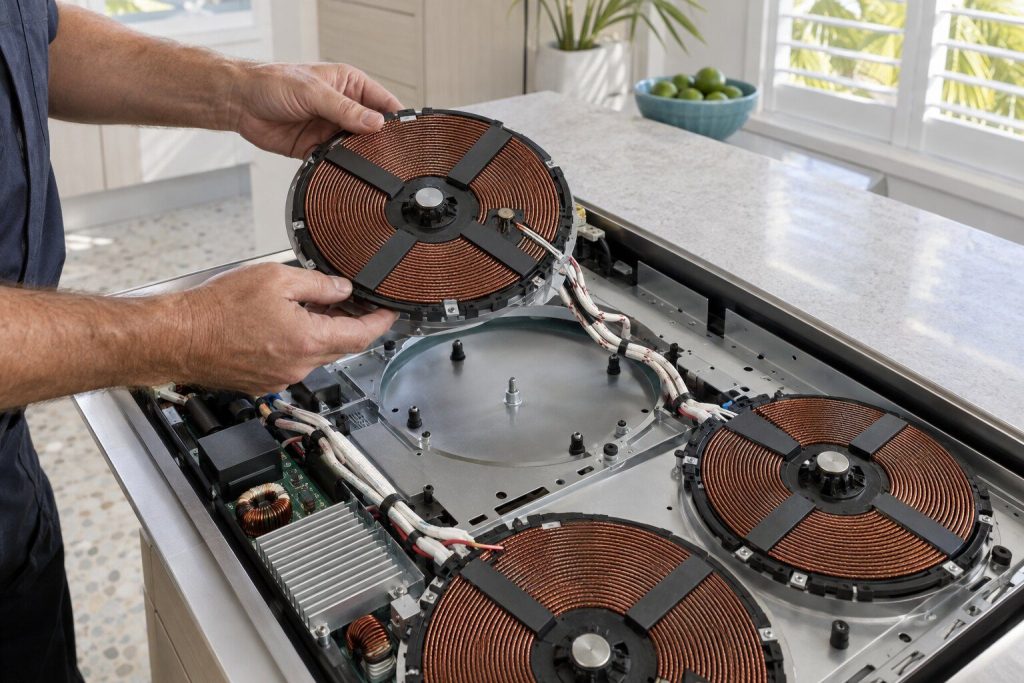
  • A black glass induction top lifted off its cut-out and turned over on a padded bench to show four coil assemblies and the control board underneath.
    from $205

    Induction cooktop repair

    The majority of what this make put into kitchens here, and the codes divide into two families that share no numbers at all: one generation prints F-strings, the other prints E and Er strings, and reading one against the other's table is how the wrong board gets ordered. Two free checks come before any of that, because they account for a good share of these calls: whether the pan is actually induction-capable, and whether the hob has been left in a lock or child-safety state that looks identical to a failure.

    • Two code families, no shared numbers — the model settles which table applies
    • Pan and lock state checked first, because both mimic a dead hob exactly
    • Overheating from a blocked air path under the counter, which is common here
    What this involves
  • One induction coil unscrewed from the underside of a cooktop and lifted an inch clear on its litz wiring, its ferrite bars and the thermistor visible.
    from $189

    Induction zone and coil repair

    One zone dead while the others work, which on induction is better news than it sounds: the problem is usually local to that zone's coil or to its section of the board, and the supply and the main control are out of it. What we check before opening anything is the pair of things that produce an identical symptom for nothing — the pan, and a bridged or linked zone setting that has moved a zone's power somewhere else without anybody meaning to.

    • One dead zone implicates its own coil, not the hob's supply
    • Bridge and link settings can move power silently and look like a failure
    • Glass lifted only after the electrical reading says it has to be
    What this involves
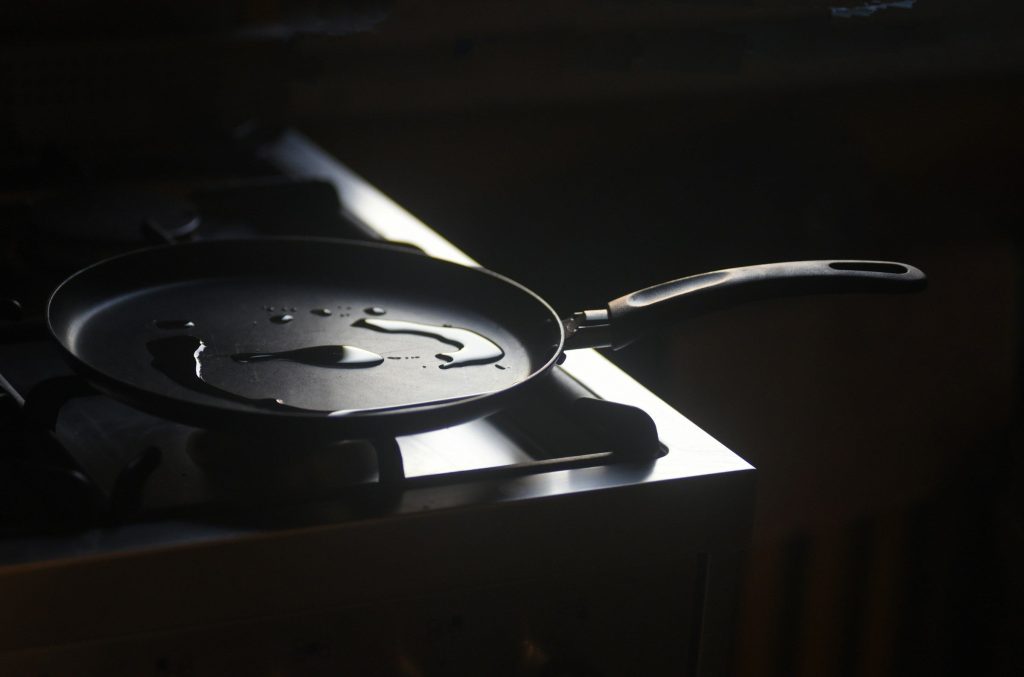
  • A frying pan on a dark induction surface in low kitchen light
    from $275

    Cooktop glass replacement

    A cracked or shattered induction top, which is not a cosmetic repair and should not be treated as one. A crack lets moisture down onto the coils and the board beneath, and the failure that follows is electrical. The right first action is to stop using it and isolate it at the breaker. Whether it is worth replacing depends on the model and on what has already got through, and on a hob no longer in the US catalog it depends on the glass still being available — which we check before quoting.

    • Stop using it and isolate at the breaker — this is not cosmetic
    • Availability checked before a figure is quoted, not after it is accepted
    • What the crack has already let through decides whether glass alone is enough
    What this involves
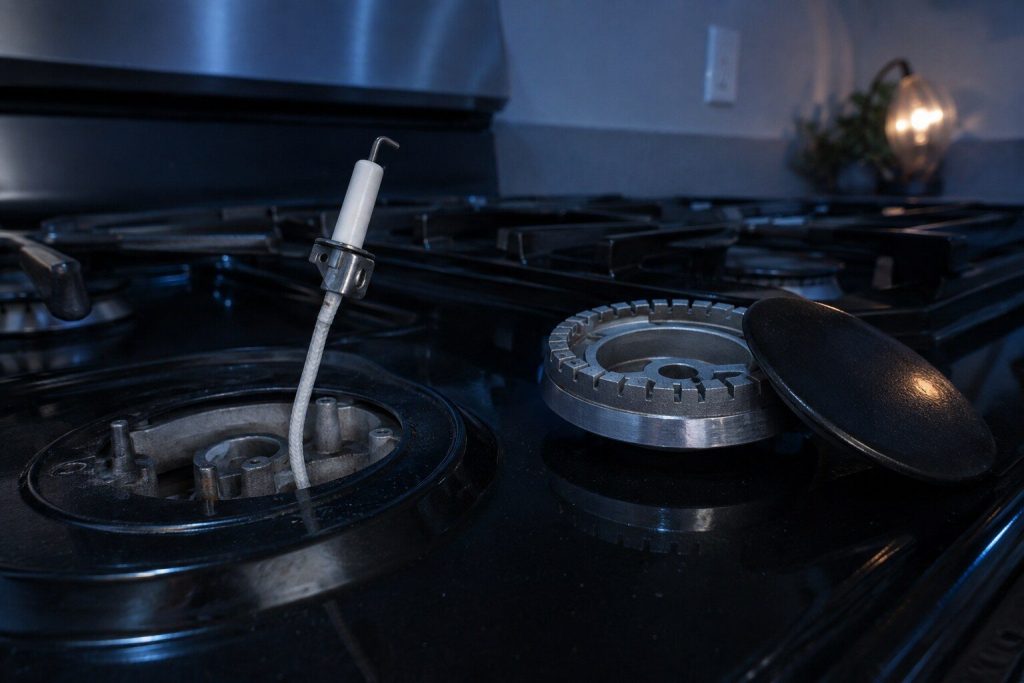
  • A spark electrode unclipped from beside a surface burner and lifted an inch clear on its lead, the burner cap and ring lying to one side on the cooktop glass.
    from $155

    Gas hob burner and igniter repair

    The simpler call on this make and not the lesser one: gas hobs here publish no codes at all, so the diagnosis is flame, spark and gas train, done by observation and measurement. A burner that clicks and will not light, one that lights and drops out, and one that burns yellow are three different problems, and which it is can usually be told before we arrive. Anything involving gas is left safe rather than merely working, and we say plainly when something is outside our trade.

    • No codes on gas here — flame, spark and gas train, measured
    • Clicking, dropping out and burning yellow are three separate problems
    • Left safe rather than merely working, and we say when it is not our trade
    What this involves
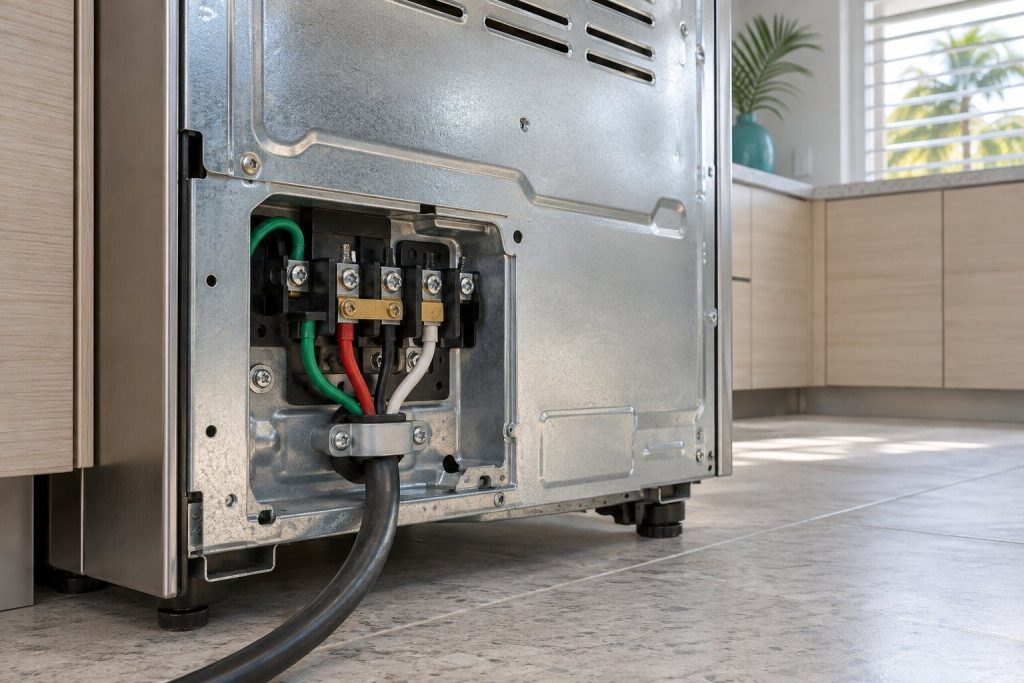
  • The terminal block behind the lower back panel of a freestanding range with its cover plate off, the supply cable clamped in and the link bars across the terminals.
    from $215

    Imported range service

    The Scandinavian cookers that were never sold here, brought over by somebody who moved or specified by a designer who knew the line. Servicing them is ordinary work with two unusual questions attached, and both are settled before anything else: what supply the machine is actually running on, and whether the parts it needs have a route. A repair fitted onto a wiring problem does not hold, and a diagnosis that ends in an unobtainable part helps nobody if it arrives after the invoice.

    • Supply checked first — a transformer or a rewired plug fakes many errors
    • Parts route and lead time established before the work is agreed
    • No code tables exist for these: the manuals are symptom, cause and remedy
    What this involves
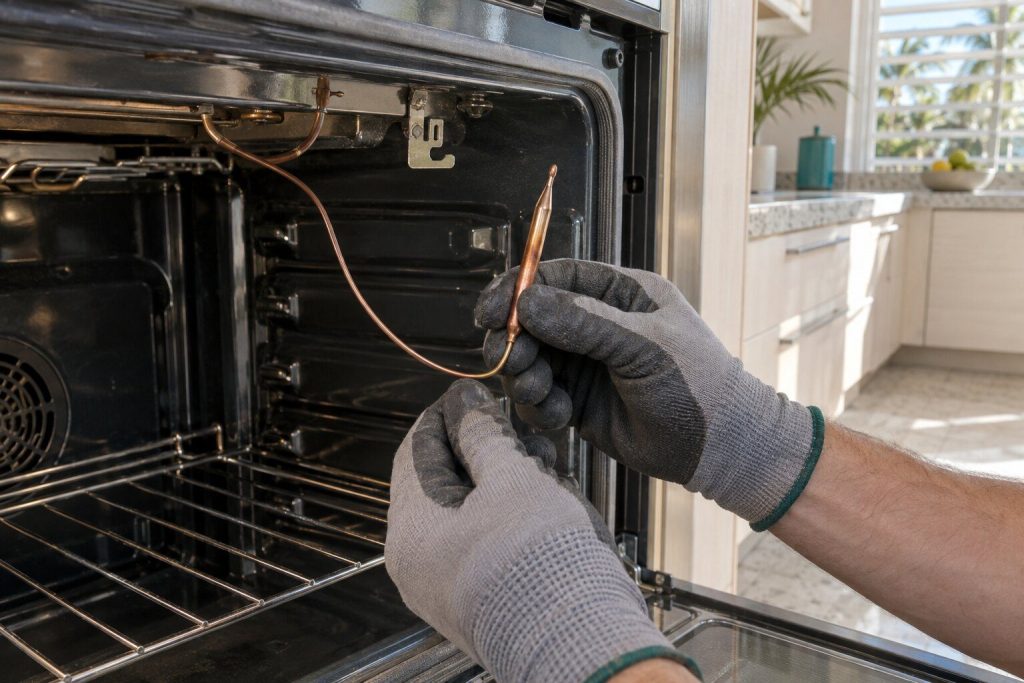
  • A capillary thermostat phial unclipped from its bracket inside an oven cavity and drawn out on its thin copper line, the bulb held in gloved fingers.
    from $175

    Range element and thermostat repair

    Ovens and hotplates on the imported cookers, where the mechanics are familiar and the supply is not. Elements, thermostats and switches on these are conventional parts that do conventional things; what differs is that they come from Europe and that a machine wired for a European supply may be running them outside their design. We measure the supply before we condemn a component, because a thermostat that looks lazy on a low voltage is a thermostat somebody paid for twice.

    • Supply measured before any component is condemned
    • Elements, thermostats and switches are ordinary parts on an unusual route
    • Salt reaches trim and fasteners here long before it reaches an element
    What this involves
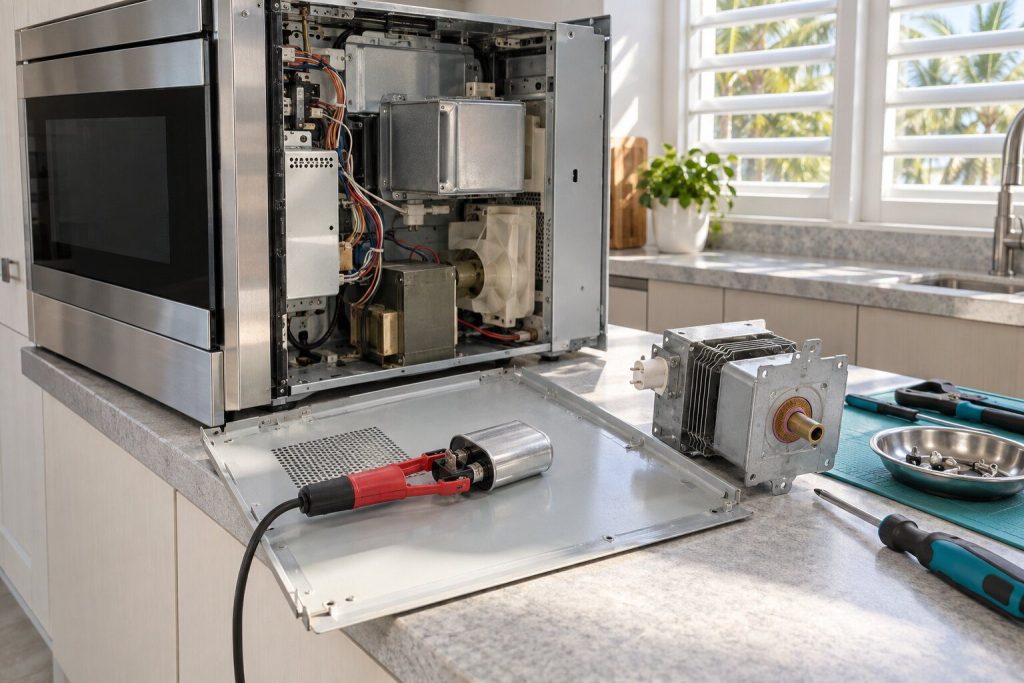
  • The side cover of a built-in combination microwave removed on a bench, a discharge tool resting across the capacitor terminals, the magnetron block beside it.
    from $195

    Built-in microwave repair

    The combination cavities — microwave and convection in one built-in oven — which are the only form this badge takes here. Like the ovens they report ERROR and two digits that no published manual decodes, so the useful split is done at the appliance and it is quick: if convection heats and microwave does not, the magnetron circuit and the door interlocks are the place to look; if neither does, the supply and the main board come first. A cup of water for a minute settles that before anybody drives over.

    • ERROR XX is undecoded in four manuals — the split is made at the appliance
    • Convection working while microwave does not halves the diagnosis immediately
    • Fitted into a cut opening, so replacing it is a joinery job, not a purchase
    What this involves
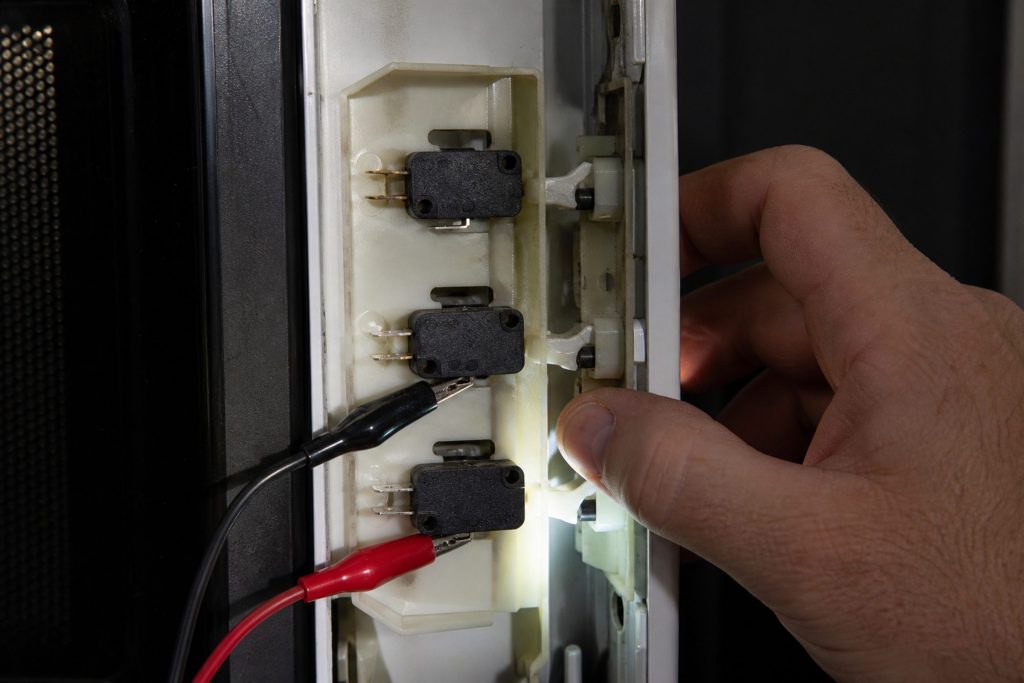
  • Meter probes held against the door interlock switches inside the frame of a microwave
    from $145

    Microwave door interlock repair

    A door that needs a push, a latch with play in it, or a cavity that has stopped running altogether — one circuit behind all three. The interlocks are safety switches, wired so that the machine cannot run unless all of them agree the door is shut, and a door that has dropped on its hinges stops satisfying them long before it looks wrong. This is worth a visit on its own even while the machine is still heating perfectly well, and we would rather say that than wait to be called for something else.

    • A microwave door is a shielding component, not a lid
    • Three switches in series: one out of agreement stops everything
    • Worth booking while the machine still works, not after it stops
    What this involves
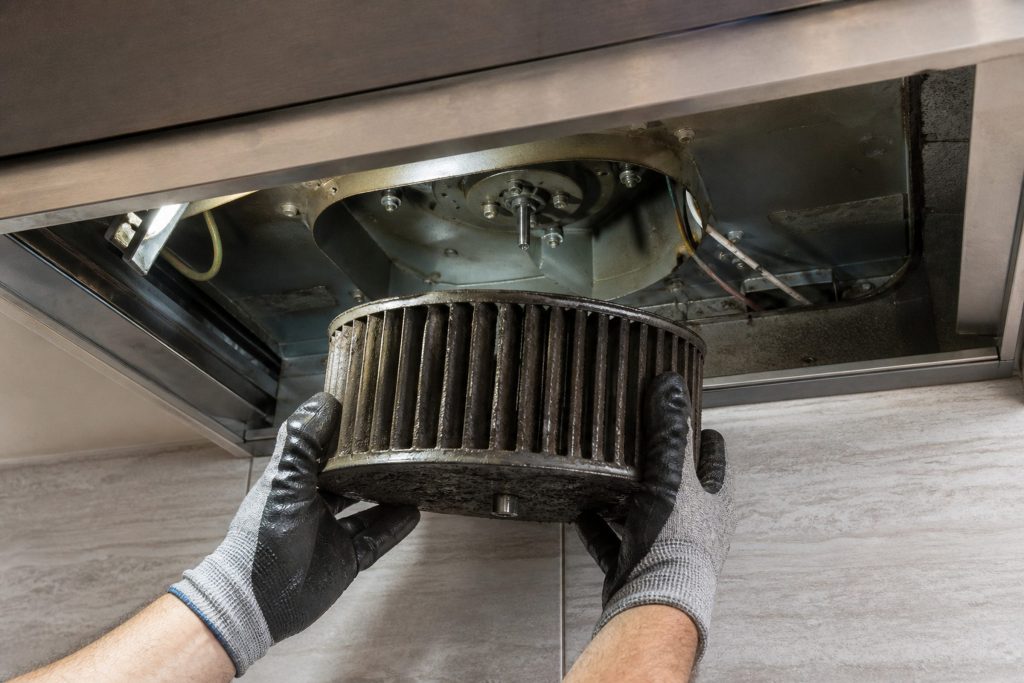
  • A squirrel-cage blower wheel unbolted from a range hood housing and lowered out of it in two gloved hands, greasy vanes clearly visible, the empty motor mount and wiring above.
    from $165

    Range hood motor and blower service

    A hood that has got louder, weaker, or has stopped altogether. The manuals for these carry no troubleshooting section whatsoever — three checked, all silent — so everything here comes from what actually fails. Noise that grew slowly is grease loading on the impeller and recovers with a proper clean; noise that arrived suddenly is a bearing or something loose in the housing and is worth stopping for. A hood that runs and does not clear the kitchen is usually not the hood at all.

    • No troubleshooting section exists in the manuals — three checked, all silent
    • Noise that grew is grease; noise that arrived is a bearing
    • The outside vent tested before any part is discussed
    What this involves
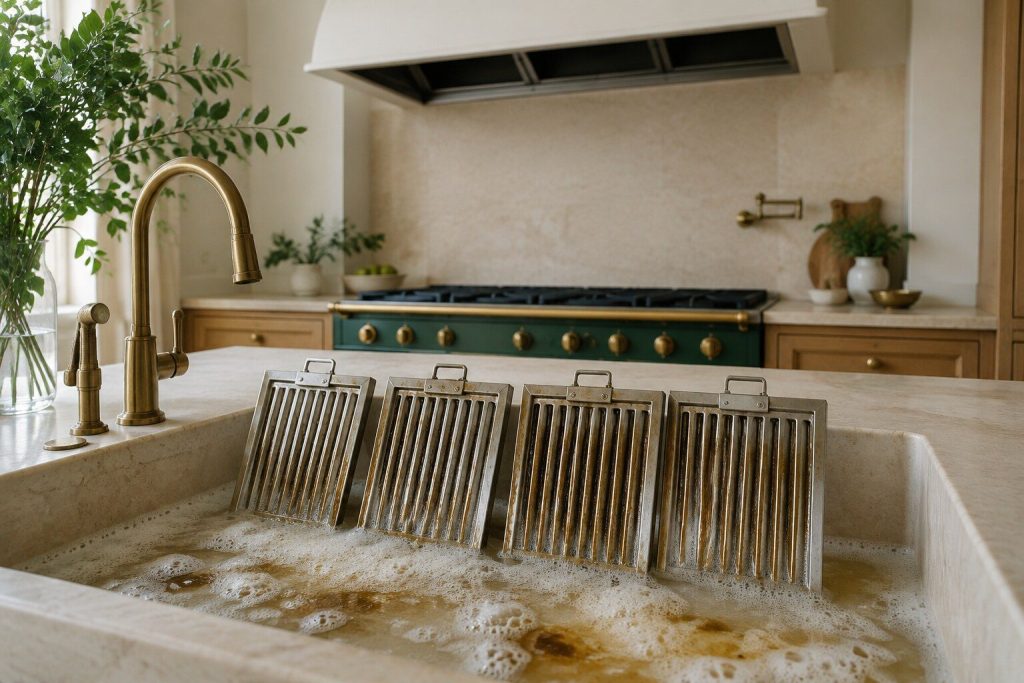
  • Four steel baffle filters standing on edge in a sink of hot soapy water, grease lifting off them into the foam, the empty hood canopy visible out of focus above and behind.
    from $175

    Hood liner service

    The concealed liners this make is known for, built to vanish into somebody else's millwork, and that is exactly what makes them awkward. Getting to one means working inside a cabinet that was closed around it, often with no service access at all, and the honest position is that this is joinery work as much as appliance work. We say before the visit what will have to come off, and we do not open a cabinet we cannot put back.

    • Access said out loud beforehand — this is joinery as much as appliance
    • We do not open a cabinet we cannot close again to the same standard
    • The duct above the liner is checked while it is the only chance to
    What this involves
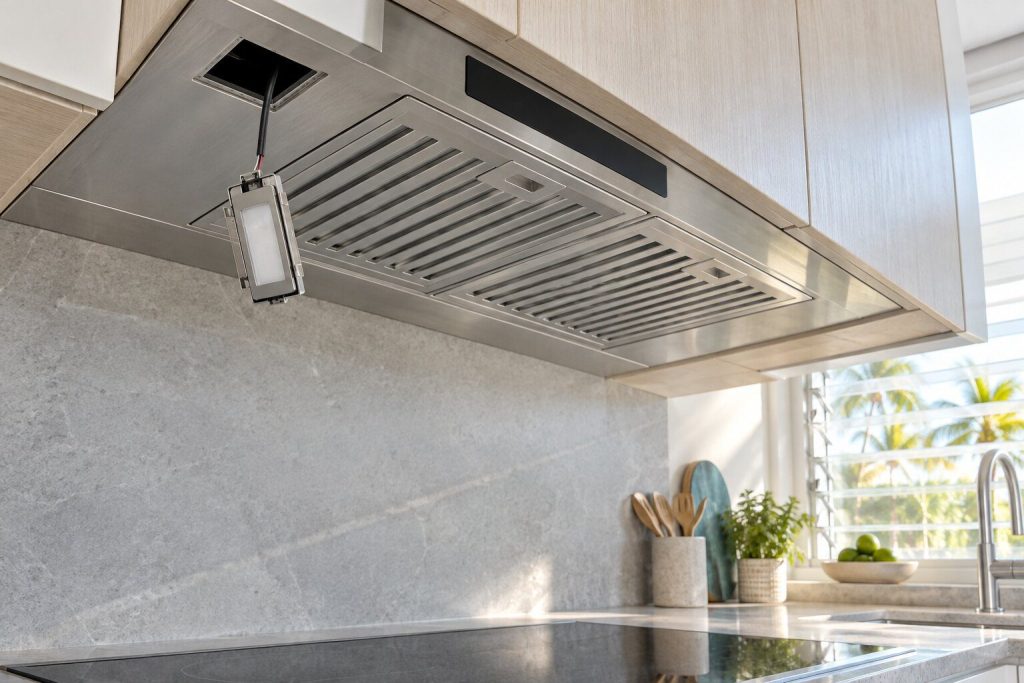
  • An LED lamp module unclipped from the underside of a hood liner and hanging on its lead, the dark control strip and two baffle filters beside it.
    from $119

    Hood light and control service

    Lamps out, a touch strip that has stopped responding, or a hood that runs at one speed whatever is asked of it. Small work, and it splits the machine usefully: lamps and motor are generally on different circuits after the switch, so lights that work while the fan does not points away from the supply entirely. Touch strips are the common failure in a kitchen where the hood is wiped down every day, and they are a straightforward part.

    • Lights working while the fan does not points away from the supply
    • Touch strips fail from daily cleaning, and they are an ordinary part
    • Lamp type matched to the liner, because the wrong one cooks its own holder
    What this involves
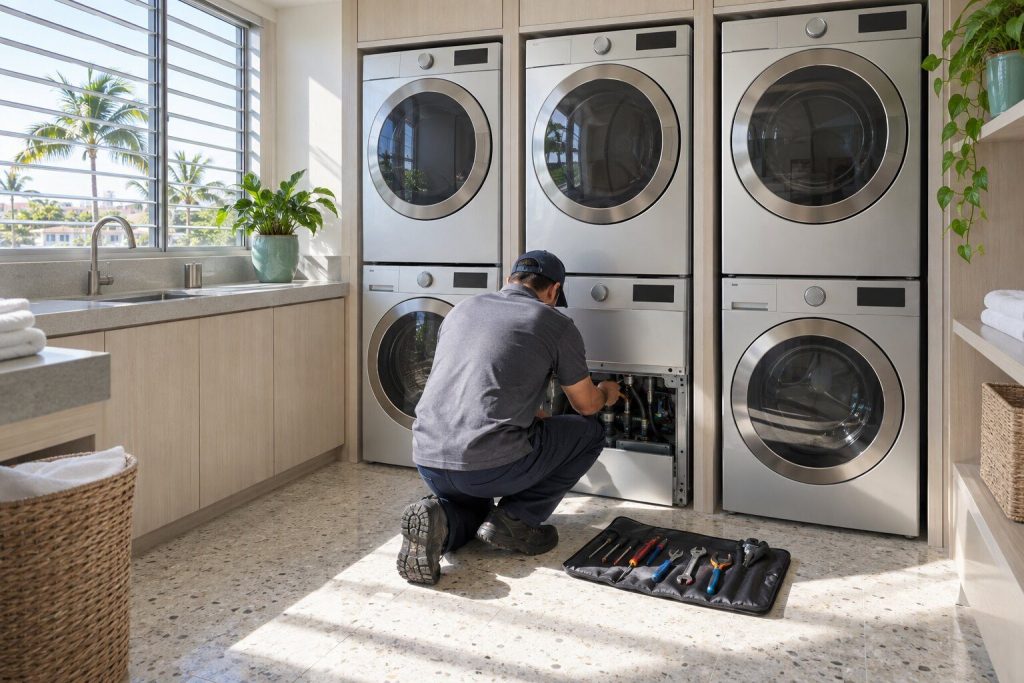
  • A technician kneeling at the open service panel of one of three stacked washer and dryer pairs in a condominium laundry room, tool roll open on the tiles beside him.
    from $225

    Commercial laundry service

    Domestic Asko laundry doing commercial-scale work, which is the honest description of almost every building machine on this badge — there is no US professional catalog to pretend otherwise about. A condominium amenity room, a boutique hotel's housekeeping closet, a salon washing towels twice a day. These machines tolerate it better than most, which is exactly why they end up doing it, and the failure pattern is its own: wear parts arrive years early and everything else arrives on time.

    • Said plainly: these are domestic machines under building duty
    • Same-day turnaround, because there is no second laundry room
    • One contact who is not a resident, and a written record after every visit
    What this involves
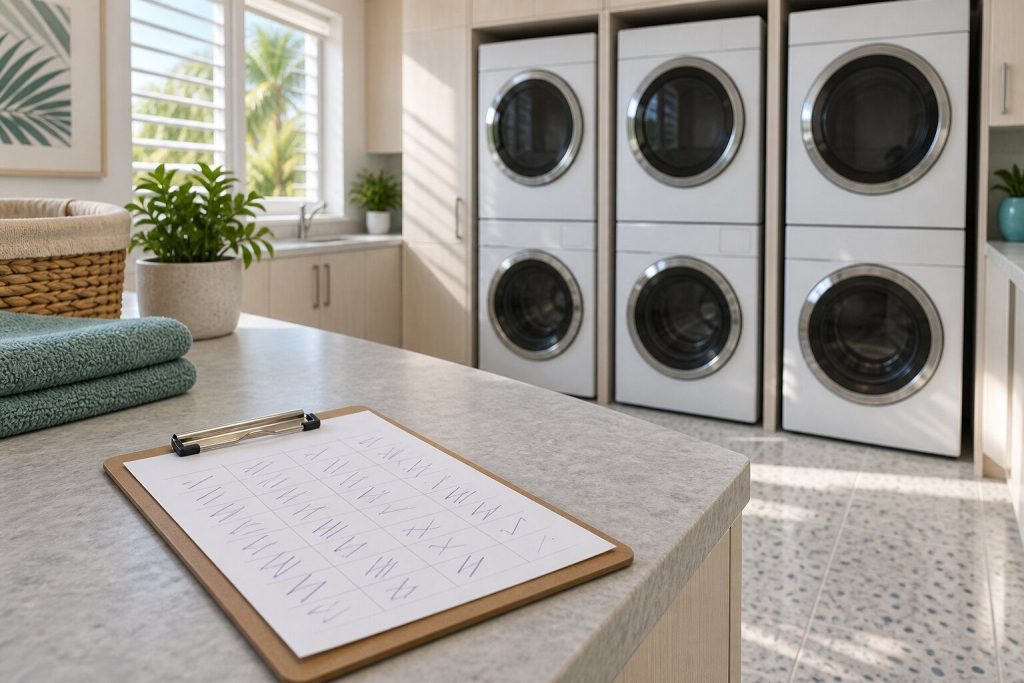
  • A clipboard with a handwritten cycle-count sheet resting on the folding counter of a condominium laundry room, three stacked machine pairs out of focus behind it.
    from $195

    Building laundry maintenance plan

    Planned work for amenity rooms and housekeeping closets, priced as planned work rather than as a series of emergencies. The argument for it is one number: a household pair runs perhaps five cycles a week, and an amenity room in a fifty-unit building can run that in a day — so it reaches a year of domestic wear in about six weeks. The consequence of missing that is not an inconvenience. A door seal that has been cutting for a month puts water into a slab, and in a condominium that becomes several units' problem.

    • The interval is set by cycles per week, not by the calendar
    • A cutting door seal in a condominium ends as somebody else's ceiling
    • Spares held on site turn a two-visit repair into one
    What this involves
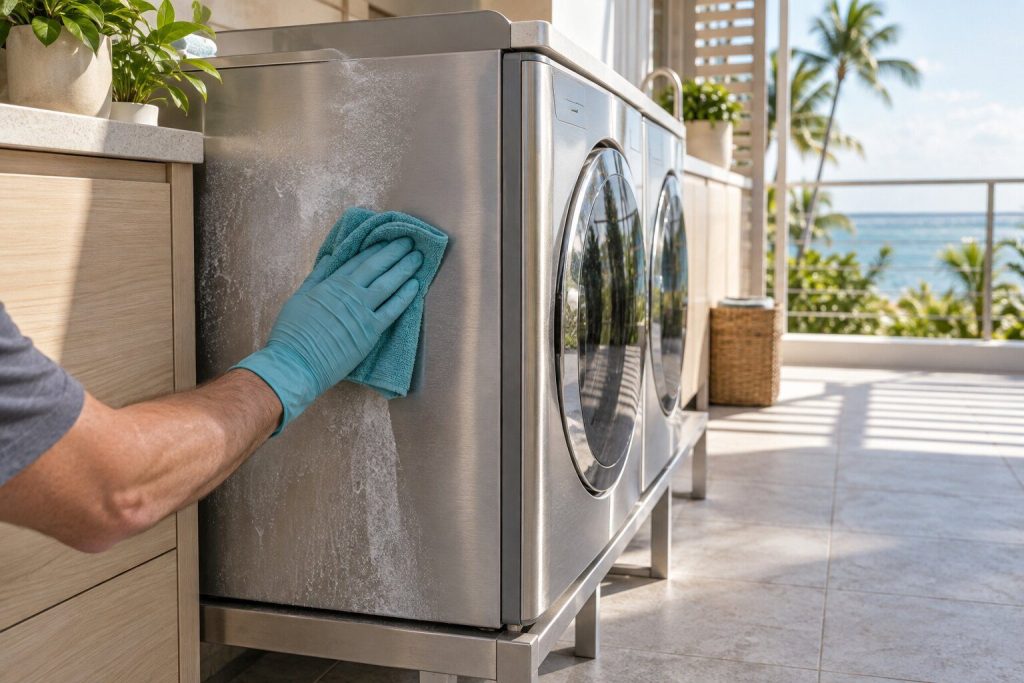
  • A gloved hand wiping white salt bloom off the stainless flank of a machine standing in an open-sided terrace utility run, the sea haze bright beyond the railing.
    from $135

    Salt air protection service

    A visit that exists because of where these machines are rather than what they are. On a barrier island or a terrace kitchen, salt reaches hinges, fasteners, trim, backdraft dampers and the outdoor dishwasher's door long before anything electrical goes wrong, and every one of those is cheap while it is still moving and expensive once it is not. Nothing here is exotic: it is cleaning, treating and freeing things on a schedule, and it is the difference between a ten-year machine and a five-year one on this coast.

    • Written for this coast: hinges, fasteners, dampers and outdoor doors
    • Everything on the list is cheap while it still moves
    • Best booked with another visit, since it is an hour rather than an afternoon
    What this involves

One job that exists on no other site we run

Establishing which machine you actually have

This make numbers its errors per platform rather than per appliance. Three dishwasher schemes, five washer code families, dryer codes that change form with the control board, two induction families that share no numbers at all. Reading a string against the wrong table produces a confident answer and the wrong part.

So identifying the platform is real work with a real value, and it is sold as a job in its own right — credited in full against a repair booked in the same visit.
See what a repair costs
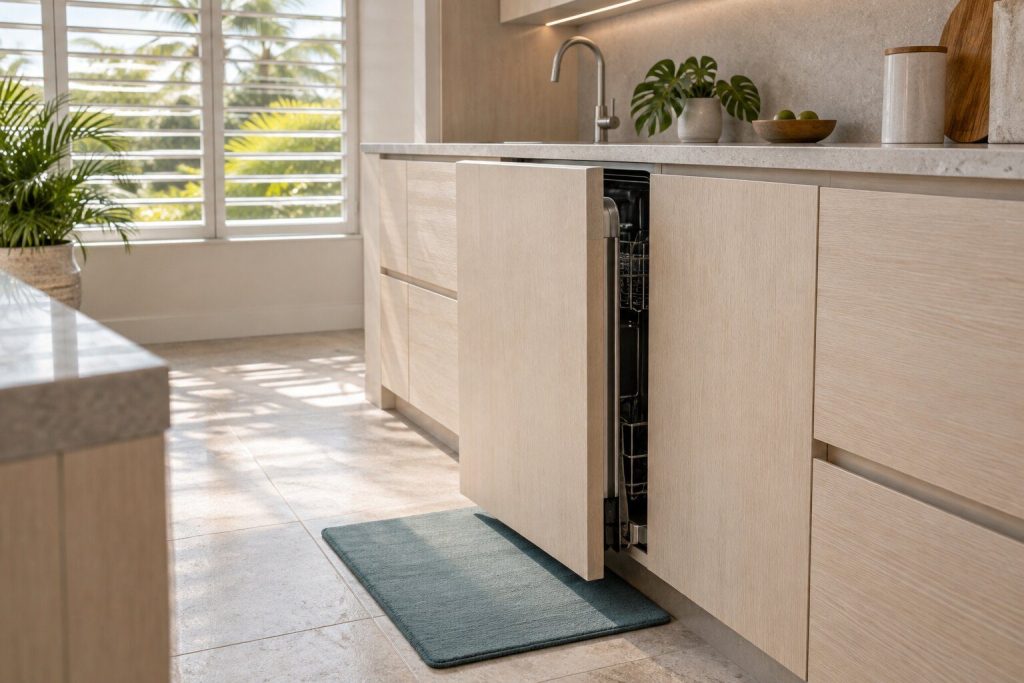
A run of pale oak cabinetry with one appliance front eased a hand-width proud of the line and a protective mat on the tile in front of it.

Why the laundry list is the longest one here

This is a laundry and dishwashing make in the United States

Twelve dishwashers, eight washers and twelve tumble dryers are listed for sale here. Ovens, hobs and hoods: none at all. The service list follows that reality rather than a template, which is why laundry and dishwashers carry it and the kitchen machines take what they genuinely need.

Those kitchen pages exist because the equipment is in South Florida kitchens, and every one of them says we service it rather than that the maker sells it.

See what a repair costs
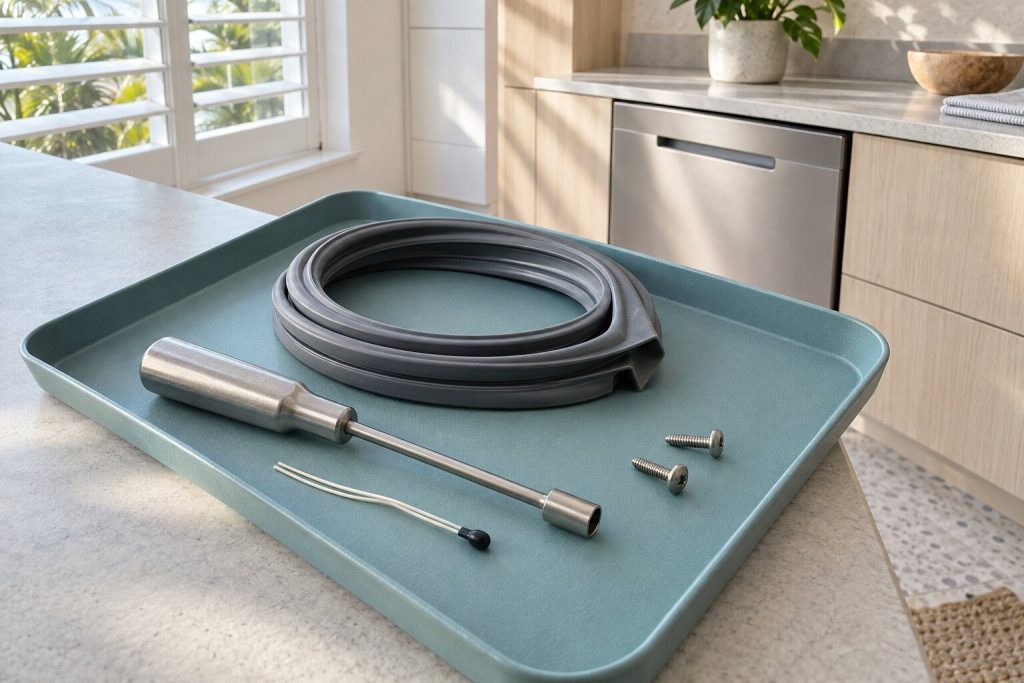
A parts tray on a light worktop holding a thermistor, a coil of door gasket and two screws, a nut driver lying across it.

Before you book

Four things that shorten the visit

Have these to hand

  • The model code off the door edge or the frame sticker. On this make it decides which code table applies before anything else.
  • The exact characters on the display, including whether there is a colon.

Worth checking first

  • The filter — dishwasher stack, washer pump filter, dryer condenser. Free, and it ends a real share of these calls.
  • Whether the machine has drained, if it will not spin or will not open.

Or start from the machine

By appliance instead

If you would rather begin from what it is than from what needs doing to it.

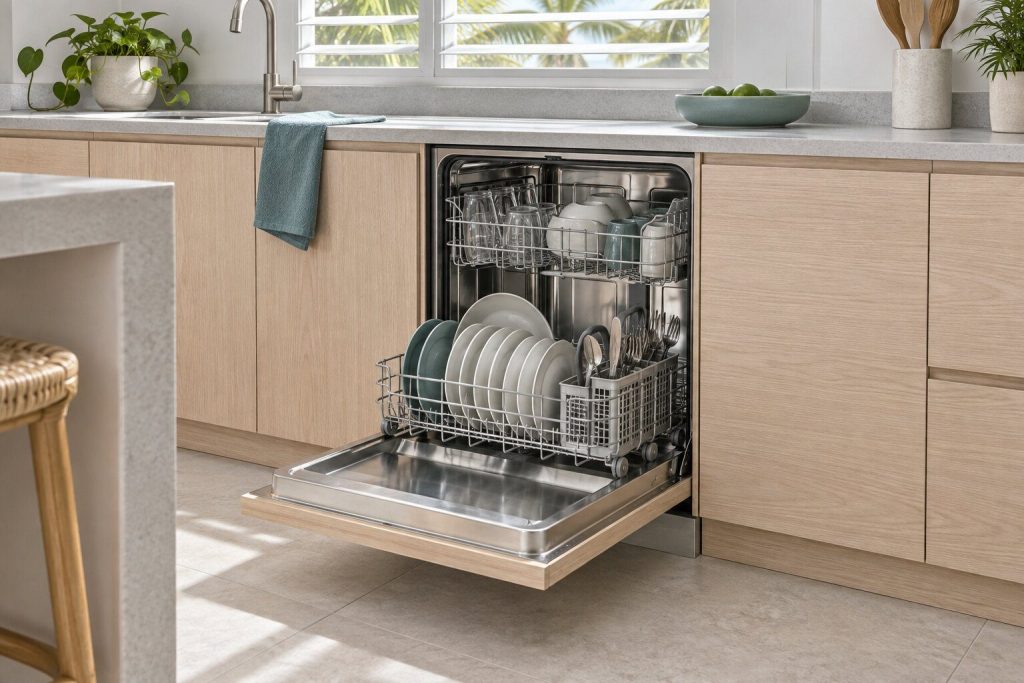
  • A panel-ready dishwasher standing open at the end of a program in a run of pale oak cabinetry, its stainless tub and two loaded baskets showing, the cabinet front matching the doors either side.
    Twelve US models · panel-ready, Touchproof steel and the Outdoor door

    Dishwashers

    The machine that made this badge, and also the one where a number on the display tells you least. Three generations are in South Florida kitchens and each numbers its errors differently: the legacy DW20.1 boards blink their trouble through the program lights and keep the F-label in a service menu nobody opens; the current generation prints F10 upward on a full-text panel; and the Outdoor door, built for a terrace kitchen and therefore common here, uses a third scheme written with a colon that means different things again. All three are twenty-four inches wide and look alike behind a cabinet panel. Which one is in the run decides the reading, the part number and whether the number on the screen reports an error at all.

    • Twelve US models — panel-ready, Touchproof stainless and the DOD Outdoor door
    • Three code schemes, none compatible: blink F1–F9, display F10–F68, Outdoor F:10
    • Steel tub, steel spray arms and a filter that is meant to be lifted out and rinsed
    Dishwasher repair
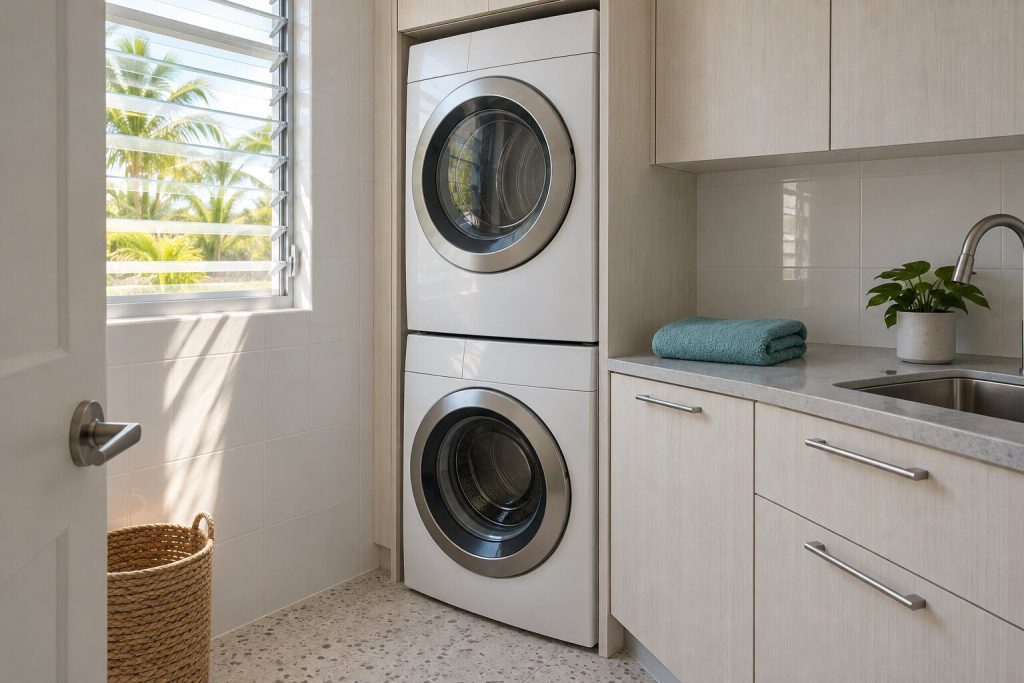
  • A front-load washer and dryer stacked in a narrow tiled utility room, both doors closed, a folded towel on the worktop beside them.
    Eight US models · Classic, Logic and Style, and five different code families

    Washers

    A front loader built around a steel frame rather than a plastic one, sold here as Classic, Logic and Style — the three-, five- and seven-series. What makes it awkward to write about honestly is that five different code families are in circulation across the machines still running in South Florida: the W6 display machines print F10 to F12; the WM75 platform speaks in E-numbers as far as E37; the numbered-LED machines use a short F-set whose meanings do not match the display machines; the analog LED machines signal L1 to L6 and mean different things by model; and the premium panels skip the code entirely and print a sentence. There is no single Asko washer code list, and any page that offers one is guessing.

    • Eight US models across Classic (3), Logic (5) and Style (7) series
    • Five code families: F10–F12, E0–E37, F1/F3/F4/F6, L1–L6, and text-label panels
    • Steel frame and steel drum — the machine outlasts the laundry room it was fitted into
    Washer repair
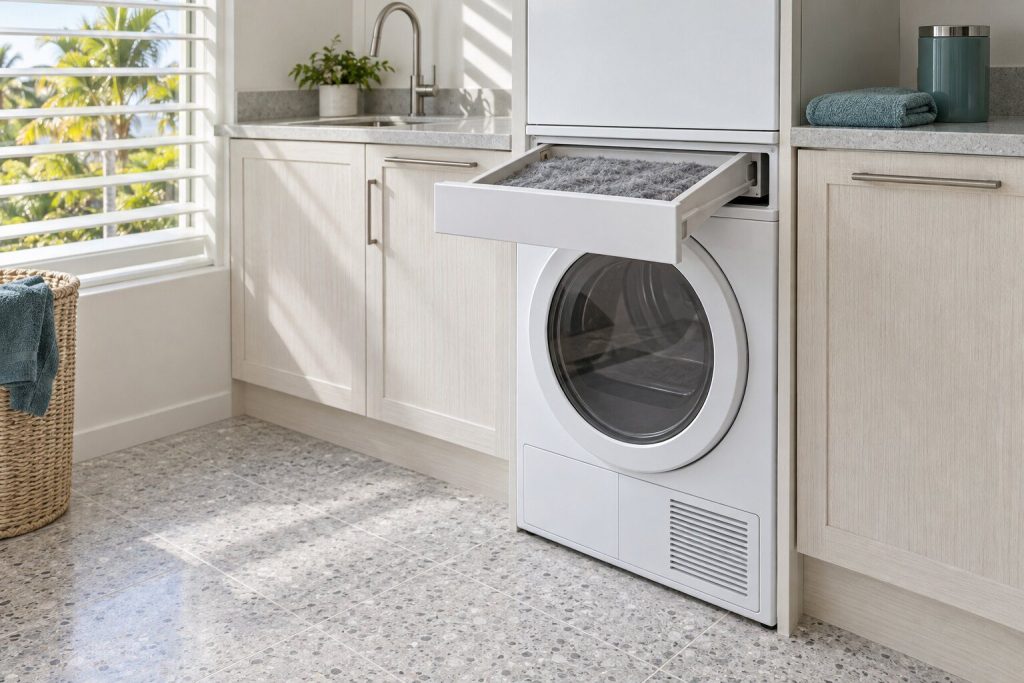
  • A heat-pump dryer standing in a white utility room with its lint drawer pulled out at the top and a gray felt mat of lint lying in it.
    Twelve US models · condenser and heat pump, and codes that change with the board

    Dryers

    Condenser and heat pump machines, which is the right choice for a closet with no external wall and the wrong machine to treat like a vented dryer. No air leaves the room: water is condensed out and kept, so a container left full or a loaded condenser filter halts the cycle every bit as firmly as a crushed duct halts a vented machine. The codes here move with the control board rather than with the model name — one revision signals L2 to L4, a later one prints F10, F29 and F30, a later one again uses S-numbers, and the steam and heat-pump platform spells ERROR_0 through ERROR_5 in full. The simplest analog condenser machines publish no codes at all, and that absence was checked rather than assumed.

    • Twelve US models — condenser and heat pump, no external vent required
    • Codes follow the board: L2–L4, then F10/F29/F30, then S1–S9, then J1 and LCD1–3
    • The T208V family publishes no codes at all — verified absence, not a gap in our research
    Dryer repair
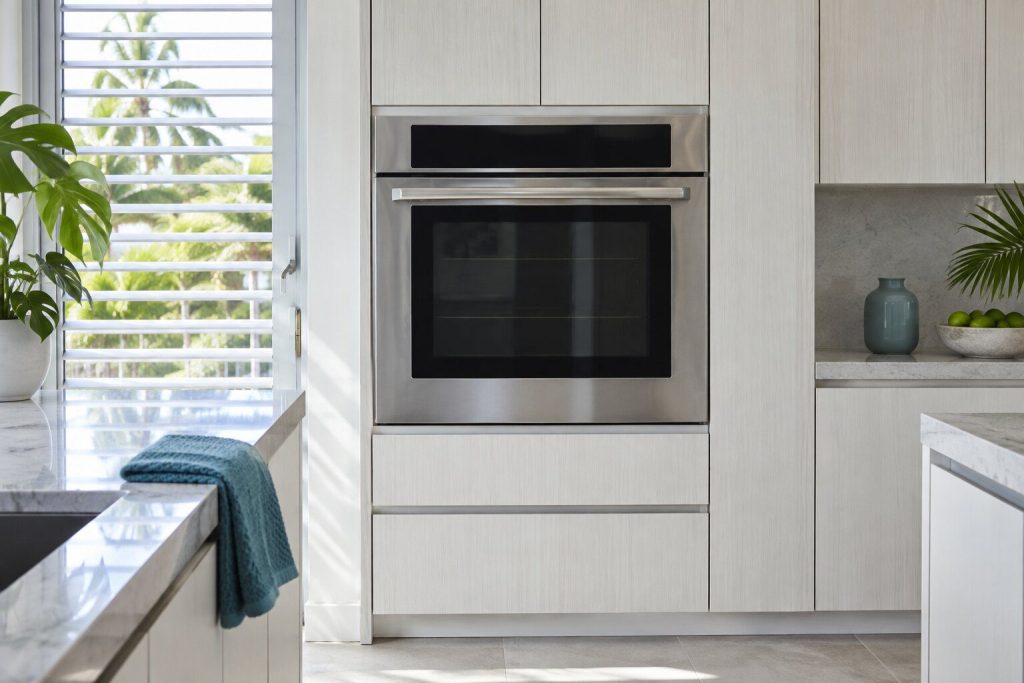
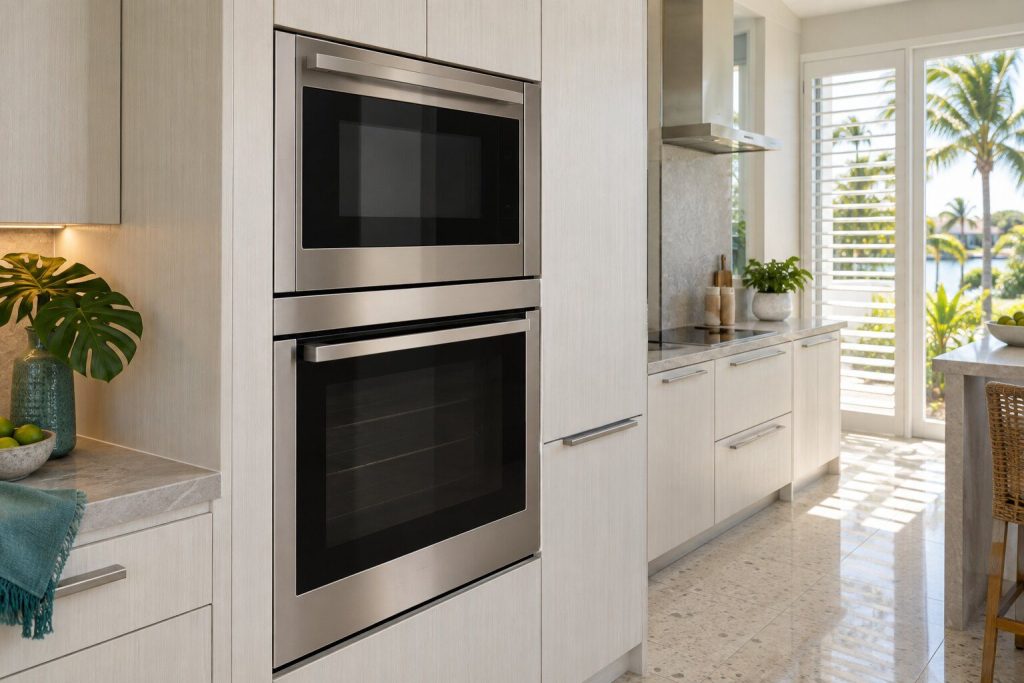
  • A built-in wall oven set into a tall pale cabinet run at chest height with its door closed and its stainless frame flush with the joinery.
    Built-in, combi-steam and combi-microwave · serviced here, no longer sold here

    Wall ovens

    Asko does not currently list a single oven on its US site, and this page is about the ones already fitted. They came in through earlier distribution and through kitchens specified around European appliances, and they are good machines in tall cabinet runs across Miami Beach and Coral Gables — multifunction, combi-steam and combi-microwave, with the jog dial and full-touch panels of the Craft and Elements design lines. The thing worth knowing before you call anybody: when one of these fails it puts ErrXX on the display and stops there. Three separate manuals decode that string the same way, which is to say they do not decode it at all — disconnect, reconnect, and if it comes back call a technician. It is a signal, not a code, and no honest page can turn it into one.

    • No US catalog listing today — every oven we open here arrived by another route
    • ErrXX is displayed and never decoded: three manuals say only to call a technician
    • Combi-steam and combi-microwave cavities need the water circuit checked, not just the element
    Oven repair
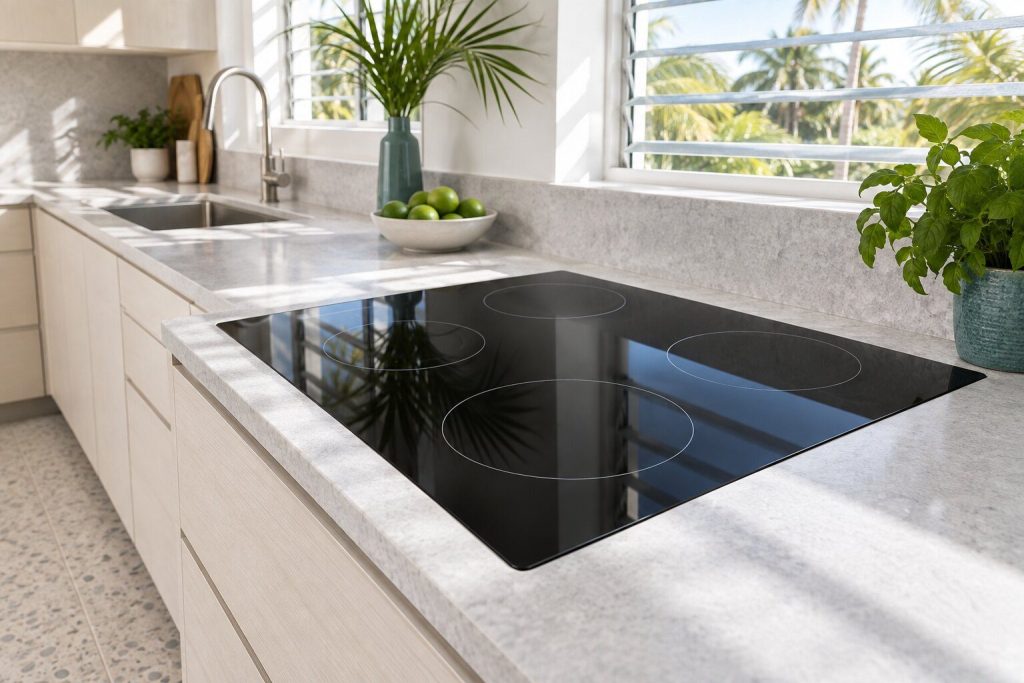
  • A frameless black glass induction cooktop set flush into a light gray stone counter, four zones printed on the surface and nothing standing on it.
    Induction and gas · two code families that do not overlap

    Cooktops

    Asko calls them hobs, which is the first thing to know when you go looking for a manual, and there are none in the current US catalog — the ones here were fitted when there were. Induction is the majority, and the codes split cleanly into two families that share no numbers: the HI1655M generation prints F-codes, F00 and F0 through F9 with FA, FC and F99 among them, and the HI1621G generation prints E and Er strings instead, up to Er47 and U400. The two are not versions of one table, and a meaning taken from the wrong family is a wrong part. Gas hobs on this make publish no codes at all, which makes them the simpler call and not the lesser one.

    • Induction hobs in two code families — F-series and E/Er-series, no overlap
    • Gas hobs publish no codes: diagnosis is by flame, ignition and gas train
    • Glass, trim and the cut in the stone decide the access before any part is named
    Cooktop repair
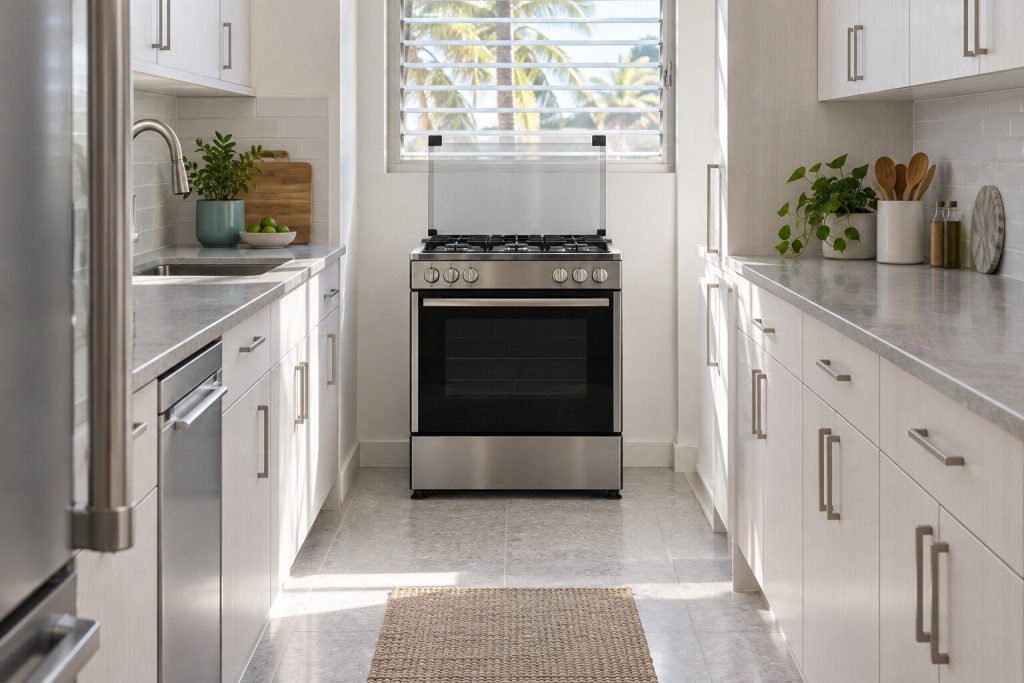
  • A freestanding range in a white galley kitchen with a glass lid folded up behind the cooking surface and the oven door closed.
    Never sold in the US · Scandinavian imports we service here

    Ranges

    Asko has never sold a freestanding range in the United States, and this page exists because we are asked to work on them anyway. The Scandinavian CC-series cookers turn up in South Florida in two ways — brought by somebody who moved, or specified into a kitchen by a designer who knew the line — and once here they need the same servicing as anything else. There is no error table on them at all — the CC96264W manual is organized as symptom, cause and remedy, and carries no codes of any kind. That makes the diagnosis conventional and the parts question the real one, because everything on these comes from Europe.

    • Not a US product — every one we see arrived by import or by relocation
    • No error codes at all: the manuals are symptom, cause and remedy
    • Parts are European-channel, so the wait is part of the answer we give at the diagnostic
    Range repair
  • A tall integrated refrigerator column faced with a pale oak cabinet panel so it reads as joinery, standing in a fitted run with the door closed, the thin shadow gap the only sign of it.
    One US SKU today · integrated columns and the wine cabinet

    Refrigerators

    The whole US refrigeration catalog for this make is one product — the WCN311942G wine climate cabinet — and that fact is the page. Everything else we open is an integrated cabinet from an earlier catalog, fitted flush behind a panel in a kitchen designed around it, and it will be there long after the badge stopped being sold in this country. None of them publish codes: the RFN-series manuals are symptom, cause and remedy tables and nothing more, which was checked in the manuals rather than assumed from a silent display. So it is diagnosed the way refrigeration always was, and one built-in question comes ahead of the sealed system: whether the cabinet can still breathe inside the joinery that was drawn around it.

    • One current US model: the WCN311942G wine climate cabinet
    • No error codes on any of them — verified in the RFN-series manuals, not inferred
    • Integrated behind a panel: how much air the fitter left around the box is itself part of the diagnosis
    Refrigerator repair
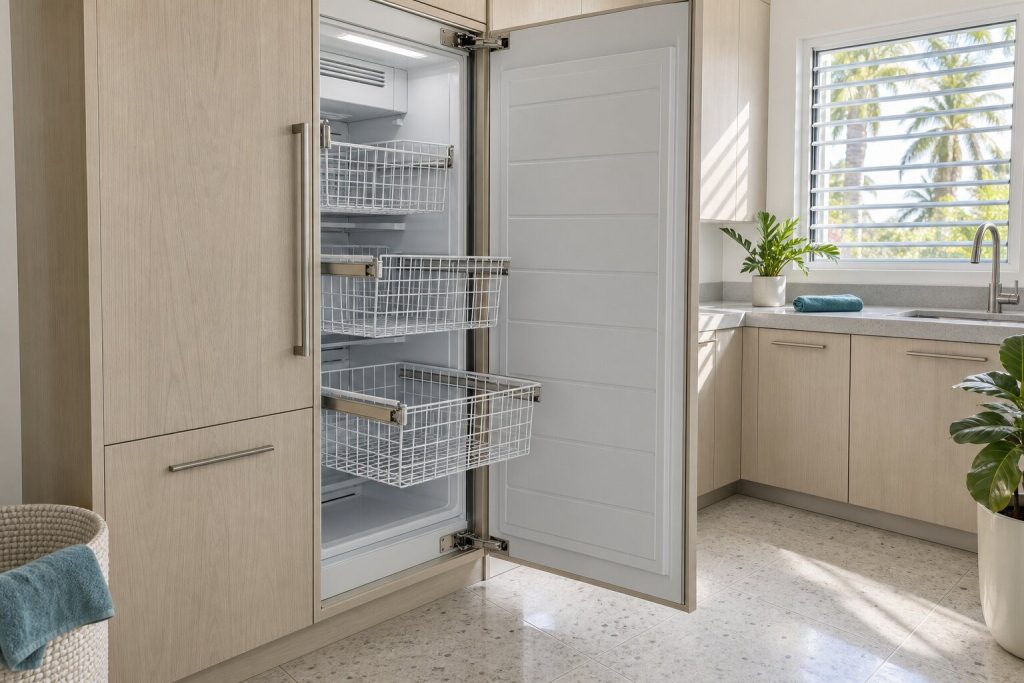
  • An integrated freezer column standing open in a utility run with three wire baskets drawn out on their runners, no frost anywhere on the liner.
    Integrated columns and combined cabinets · no code table anywhere

    Freezers

    Integrated freezer columns and the freezer half of combined cabinets, and like the refrigeration they publish nothing: the FN31842I manual is a problem, cause and solution table with no error numbers in it at all. In this county a freezer fails in a way that is easy to misread, because the room it stands in is doing half the work against it. A garage or an unconditioned utility room in August is a harder environment than the machine was specified for, and a cabinet that is coping in February will start to lose its battle in the summer without anything inside it having broken. Telling those two apart is most of the job, and it is a reading rather than a part.

    • No published codes — checked in the manual, not concluded from a blank display
    • Frost pattern is the diagnosis: where it forms says which of four things it is
    • A garage installation in summer is a different machine from the same one indoors
    Freezer repair
  • A built-in combination microwave oven set into a tall pale cabinet run above a wall oven, its door closed and the cavity dark behind the glass.
    Built-in combination cavities · ERROR XX, undecoded in four manuals

    Microwaves

    This badge has never meaningfully sold a countertop microwave in the United States. What there is, and what we are called to, is the built-in combination cavity — microwave and convection in one oven, the OCM and OM lines, fitted into a tall run beside a full oven. It fails the same way the ovens do and it reports the same way: ERROR followed by two digits, which four separate manuals print without ever saying what the digits mean. That is a signal and we publish it as one. The part of this machine that actually fails often is more mundane — the door interlocks, which are safety switches, and which stop the cavity dead the moment one of the three disagrees with the others.

    • Built-in combination cavities only — no US countertop model on this badge
    • ERROR XX is undecoded in the OM, OT, OP and OCM manuals alike
    • Three door interlocks in series: one out of agreement stops the machine
    Microwave repair
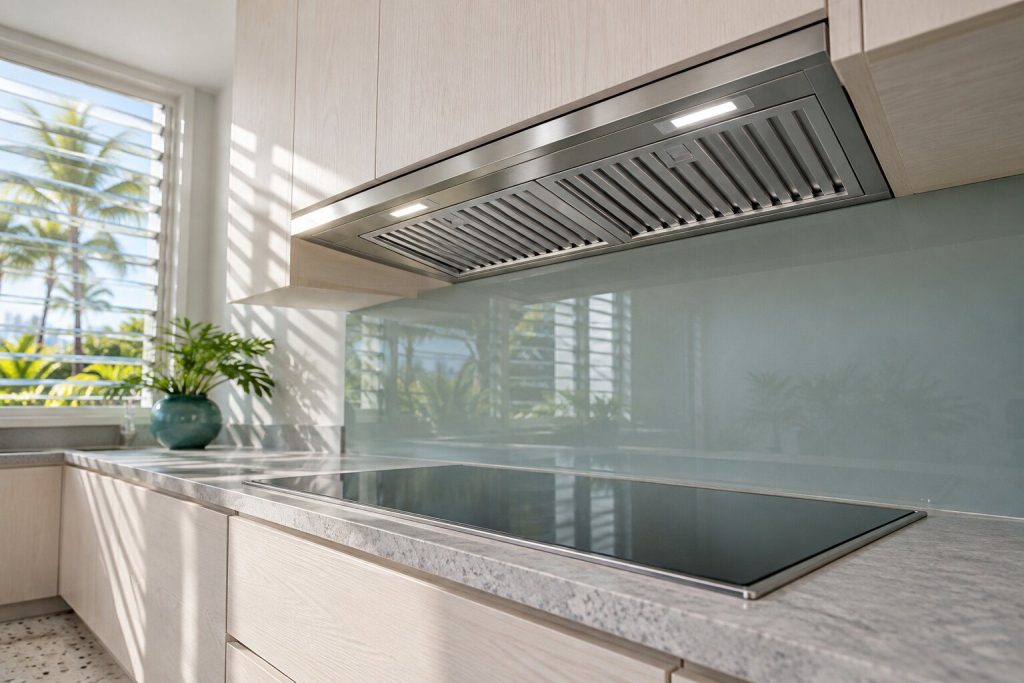
  • A concealed hood liner fitted into the underside of a wall cabinet above an empty cooking surface, its slim stainless front edge and two baffle filters visible from below.
    Concealed liners · manuals with no troubleshooting section at all

    Range hoods

    Concealed liners for the most part, built to disappear into the cabinet above the hob so that only a strip of steel and a slide-out shows. They are the quietest page on this site to write because there is genuinely little to report: the CG1, CO4927S and CBB901SB manuals have no troubleshooting section whatsoever — not a thin one, not a symptom table, none. So everything here comes from what actually fails, which on a hood is four things: the motor, the switch or touch strip, the lamps, and the duct run somebody else installed. In this climate the fifth is the damper, which sticks with salt and stops the hood extracting long before anybody notices it has.

    • No troubleshooting section exists in the manuals — three checked, all silent
    • Four things fail: motor, switch, lamps and the duct somebody else installed
    • Salt-stuck backdraft dampers are the local trouble nobody looks for
    Range hood repair
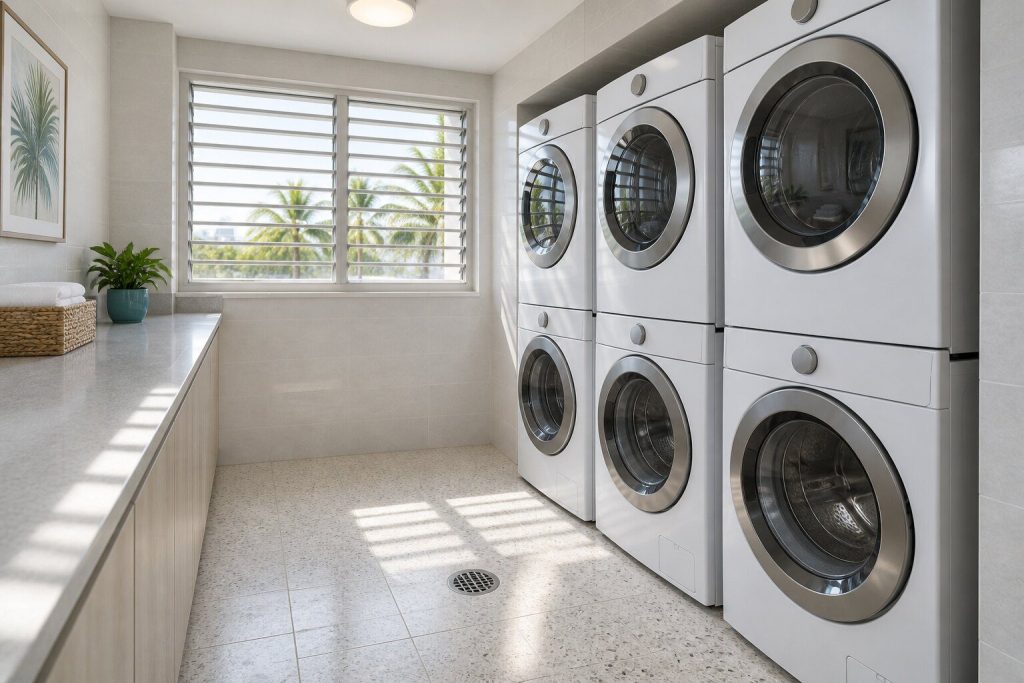
  • A condominium laundry room with three stacked washer and dryer pairs along a tiled wall, a folding counter opposite and a floor drain in the middle of the floor.
    Domestic machines under building duty · the honest version of a commercial page

    Commercial installations

    This is not a commercial catalog page, because there is no US commercial catalog on this badge to write one from. It is about a real situation instead: domestic Asko laundry doing commercial-scale work. A stacked pair in a condominium amenity room, a boutique hotel's housekeeping closet, a salon washing towels twice a day — machines specified for a household and asked to run twenty cycles a week. They tolerate it better than most, which is exactly why they end up doing it, and the failure pattern that follows is its own thing: wear parts arrive years early and everything else arrives on schedule. A maintenance interval that suits a family is the wrong interval for a building, and getting that number right is most of what we do here.

    • Domestic machines in building duty — said plainly, because there is no US pro line
    • Wear parts arrive early: seals, bearings, pumps, hoses and shock absorbers
    • The right service interval is set by cycles per week, not by the calendar
    Commercial appliance repair

Worth saying

Several of these end with us telling you not to book

A dishwasher door that swings open at the end of a program is the drying system doing its job. An induction zone cutting out after a few minutes is usually a hob defending itself against a cabinet that has closed off its air. A washer that redistributes a load ten times and then finishes without spinning is behaving exactly as the manual describes.

Every one of those has a page here that says so, because a visit for something that is not a problem helps nobody.

Before you book

The questions this page is asked

Do you work on Asko machines that are no longer sold here?

Yes, and it is a good deal of what we open. Ovens, hobs, hoods, ranges and refrigeration all reached South Florida through earlier distribution or by import. The mechanics are ordinary; the parts travel from a European channel, and we state that timing at the diagnostic rather than after.

Why is access quoted separately?

Because on an integrated machine it is honestly the longer half of the visit. A custom door, its handle, the toe kick and sometimes a scribe come off before the appliance can move at all. Burying that in an hourly rate would make every estimate on this site wrong.

Do you take on buildings as well as apartments?

Yes, and it is quoted as planned work rather than as a call-out. An amenity room reaches a year of domestic wear in about six weeks, so the interval is set from a cycle count off the machine and the record is written for somebody who is not a resident.

In more detail

How this list was decided, and what is not on it

Weighted like the catalog, not like a template

51 jobs, and they lean the way this maker’s US range leans: laundry and dishwashers carry the list, and the kitchen machines take the jobs they genuinely produce. There is no commercial catalog on this badge either, so the two building jobs here are about domestic machines under commercial duty — which is what they actually are.

What a starting figure is

Every number on these pages is a from. The diagnostic is from $95, credited toward the repair, and no final price is published anywhere on this site — the cost is measured at your appliance and agreed in writing before anything is opened.

Not sure which of these it is?

Tell us what the machine is doing and the model code off its door edge, and we will say which page you are on. Where a diagnostic is the right next step it is from $95, credited toward the repair.

This article is based on:

  • Official manufacturer documentation
  • Internal repair procedures
  • Technician repair history
  • Company quality standards
Call (305) 363-1406