Troubleshooting
Asko Dishwasher Error Codes: Three Generations, Three Different Answers
Asko dishwasher error codes belong to three separate schemes and the same digits mean different things in each. The legacy DW20.1 boards do not print anything — they blink the code through the program lights, F1 to F9 plus FA and FB. The current display generation prints F10 through F68 on a full-text panel. The Outdoor door uses a third scheme written with a colon, F:10 upward, and its meanings directly clash with the current generation: F:10 is a temperature stop where F10 is an overfill, F:11 is a leaking inlet valve where F11 is a drainage problem. So the model code from the door edge decides what any number means, and looking a code up without it is guesswork. Every code page on this site names its platform for exactly this reason.
The full guide
Three Asko dishwasher generations are in South Florida kitchens and they number their errors independently. That is not untidiness in the documentation — it is what the manuals actually say, and reading one against another is how the wrong part gets ordered.
Start with the door edge, not the screen
Open the door and look along its edge for the model sticker. You are after something like DFI565XXL, DBI786IXXLSSOF or DOD561TXXLS. Photograph it. On this make that string is worth more than the number on the display, because it decides which of three tables the number belongs to.
Generation one: the machine that blinks
The DW20.1 platform, sold as the 3000-series, has no display worth the name. Its errors are blink patterns across the program lights, and the F-labels — F1 through F9, then FA and FB — are a service-menu readout rather than something the machine shows you. If your machine is signaling by flashing lights in a pattern, you are here, and no F-number on the front panel exists to look up.
What the patterns mean runs from a heating stage that gave up, through overfilling and a thermistor problem, to a blocked filter and a circulation problem. Two of those are cleared by lifting the filter stack out and rinsing it.
Generation two: the display machines
The current line prints F10 upward on a full-text panel: F10 and F54 for overfilling, F11 and F68 for getting water out, F12 and F67 for getting it in, F40 for an inlet valve that leaks while off, F41 for heating, F45 for the diverter, F52 for water level with its own instruction to clean the filters, and F56 for the circulation pump.
Note what is missing. F13 to F39, F42 to F44, F46 to F51 and most of the fifties and sixties appear in no consumer manual anywhere. They are almost certainly defined only in Asko's internal service documentation. Anything online that decodes them confidently is not reading a manual.
Generation three: the Outdoor door
Built for a terrace and therefore common on this coast, the DOD Outdoor machine uses a colon format and its own service scheme. It is not a variation of the indoor list. Its numbers collide with the display generation and mean other things:
- F:10 — temperature stop, where F10 indoors is an overfill
- F:11 — inlet valve leakage, where F11 indoors is drainage
- F:12 — overfilling, where F12 indoors is a failure to fill
- F:41 — the door is open, where F41 indoors is heating
Four collisions in the first five numbers. That is why the terrace machine gets its own pages here.
What to do with the number once you have it
Write down the model code and the exact characters, including whether there is a colon. Then do the free checks that apply to almost every one of these: lift the filter stack out and rinse it, check the service valve under the sink is fully open, and look at whether the drain hose is crushed behind the cabinet. A good share of the codes above are cleared by one of those three.
If it turns out to be a repair
What this leads to, and what it costs
Every job on this site is priced the same way: an on-site diagnostic first, the figure agreed in writing before anybody starts.
-
Platform identification
The job this make needs and no other make on our list does. Three dishwasher generations, five washer code families, dryer schemes that change with the control board and two induction families that share no numbers — and from the front of the kitchen they are indistinguishable. This is the visit that settles which machine is actually in the run, records it, and gives you a code table that applies to your appliance instead of to the badge in general. For anyone who intends to keep the machine another decade it is the cheapest useful thing we sell.
- Which generation, which board, which code table — established and written down
- Turns every future number on the display into something readable
- Credited in full against a repair if it is booked in the same visit
-
Dishwasher drain and pump repair
A pool left in the sump when the program ends — which this make announces in three unrelated ways, depending on the generation. The current display machines print it as a printed code; the legacy boards blink it through the program lights; the Outdoor door prints its own string that belongs to neither table. Underneath all three the machine is the same: a filter stack, a drain pump, a hose and an air gap, and the water has stopped at one of them.
- Filter stack first — it is free, and it ends this call more often than a pump does
- Drain hose and the air gap at the sink, which are somebody else's install
- The pump proved on a meter before it is replaced, not diagnosed by elimination
-
Dishwasher error code F10
Asko dishwasher error code F10: The machine has taken on more water than it wanted and has stopped rather than carry on. Which machines can raise it, what the maker publishes about it, and what to do next.
What this one means -
Dishwasher error code F:10
Asko dishwasher error code F:10: This is the DW Outdoor scheme, written with a colon, and it is not the indoor list. Which machines can raise it, what the maker publishes about it, and what to do next.
What this one means

Questions people ask about this
My machine shows F10. What is it?
On the current display generation, an overfill: more water in the machine than the program asked for, and it has stopped rather than carry on. On an Outdoor door the same digits appear as F:10 and mean a temperature stop instead. On a legacy machine there is no F10 at all — those boards run F1 to F9 and then to letters, and they blink rather than print. Which of the three you have is the first question, not the last.
Why does a search give me contradictory answers?
Because the pages doing the answering merged the three schemes into one list. It is an easy mistake to make from the outside: all three are twenty-four inches wide, all three sit behind a cabinet panel, and all three print F-numbers. The manuals keep them apart and so does this site.
Where is the model code?
On the edge of the door, visible when the door is open, usually on a sticker along the top or the hinge side. On an integrated machine you may need to open it fully. It is worth photographing once and keeping.
Troubleshooting
More guides like this one
-
Asko Washer Error Codes: Five Families, and How to Tell Which Is Yours
F10, E7, L3, F3 and a machine that prints whole sentences — five separate code families run across Asko washers, and two models of the same generation give the same L-number opposite meanings.
Read more -
An Asko Oven Showing Err and Two Digits: What the Manuals Actually Say
Six Asko oven manuals across several generations print an undecoded ErrXX and the same instruction: disconnect, reconnect, call a technician. There is no published table, and the decoded lists online do not come from Asko.
Read more -
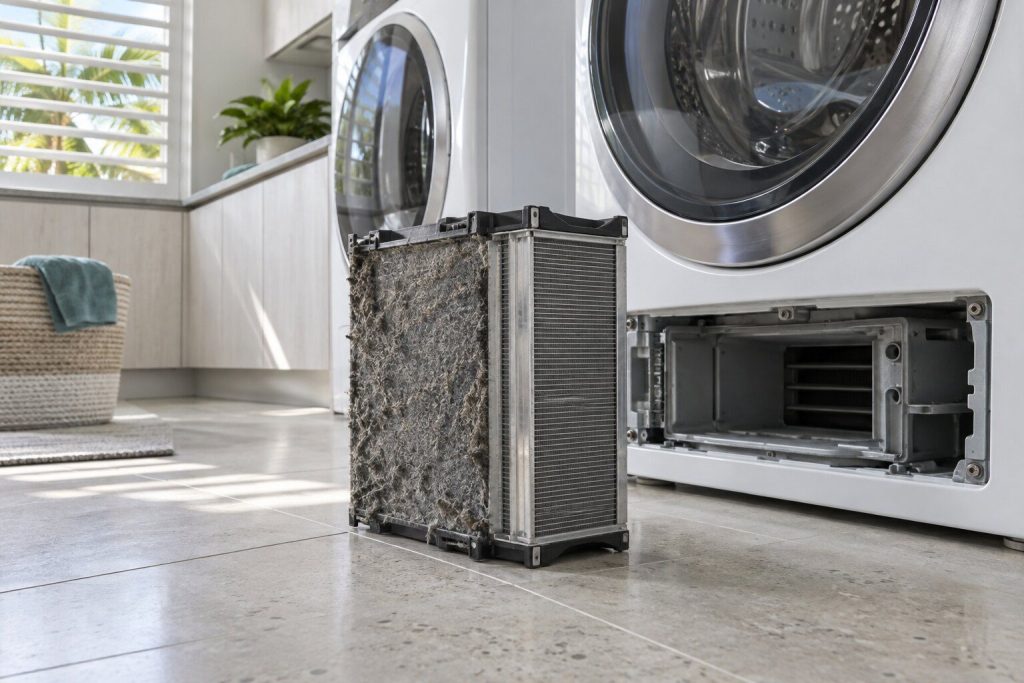
An Asko Dryer That Will Not Dry: Three Filters, In Order
Nothing is vented outside on these machines, so drying depends on three filters and a condenser staying clear. In a Miami laundry closet they load far faster than the manual assumes.
Read more
Tell us the model number and what it is doing.
This article is based on:
- Official manufacturer documentation
- Internal repair procedures
- Technician repair history
- Company quality standards