Troubleshooting
An Asko Dishwasher That Will Not Drain: Ten Minutes Before You Call
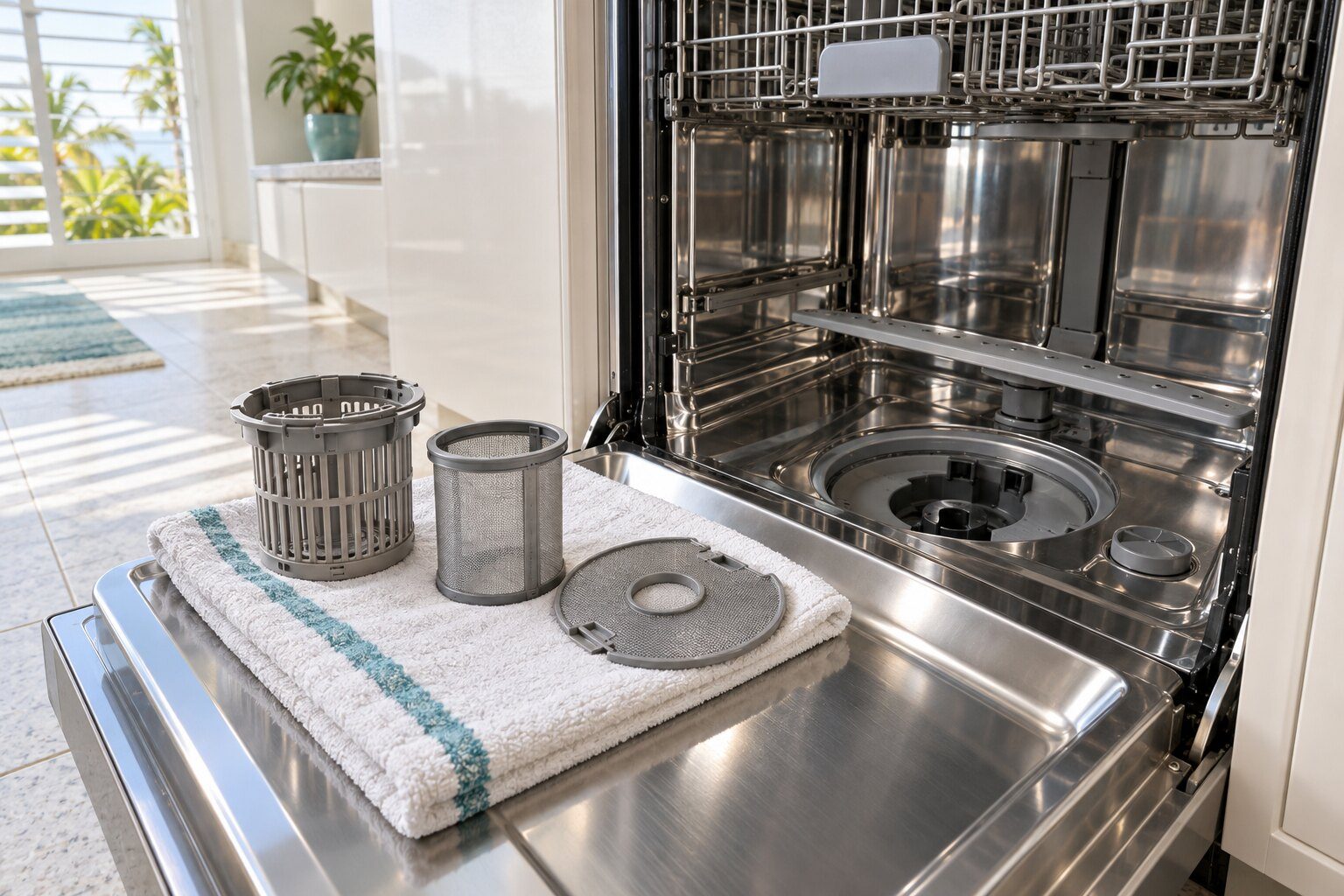
An Asko dishwasher that will not drain is reporting one short path — sump, filter stack, pump, hose, and whatever the kitchen fitter connected at the sink. Two of those five are free to check and they end this call more often than a part does. Lift the entire filter stack out, coarse filter, fine filter and the plate beneath, rinse everything and seat it until it locks; a stack put back a quarter-turn short is the reason for the next call. Then check whether the sink itself drains normally, because an air gap silted up or a disposal branch never punched out will empty a dishwasher slowly for a year before it stops. The code differs by generation: F11 or F68 on the display machines, a blink pattern on the legacy boards, F:45 on the Outdoor door.
The full guide
Standing water in the bottom of the machine at the end of a program. It is the most common dishwasher call we take, and on this make it is also the one where the free checks pay off most often.
Get the water out first
Sponge or scoop the standing water out before anything else. It makes the filter reachable, it stops a quart of gray water coming out with the stack, and it prevents the smell that follows a day of standing water in a warm kitchen.
Lift the whole filter stack
Pull the lower basket out. Set into the tub floor is a cylinder that unlocks with a quarter turn and comes away; under or alongside it sits a flat plate. Neither needs a tool.
This is the step people half-do. Rinsing the cylinder under a tap and putting it back leaves the plate underneath exactly as it was, and the plate is where the load actually sits. Take both out, rinse both, feel into the well underneath for glass, a cherry stone or a peeled-off label.
Now refit the stack and rotate it home until it seats. A stack seated a quarter-turn short causes its own leak later, and a good share of the leaks we are called to began with somebody clearing a filter correctly and reassembling it hastily.
Check whether the machine is even to blame
Run the kitchen tap and watch the sink. If the sink drains slowly, the dishwasher is innocent and the problem is in the waste it shares. Two specific things account for most of that:
- An air gap at the sink that has silted up.
- A knockout plug in the disposer, left in place at installation. Machines fitted that way have never drained properly and nobody connected the two.
Then look behind the machine as far as you can see, for a drain hose crushed when the appliance was last pushed back.
What the code tells you, and what it does not
On the current display machines, F11 means the water did not get out and F68 means the control has read a problem in the drain pump itself. On the legacy DW20.1 boards the same condition is a blink pattern rather than a number. On the Outdoor door it is F:45, which on an indoor machine would be the diverter — a different part entirely.
So the code narrows things once you know which machine you have, and misleads if you do not.
When it is ours
Filter clear, sink draining, hose straight, and the water still standing. Now the pump, or the route inside the machine, is what remains — and it gets a meter on it rather than a replacement on a hunch, because an impeller fighting a jam sounds exactly like a pump that has died.
If it turns out to be a repair
What this leads to, and what it costs
Every job on this site is priced the same way: an on-site diagnostic first, the figure agreed in writing before anybody starts.
-
Dishwasher drain and pump repair
A pool left in the sump when the program ends — which this make announces in three unrelated ways, depending on the generation. The current display machines print it as a printed code; the legacy boards blink it through the program lights; the Outdoor door prints its own string that belongs to neither table. Underneath all three the machine is the same: a filter stack, a drain pump, a hose and an air gap, and the water has stopped at one of them.
- Filter stack first — it is free, and it ends this call more often than a pump does
- Drain hose and the air gap at the sink, which are somebody else's install
- The pump proved on a meter before it is replaced, not diagnosed by elimination
-
Dishwasher not draining
The program finishes and there is a pool in the sump. On this make the machine will tell you so in one of three unrelated ways depending on which generation is behind the panel — a printed number on the current display machines, a blink pattern on the legacy boards, and a colon-format string on the Outdoor door whose digits mean something else again. Underneath all three the machine is identical: a filter stack, a drain pump, a hose and whatever the sink end was connected to. Two of those four are free to check and they end this complaint more often than any part does.
- The filter stack lifts out by hand, costs nothing, and usually ends this
- Three code schemes describe this behavior; the model decides which one you are reading
- If the sink drains slowly too, the appliance is innocent
-
Dishwasher error code F11
Asko dishwasher error code F11: Everything between the sump and the wall is a candidate, and it is worth working from the cheap end because the cheap end is usually right. Which machines can raise it, what the maker publishes about it, and what to do next.
What this one means

Questions people ask about this
It drains on short programs and not on long ones.
That is a partial blockage rather than a dead pump — a short program moves less water and gets away with it. Say so when you call, because it points at the filter and the hose rather than at the pump and it changes what goes on the van.
Do I need tools?
No. The filter stack comes out by hand: the cylindrical filter twists a quarter turn and lifts, and the flat plate beneath it lifts straight out. Everything else in the free checks is looking rather than dismantling.
Why does the machine refuse to start again?
Some programs will not begin with water standing in the sump, which is the machine protecting the floor rather than a second problem. Clearing the water and the filter usually lets it run.
Troubleshooting
More guides like this one
-
Asko Washer Error Codes: Five Families, and How to Tell Which Is Yours
F10, E7, L3, F3 and a machine that prints whole sentences — five separate code families run across Asko washers, and two models of the same generation give the same L-number opposite meanings.
Read more -
An Asko Oven Showing Err and Two Digits: What the Manuals Actually Say
Six Asko oven manuals across several generations print an undecoded ErrXX and the same instruction: disconnect, reconnect, call a technician. There is no published table, and the decoded lists online do not come from Asko.
Read more -
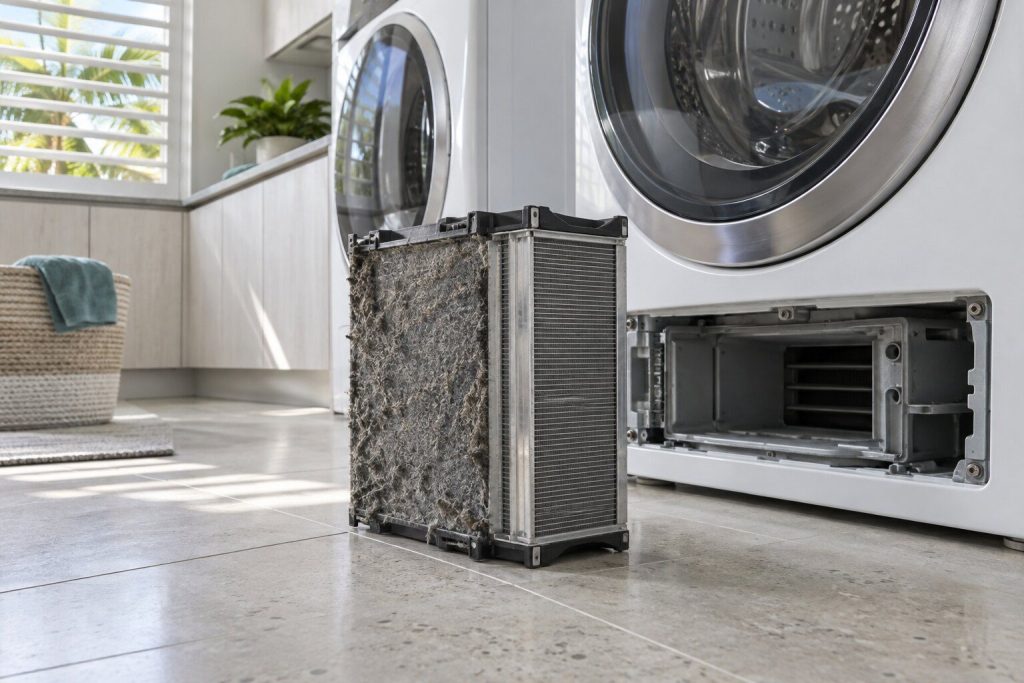
An Asko Dryer That Will Not Dry: Three Filters, In Order
Nothing is vented outside on these machines, so drying depends on three filters and a condenser staying clear. In a Miami laundry closet they load far faster than the manual assumes.
Read more
Tell us the model number and what it is doing.
This article is based on:
- Official manufacturer documentation
- Internal repair procedures
- Technician repair history
- Company quality standards