Model
W5XLT repair
Asko W5XLT repair in Miami: what owners of this 5-series unit search for, what those symptoms usually point at, and what the work involves. Diagnostic from $95, credited toward the repair.
- From $95 diagnostic, credited to the repair
- 59 cities and neighborhoods covered
- OEM parts available on order
- In writing the price, before anything is opened
The short version
What the number tells us
The full model number decides which parts exist, how quickly they arrive and what a repair on this unit is worth. It is the first thing we ask for.
Model
W5XLT
Give us this number when you book and the technician arrives knowing what the unit is and which parts it takes.
or call (305) 363-1406
Parts
OEM on order; legacy parts take longer
Diagnostic
From $95, credited to the repair
What we can tell you
What this number means for a repair
Not a specification table. Capacity, dimensions and production years are not something we can verify, and a plausible-looking table of them would be invention rather than information.
-
The full number is the first thing we ask for
It decides what the display can tell you and how easily parts are found, and the data plate settles it in one line. Letters after the digits are not decoration — they identify the configuration, and two units sharing the digits can take different components.
-
What we ask you to read off the unit
The data plate, not the box or the invoice. On this equipment it sits inside the cabinet — along a side wall, behind the lowest drawer, or under the lid of a wine cabinet — and it carries the full number and the service index together. A photograph of it is worth more than any table we could publish.
What owners of this model ask about
The symptoms searched most often with the W5XLT
Taken from real search suggestions rather than from a list we made up. Each page says what the symptom usually points at and what to check first.
-
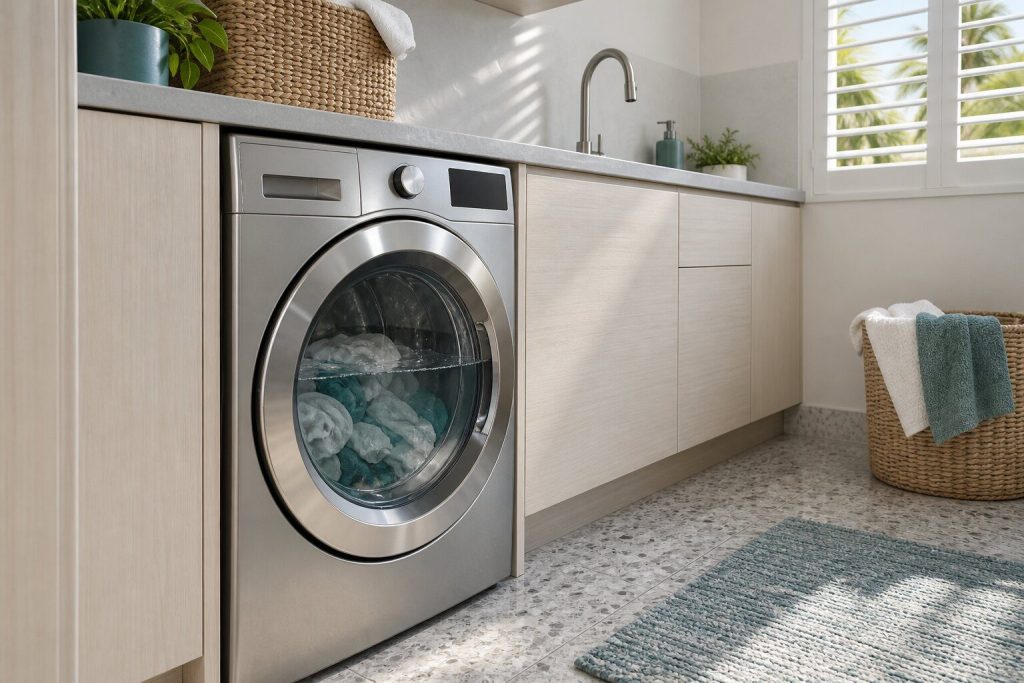
The drum is full of water at the end of the program Washer not draining
A cycle that has finished with the water still in it, and a machine that then refuses to spin — that refusal is deliberate rather than a second failure, because spinning a full drum would put the water on the floor. How the machine says so depends entirely on the panel: the display models print a number, the numbered-LED models a short code from an unrelated family, the analog ones a letter and a light, and the premium panels write out a sentence. Behind every one of them is the same short path from sump to standpipe, and the cheap end of it ends most of these.
- The pump filter is behind the lower panel and it is free to check
- Empty the drum through the drain hose BEFORE opening the filter cap
- Five different code families describe this — the model decides which one you have
-
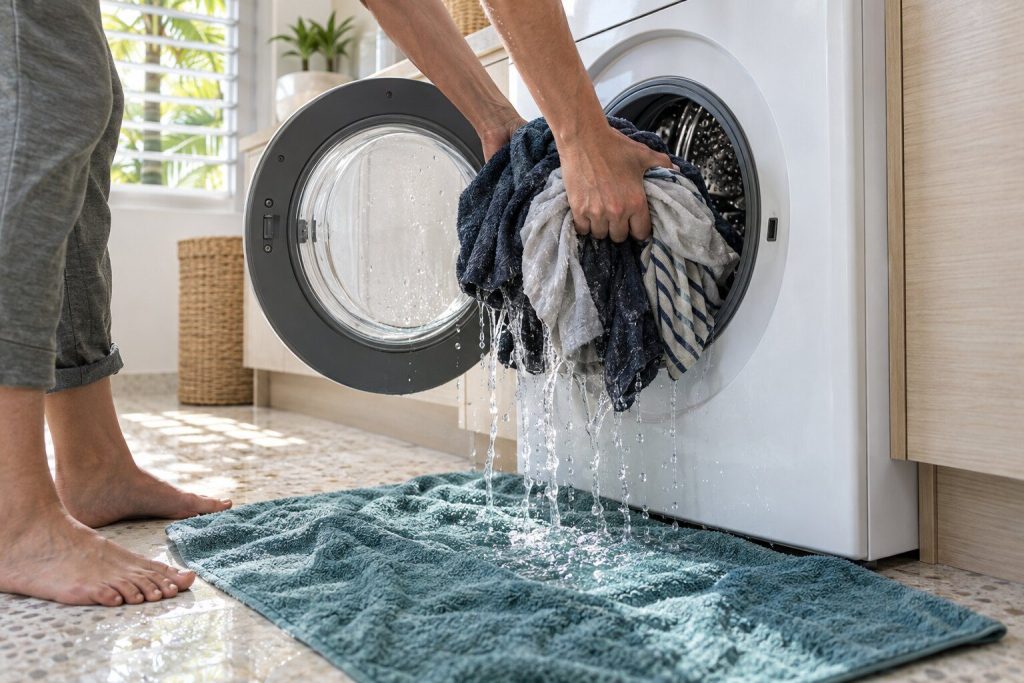
The load comes out soaked after a cycle that seemed to finish Washer not spinning
Clothes heavy with water at the end of a program that otherwise ran normally. Three free things account for most of these and all three can be settled before anybody is called: the machine has not drained, the load will not balance, or the program chosen has no spin in it. What is left after those is genuinely mechanical — the door lock the machine will not spin without, the motor and its control, or the shock absorbers that have worn far enough that the drum moves more than the balance check will allow.
- Run a spin-only program on an empty drum — it separates three causes in five minutes
- A machine holding water will never spin, by design
- Persistent imbalance on ordinary loads is worn suspension, not laundry
-
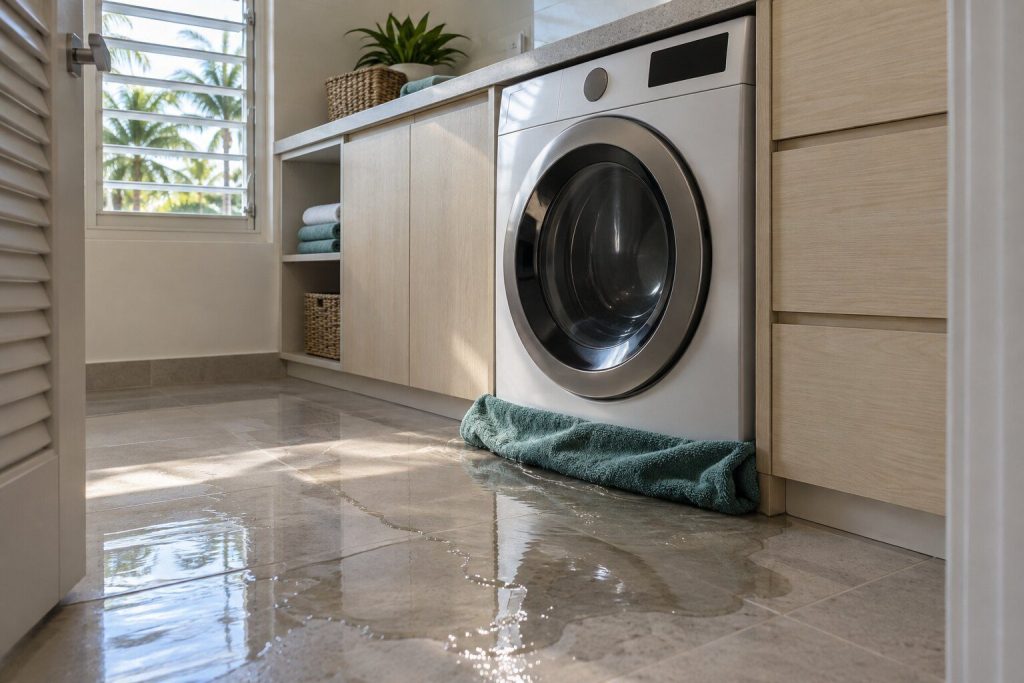
Water on the laundry floor and no obvious source Washer leaking
Water appearing under or beside the machine, and by the time it shows on the tile it has usually traveled along the frame from somewhere else. Three places account for nearly all of it: the door seal, where grit collects in the bottom fold and cuts the rubber from the inside over months; the pump filter cap, very often after somebody cleared a blockage and did not seat it; and the hose unions at the wall. In a condominium this matters further than the machine does, because water in a laundry closet reaches a floor slab and then somebody else's ceiling.
- Turn the taps off and stop using the machine — a program uses several gallons
- Check the filter cap first if anyone has cleared a blockage recently
- In a building this is a shared problem long before it is an expensive one
-
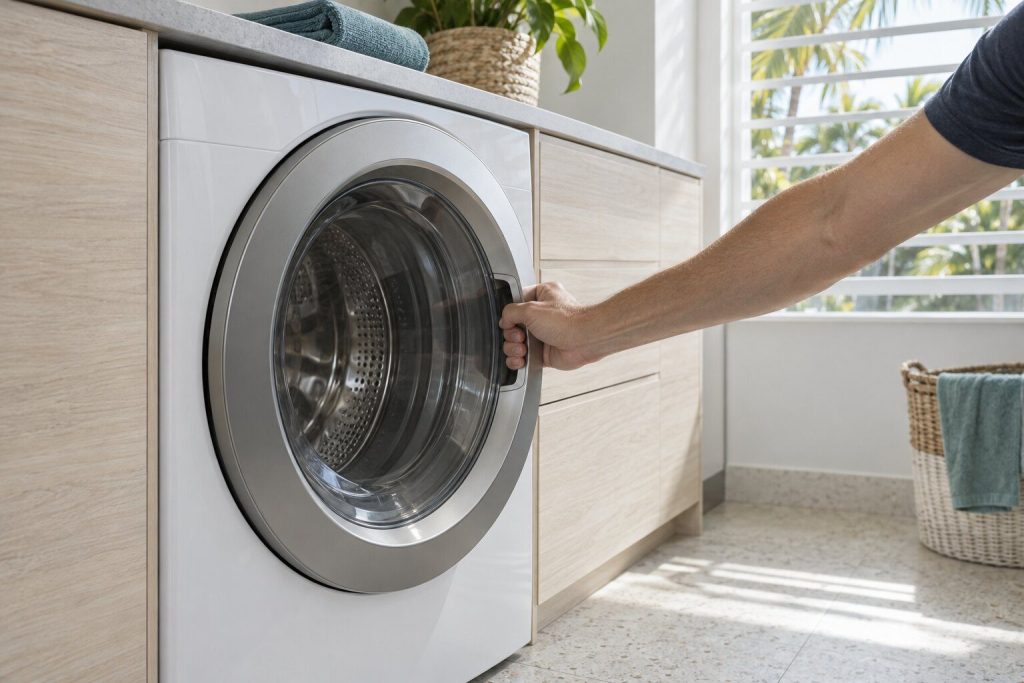
The cycle has ended and the door is still locked Washer door will not open
A finished program and a door that will not release, usually with a drum that still has water in it. Those two facts are connected: the lock stays engaged while there is water inside, which is the machine protecting the room rather than a failure. So the sequence that works is drain first, open second. Where the drum is genuinely empty and the door still will not release, the lock itself has failed — and on this make the premium panels say so in words while the numbered ones give a short code from whichever family that model belongs to.
- Drain the machine before anything else — a locked door with water in it is correct
- Do not force it: the lock is the failed part and forcing adds the handle
- Some models release after a full power-off of several minutes
-
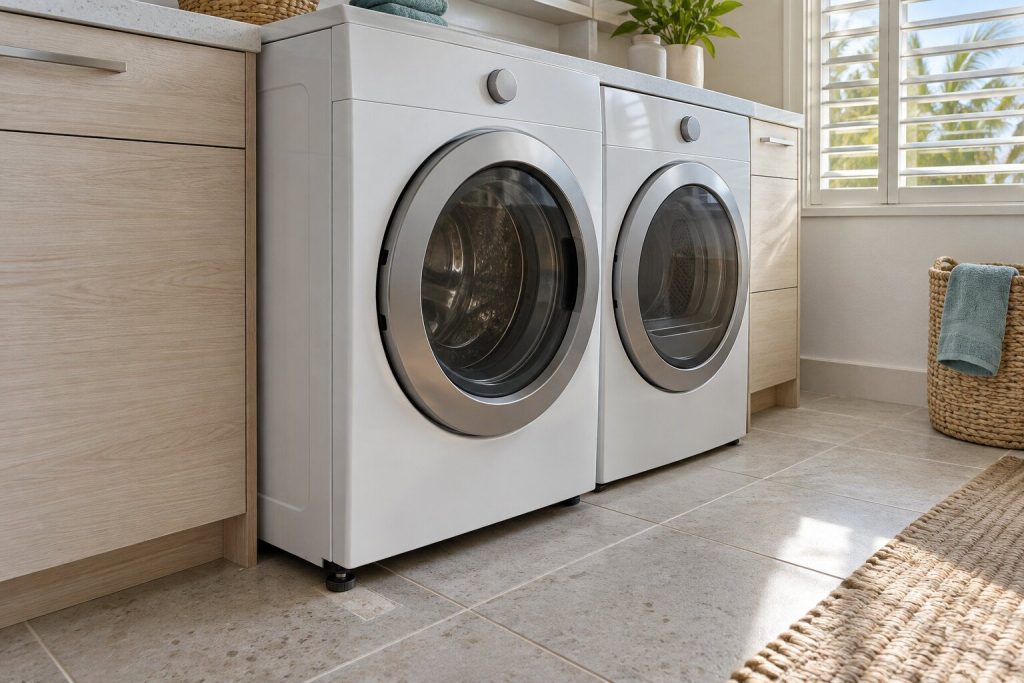
It has become noisy, and it walks Washer loud or moving on spin
A machine that has grown louder over months, or one that moves across the floor when it accelerates. Both are the suspension rather than the motor, and both are worth acting on early for a reason that has nothing to do with the noise: worn damping lets the drum travel further on every spin, and that travel is what eventually takes the drum bearing. A bearing is a day's strip-down. Shock absorbers are an afternoon. The gap between those two prices is the entire argument for calling while it is still only annoying.
- Noise that grew over months is suspension; noise that arrived suddenly is a bearing
- A machine that walks is not level, or its damping has gone — check level first
- Catching this early is what prevents the expensive repair
Also called out to on this equipment
- Dishwasher not draining
- Dishes come out dirty
- Dishwasher leaking
- Dishes come out wet
- Dishwasher will not start
- Dryer not drying
- Dryer takes far longer than it used to
- Dryer runs but there is no heat
- The water container fills constantly
- Dryer will not start
- Oven not heating
- Oven bakes unevenly
- One induction zone dead
- Refrigerator not cooling
- Water or ice under the drawers
- Freezer not freezing
- Range hood not clearing the kitchen
- Hood lamps work but the fan does not
- Combination microwave hums but does not heat
In more detail
About W5XLT repair
What owners of the W5XLT search for
These are the phrases people pair with this model number, taken from real search suggestions rather than from a list we made up. They are a fair map of what tends to go wrong on it — and each one has a page of its own explaining the likely causes.
- asko w5xlt
- asko w5xlt repair
What the display can tell you
The 5-series reports very little through its display, which is why more of the diagnosis on this generation is measured rather than read. If something is showing on yours, photograph it before it clears and look it up in the full error code list — codes do not wait, and the number is often gone by the time a technician arrives.
What we do not publish about it
No specification table: capacity, dimensions, configuration and production years are not something we can verify, and a plausible-looking table of them would be invention rather than information. What we can tell you is what the number means for a repair — which generation it is, what its display can report, and how easily parts are found.
Before you call
- Check the full model number on the data plate — the three digits are the family, and the letters after them matter for parts
- Photograph the display if anything is showing on it
- Look at the condenser through the grille
- Note whether this started after a power cut
This article is based on:
- Official manufacturer documentation
- Internal repair procedures
- Technician repair history
- Company quality standards
Before you book
Questions about W5XLT repair
Is the W5XLT still worth repairing?
Usually. The 5-series was built to be repaired, and a cabinet in good condition with sound cabinetry is worth keeping well past twenty years. Where the work approaches what the unit is worth, or a second major failure is already visible, we say so on the visit rather than after.
Can you still get parts for the W5XLT?
For most of what fails, yes — OEM parts are ordered against your model. Legacy parts can take a few days to source, which is why we confirm a part is the problem before ordering it rather than after.
Where do I find the full model number on a W5XLT?
Inside the door opening or under the lid, on the frame. Photograph the whole plate rather than writing it down — the letters after the digits decide which parts fit, and they are the part people misread most often.
What tends to go wrong on the W5XLT?
Judging by what its owners search for: washer not draining, washer not spinning, washer leaking, washer door locked shut, and washer loud on spin. Each of those has a page explaining the likely causes and what to check before booking anything.
Do you publish specifications for the W5XLT?
No. Capacity, dimensions, configuration and production years are not something we can verify, and a plausible-looking table of them would be invention rather than information. What we can tell you is what the number means for a repair.