AskoRepair Miami

105 codes · 18 platforms

Asko error codes, and why the same digits mean different things.

Three dishwasher schemes, five washer code families, dryer codes that change form with the control board, two induction families sharing no numbers. Every page here names its platform, because a code without one is not an answer.

  • 105 codes from manuals
  • 18 platforms behind them
  • 17 strings meaning different things
  • 16 circulating strings we refuse to publish

Jump to a table

By appliance and platform

Type what the panel shows and the index will find it. If more than one row comes back, that is not a bug — the same string belongs to more than one table on this make, and the model code decides which is yours.

7 kinds of machine on this badge publish no codes at all. If yours is one of them, the symptom pages are the honest place to start.

The finding that shapes this whole site

17 strings mean different things on different machines

F10 is an overfill on a display dishwasher, a temperature stop on the Outdoor door, a full condensate tank on one dryer revision and an overfill again on a washer. Four machines, four tables, one string.

That is why there is no page here answering what F10 means on an Asko. There is no such question — only what F10 means on a particular platform, which is what each page answers.
Start from the behavior
A service manual lying open on a bench mat under a work light, its pages a grid of rows too small to read.

What we will not publish

16 strings that circulate and are not in any manual

A decoded oven table runs from ERR1 to ERR15 with F85 at the end, and it matches none of the six oven manuals that were read. The two accessible sites carrying it share their wording closely enough to be one source rather than two.

It is recorded here as refused so that nobody adds it later thinking it was an oversight, and the builder that writes these pages will not accept any string from that list.

Start from the behavior
Five control panels of different generations laid out in a row on a workshop bench, their layouts plainly unalike, nothing readable on any of them.

Before you look anything up

Two things, in this order

First

  • The model code from the door edge, frame or plate.
  • The panel type: display, numbered LEDs, plain lights, or sentences.

Then

  • The exact characters, including a colon if there is one.
  • Whether the machine blinked it or printed it.

Or start from behavior

By what the machine is doing

If nothing is displayed, or the machine does not print codes at all.

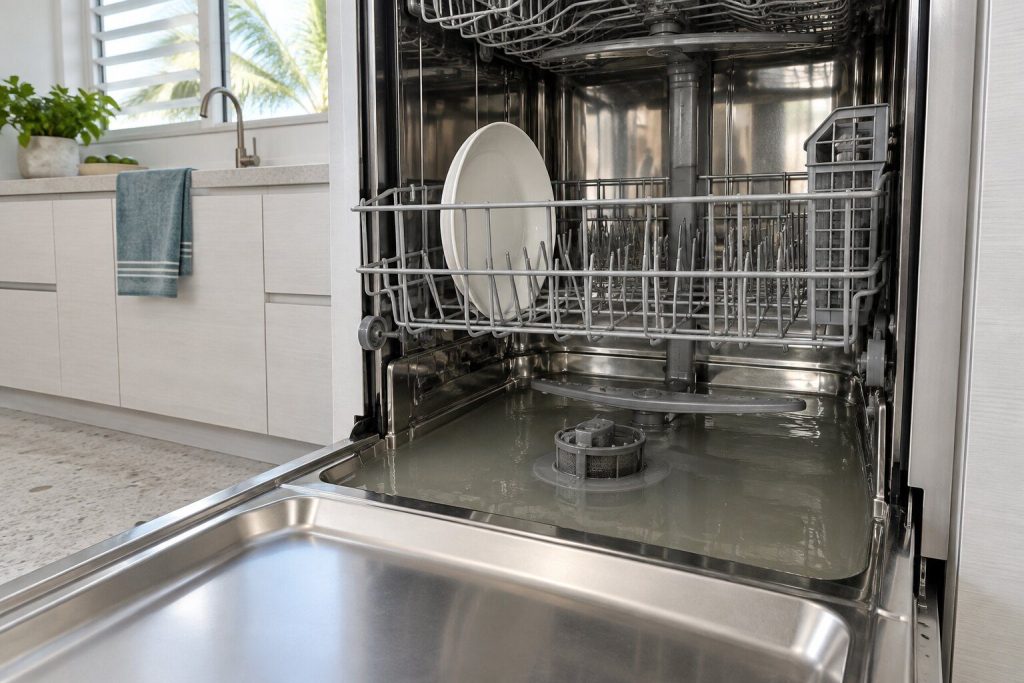
  • An inch of gray water standing over the filter in the floor of an open dishwasher tub at the end of a program, a plate still in the lower basket above it.
    Water standing in the bottom when the program ends

    Dishwasher not draining

    The program finishes and there is a pool in the sump. On this make the machine will tell you so in one of three unrelated ways depending on which generation is behind the panel — a printed number on the current display machines, a blink pattern on the legacy boards, and a colon-format string on the Outdoor door whose digits mean something else again. Underneath all three the machine is identical: a filter stack, a drain pump, a hose and whatever the sink end was connected to. Two of those four are free to check and they end this complaint more often than any part does.

    • The filter stack lifts out by hand, costs nothing, and usually ends this
    • Three code schemes describe this behavior; the model decides which one you are reading
    • If the sink drains slowly too, the appliance is innocent
    What it usually means
  • Two plates lifted out of a finished dishwasher and held up in the light, both dulled with a fine gritty film, the open machine out of focus behind.
    Everything runs, nothing errors, the dishes are gritty

    Dishes come out dirty

    The machine completes its program without complaint and the load is worse than when it went in. There is no code for this on any of the three generations, which people find unsettling and which is actually the useful fact: nothing has failed. Four ordinary things decide whether a dishwasher cleans on this water, and all four drift slowly enough that nobody notices until the difference is obvious — spray jets liming shut, a filter rinsed but never lifted, a hardness setting still on the number it left the factory with, and a detergent dose meant for softer water than South Florida has.

    • No code and no failure — this is performance, and it is usually reversible
    • The hardness setting is the one nobody touches, and this water is not soft
    • Both spray arms come off by hand and every jet should pass light
    What it usually means
  • A thin spread of water across pale tile at the foot of a run of oak cabinetry, a folded towel laid along the kickboard and the panel front giving nothing away.
    Water on the floor, and the machine is behind a panel

    Dishwasher leaking

    Water appearing at the toe kick, which on an integrated machine is almost never where the leak started — it tracks along the frame and comes out at the front. That single fact decides how this is handled: the panel comes off and the machine comes forward before anybody says where the water is from, because a good door seal gets replaced every day by somebody guessing from the front. On a legacy machine the base float may raise an overfill message while the tray fills, and that message is the machine protecting your floor rather than a separate problem.

    • An overfill message with a wet base tray is a leak, not a sensor
    • Turn the water off at the sink and stop using the machine
    • Where it shows at the front is not where it started
    What it usually means
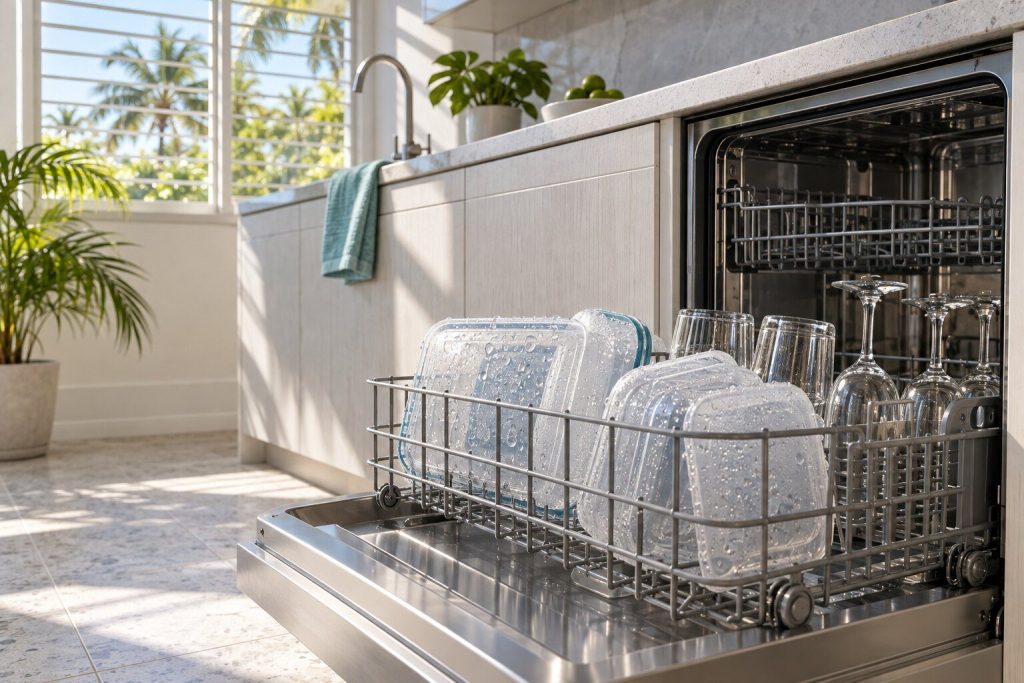
  • An open dishwasher basket of plastic containers beaded all over with water standing beside glassware that has come out dry.
    Everything is clean and nothing is dry

    Dishes come out wet

    A load that washes perfectly and comes out soaked. The useful split happens early and you can make it yourself: if the dishes are also cold, the machine is not heating and this is a heating problem with a part behind it; if they are hot and wet, the machine heated correctly and this is about how the moisture leaves. Those are different repairs at different prices, and on the turbo drying models there is a third possibility again, because those add a fan that can fail on its own.

    • Warm and soaked means condensation; cold and soaked means heat
    • Rinse aid does more for drying on this make than people expect
    • Plastic will always dry worse than china — that is heat capacity, not a defect
    What it usually means
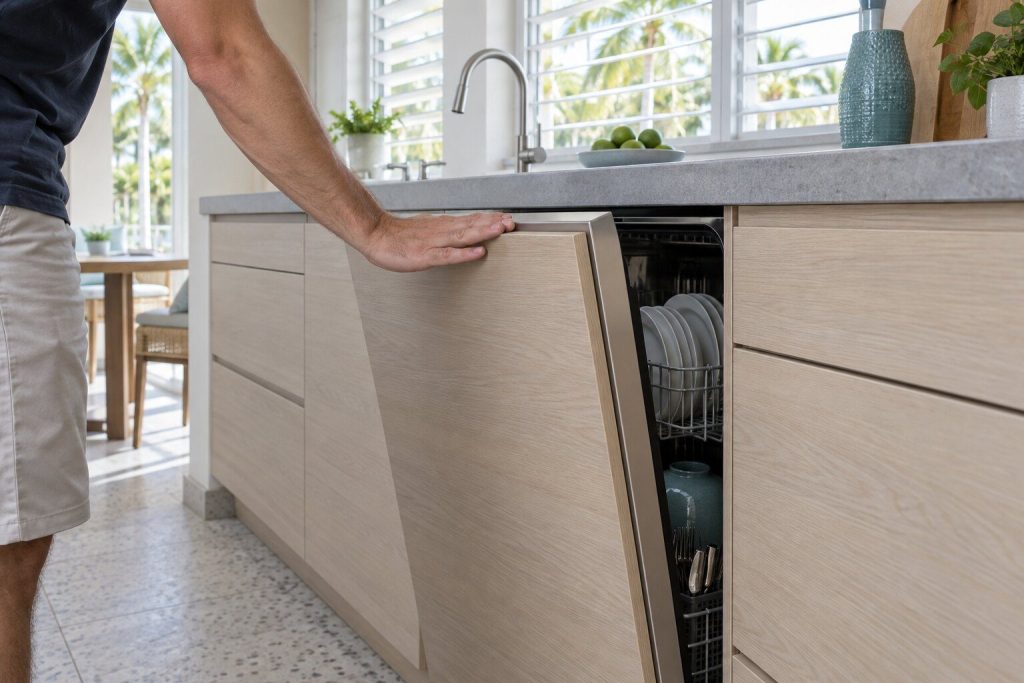
  • A hand pressing the door of a panel-ready dishwasher closed against its catch, the machine dark and silent, a full lower basket visible through the gap.
    The door shuts, the program is chosen, and nothing happens

    Dishwasher will not start

    Dead silence, and on an integrated machine the prime suspect is mechanical rather than electrical: is the door. A custom panel adds weight the hinge springs were set for on installation day, joinery settles over the years, and a door that looks perfectly shut can be sitting a millimeter proud of the switch that proves it. On the Outdoor machines there is even a message for it in as many words. After the door there is the supply, and then a control that is genuinely not responding — in that order, because that is the order of cost.

    • Push the door firmly and try again — on an integrated machine this is the usual answer
    • A delay start nobody cleared behaves precisely like a dead machine
    • Check the socket behind the cabinet, which nobody can see
    What it usually means
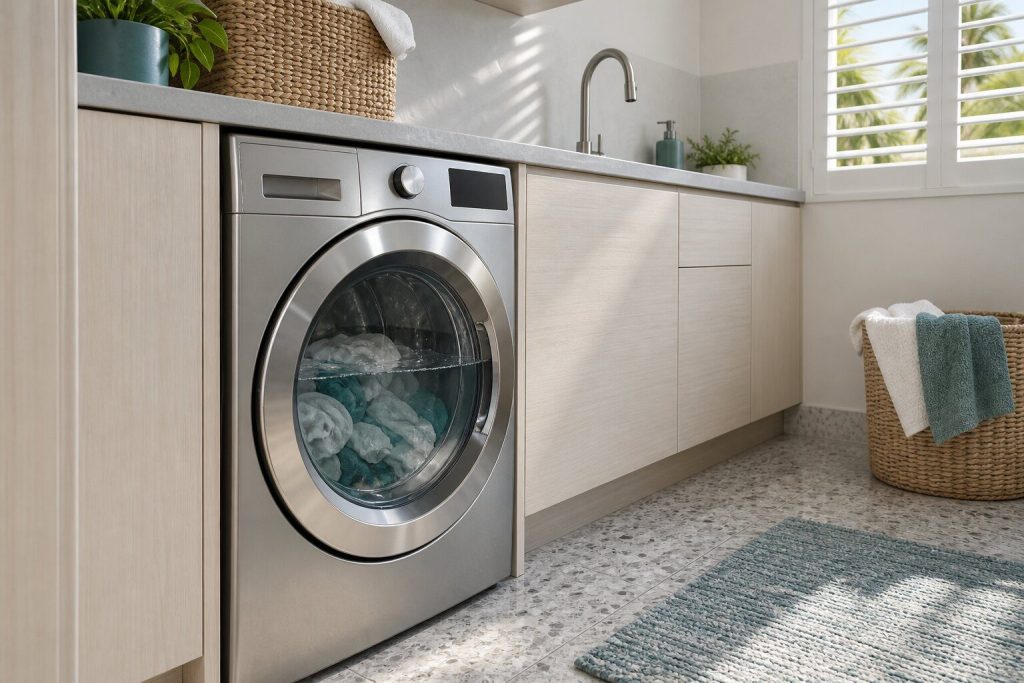
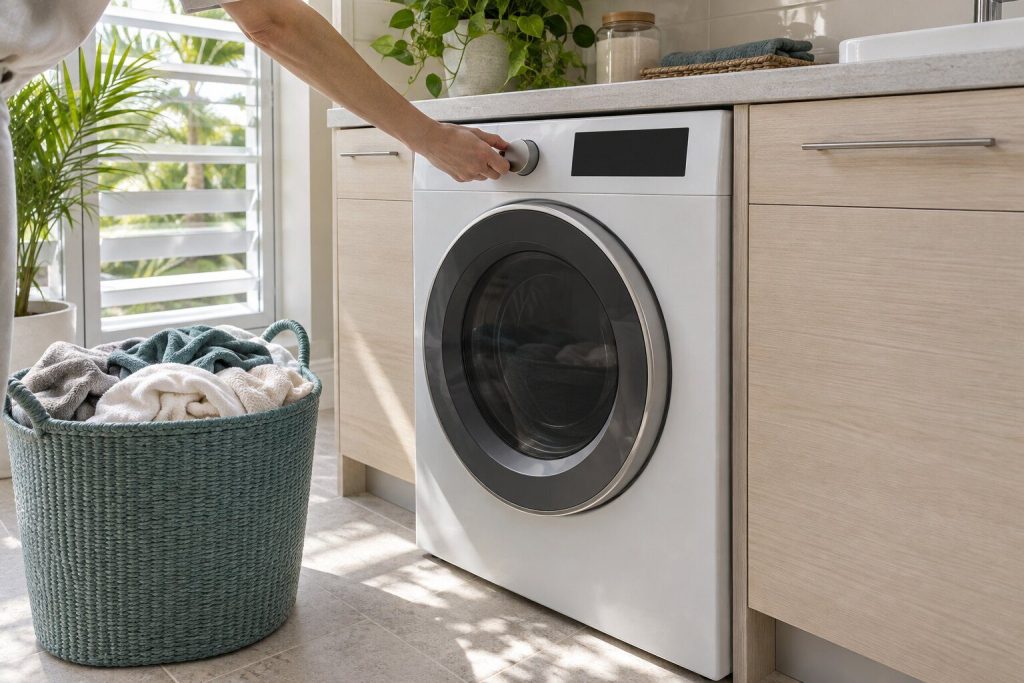
  • The drum of a front-load washer half full of standing water behind the closed glass door at the end of a program, laundry floating in it.
    The drum is full of water at the end of the program

    Washer not draining

    A cycle that has finished with the water still in it, and a machine that then refuses to spin — that refusal is deliberate rather than a second failure, because spinning a full drum would put the water on the floor. How the machine says so depends entirely on the panel: the display models print a number, the numbered-LED models a short code from an unrelated family, the analog ones a letter and a light, and the premium panels write out a sentence. Behind every one of them is the same short path from sump to standpipe, and the cheap end of it ends most of these.

    • The pump filter is behind the lower panel and it is free to check
    • Empty the drum through the drain hose BEFORE opening the filter cap
    • Five different code families describe this — the model decides which one you have
    What it usually means
  • A soaked bundle of laundry lifted out of a washer drum in two hands, water running off it onto the tiled floor and a towel already spread there.
    The load comes out soaked after a cycle that seemed to finish

    Washer not spinning

    Clothes heavy with water at the end of a program that otherwise ran normally. Three free things account for most of these and all three can be settled before anybody is called: the machine has not drained, the load will not balance, or the program chosen has no spin in it. What is left after those is genuinely mechanical — the door lock the machine will not spin without, the motor and its control, or the shock absorbers that have worn far enough that the drum moves more than the balance check will allow.

    • Run a spin-only program on an empty drum — it separates three causes in five minutes
    • A machine holding water will never spin, by design
    • Persistent imbalance on ordinary loads is worn suspension, not laundry
    What it usually means
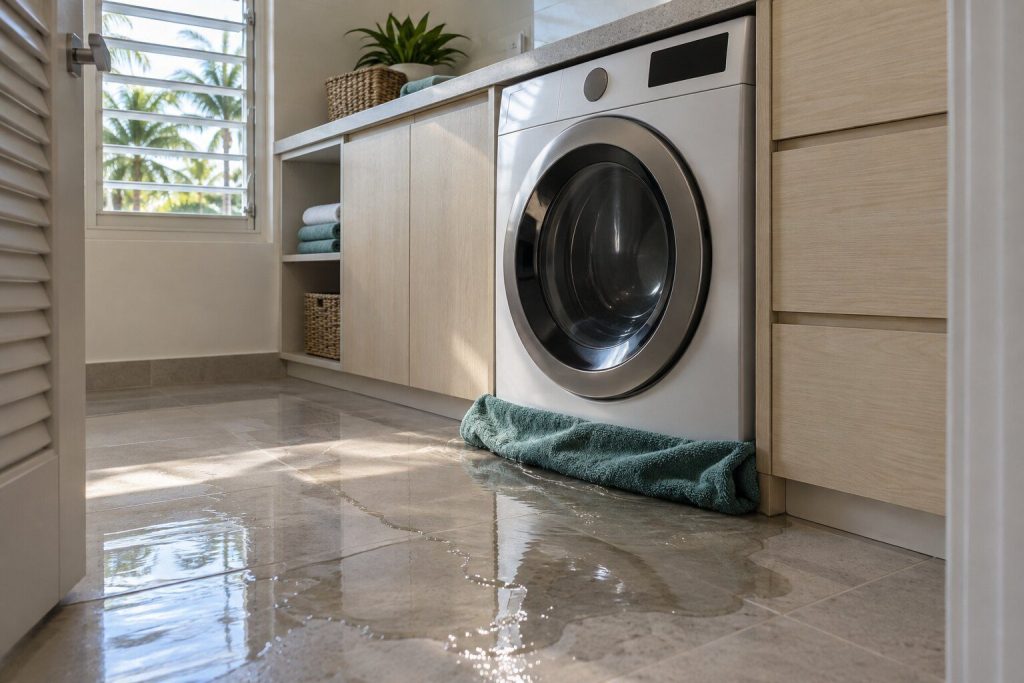
  • Water spreading across the tiled floor of a laundry closet from under a washer, no source visible, a towel pushed against the plinth.
    Water on the laundry floor and no obvious source

    Washer leaking

    Water appearing under or beside the machine, and by the time it shows on the tile it has usually traveled along the frame from somewhere else. Three places account for nearly all of it: the door seal, where grit collects in the bottom fold and cuts the rubber from the inside over months; the pump filter cap, very often after somebody cleared a blockage and did not seat it; and the hose unions at the wall. In a condominium this matters further than the machine does, because water in a laundry closet reaches a floor slab and then somebody else's ceiling.

    • Turn the taps off and stop using the machine — a program uses several gallons
    • Check the filter cap first if anyone has cleared a blockage recently
    • In a building this is a shared problem long before it is an expensive one
    What it usually means
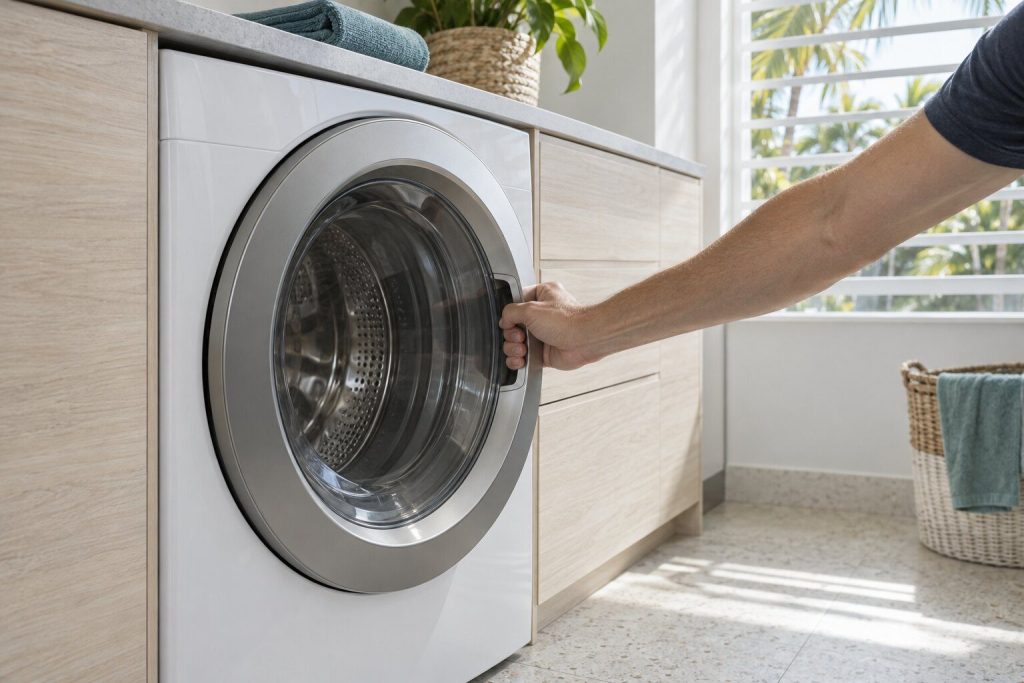
  • A hand pulling at the closed glass door of a front-load washer that has finished its cycle, the drum still and the door not moving.
    The cycle has ended and the door is still locked

    Washer door will not open

    A finished program and a door that will not release, usually with a drum that still has water in it. Those two facts are connected: the lock stays engaged while there is water inside, which is the machine protecting the room rather than a failure. So the sequence that works is drain first, open second. Where the drum is genuinely empty and the door still will not release, the lock itself has failed — and on this make the premium panels say so in words while the numbered ones give a short code from whichever family that model belongs to.

    • Drain the machine before anything else — a locked door with water in it is correct
    • Do not force it: the lock is the failed part and forcing adds the handle
    • Some models release after a full power-off of several minutes
    What it usually means
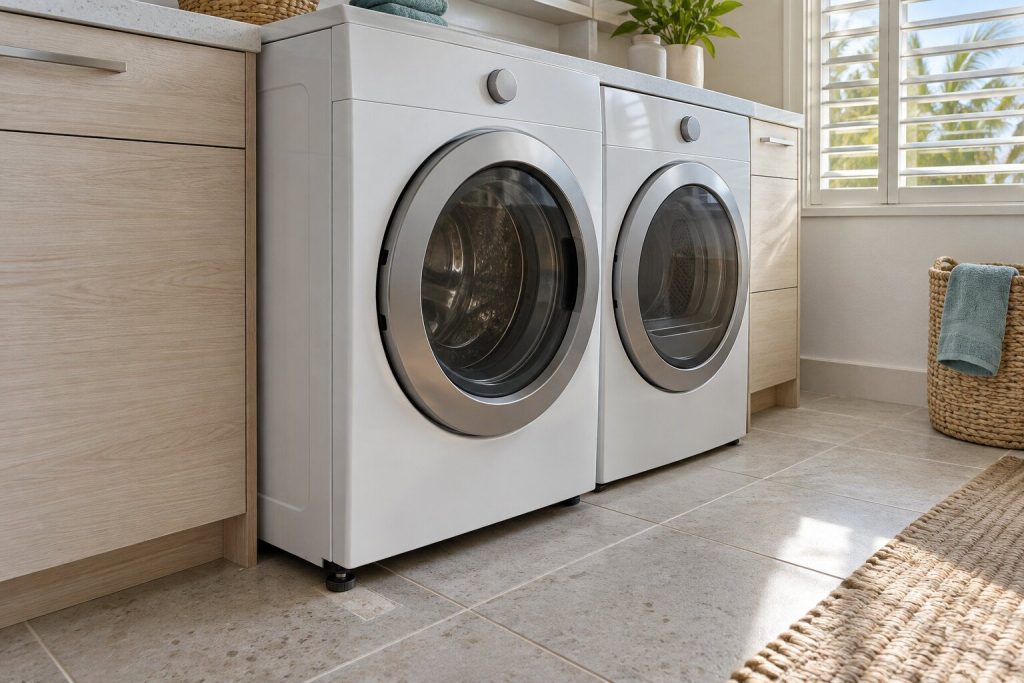
  • A front-load washer standing a hand-width out of line with the dryer beside it on a tiled laundry floor, one foot clear of its mark on the tile.
    It has become noisy, and it walks

    Washer loud or moving on spin

    A machine that has grown louder over months, or one that moves across the floor when it accelerates. Both are the suspension rather than the motor, and both are worth acting on early for a reason that has nothing to do with the noise: worn damping lets the drum travel further on every spin, and that travel is what eventually takes the drum bearing. A bearing is a day's strip-down. Shock absorbers are an afternoon. The gap between those two prices is the entire argument for calling while it is still only annoying.

    • Noise that grew over months is suspension; noise that arrived suddenly is a bearing
    • A machine that walks is not level, or its damping has gone — check level first
    • Catching this early is what prevents the expensive repair
    What it usually means
  • A still-damp load being lifted out of a dryer drum at the end of a finished program, the clothes heavy and creased, the drum lit from inside.
    The program finishes and the load is still damp

    Dryer not drying

    A cycle that runs its full length and leaves the washing wet. On a condenser or heat pump machine — which is what this badge sells — this is almost never about heat, and that is the thing worth understanding before anybody is called. Nothing is being blown outside: moisture is condensed out of the air and collected, so the machine depends on three separate filters and a condenser staying clear. In a South Florida laundry closet those load far faster than any manual assumes, and clearing them ends this complaint more often than any part.

    • Three filters, not one — door lint, condenser, and the water container
    • The condenser filter is behind the plinth and most owners never knew it existed
    • Sensor bars filmed with softener tell the machine a wet load is dry
    What it usually means
  • A dryer running with its display lit too small to read and a full laundry basket standing on the tile in front of it, late afternoon light through a shutter.
    It still dries, but the cycle has doubled

    Dryer takes far longer than it used to

    Nothing has failed and everything takes twice as long — the most gradual complaint on this machine and the one people put down to age. It is almost never age. A condenser dryer's cycle length is a direct measure of how well air moves through it, so a program that has quietly grown from ninety minutes to three hours is reporting a blocked path in the only language it has. There is a limit built in at two hundred minutes, and every dryer platform on this badge has a code for hitting it, under a different name on each revision.

    • Cycle length is the measurement — write down what a standard load takes now
    • Every platform here stops at two hundred minutes and reports it differently
    • Lint past the filter collects inside the cabinet, where no owner check reaches
    What it usually means
  • A hand held flat inside the open drum of a dryer that has run a full program, the drum cool and the load lying tumbled and cold.
    The drum turns, the cycle runs, nothing gets warm

    Dryer runs but there is no heat

    The machine behaves normally in every way except the one that matters. On a condenser machine this splits into a heater and its thermostats; on a heat pump machine it is a sealed refrigeration circuit and the answer is a different order of expense entirely. Which one you have is therefore the first question, and it is answered by the model rather than by the symptom. Before either, though, the same free checks apply: a machine that cannot move air will trip its own thermal protection and then run cold, and that is not a heater problem at all.

    • A blocked machine overheats, trips its cut-out and then runs cold
    • Heat pump and condenser machines fail differently and cost differently
    • Clear the filters first — a tripped cut-out with a clean machine is a real repair
    What it usually means
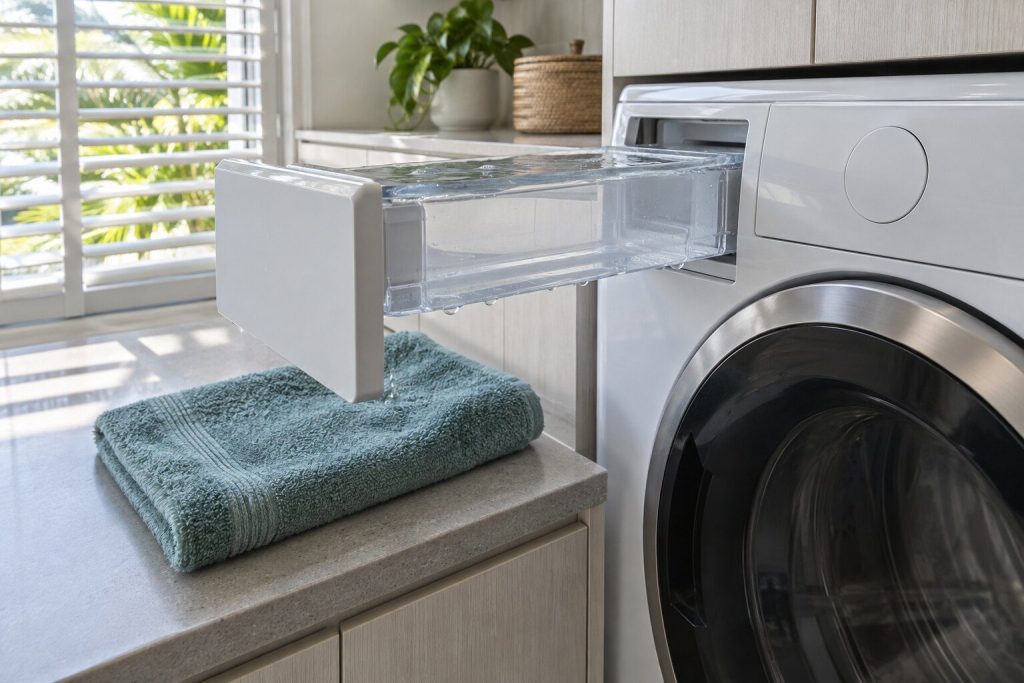
  • The water container of a heat-pump dryer pulled out at the top of the machine and brimming, water at the lip, a towel under it on the worktop.
    It needs emptying every load, or it overflows

    The water container fills constantly

    A container that needs emptying far more often than it used to, or one that reports itself full when it is not. Both are worth understanding because the first is frequently not a problem at all: a condenser dryer takes every drop out of the washing, so a heavier load, a wetter spin or a more humid room all mean genuinely more water. What is a problem is a machine that reports full with an empty container — that is the microswitch — or one plumbed to a drain that has stopped clearing.

    • More water can simply mean wetter loads or a more humid room
    • Full reported with an empty container is the switch, not the water
    • On a plumbed machine, the same message means the drain is not clearing
    What it usually means
  • A hand at the program selector of a dryer with the door closed and nothing lit, a full basket of washing waiting on the floor beside it.
    Nothing happens when the program is selected

    Dryer will not start

    A machine that does nothing at all, and as with the dishwasher the first suspect is the door rather than the electronics: a dryer will not run with the door unlatched, and a catch that has worn is the most ordinary explanation there is. After that comes the container, because a machine reporting itself full stops before it starts, and only then the supply and the control. That order matters because it runs from free to expensive, and most of these calls end in the first two.

    • Push the door until it latches — a worn catch produces this exactly
    • A full or unseated water container stops the machine before it begins
    • An unlit panel and a lit one that ignores you are two separate problems
    What it usually means
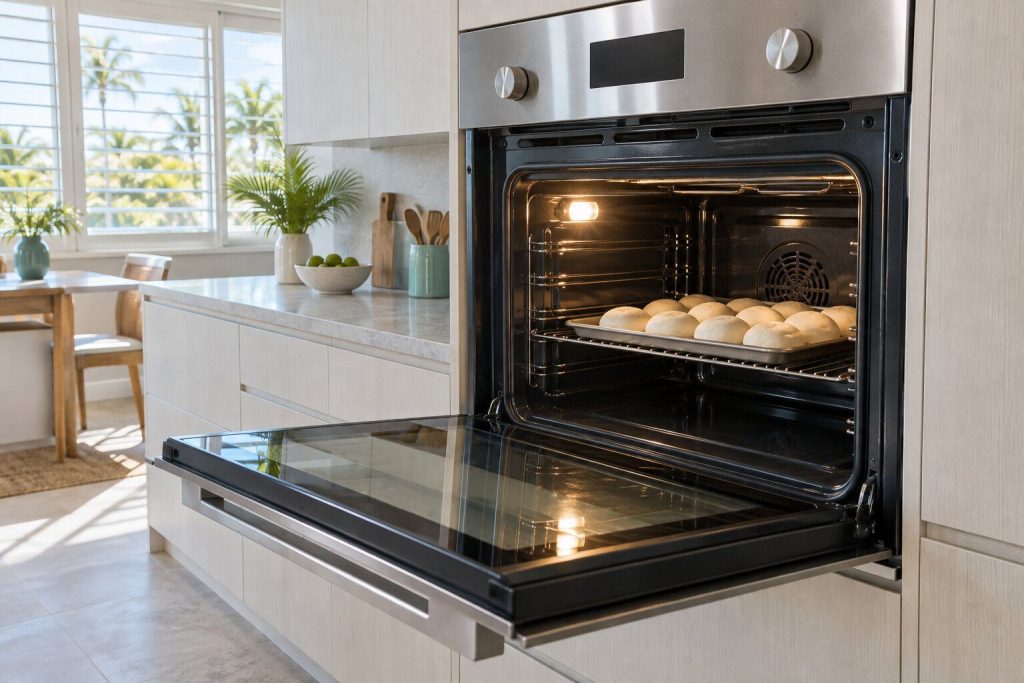
  • A tray of pale raw rolls sitting on the shelf of an oven whose interior light is on and whose cavity is plainly cold, the door held open.
    The fan runs, the light works, nothing gets hot

    Oven not heating

    An oven that stays cold, or one that heats on some functions and not others. The display will not help here and that is a documented fact rather than an omission: six oven manuals across several generations print an undecoded ErrXX and the same instruction to power-cycle and call somebody. So the reading is conventional and the single most useful thing anybody can supply is which functions still produce heat. A grill working while the bake element does nothing cuts the diagnosis in half before anybody arrives.

    • Nothing narrows this faster than a list of which functions still heat
    • ErrXX has no published meaning — that is the manuals, not our research
    • A tripped thermal cut-out is common, and why it tripped is the repair
    What it usually means
  • A tray of rolls taken out of an oven with the row along one side browned dark and the row along the other barely colored.
    One side browns and the other does not

    Oven bakes unevenly

    Everything works and nothing is right. One complaint here carries two unrelated problems behind it, each with its own repair: an oven whose sensor now reads a few degrees out, which is accuracy, and an oven perfectly accurate at its own sensor while being wildly uneven inside, which is airflow or a door seal. No amount of calibration fixes the second, which is why the cavity gets mapped with a probe at several positions rather than read once in the middle.

    • Accuracy and evenness are different problems with different parts
    • A door seal that has set is the commonest cause of uneven by a distance
    • Measured with an independent probe at several points, not one
    What it usually means
  • A pan standing on one zone of a black glass induction top with three other zones showing faint use marks, nothing happening under it.
    Three zones work and the fourth does nothing

    One induction zone dead

    A single dead zone on an induction hob is better news than it sounds: the problem is usually local to that zone's coil or to its section of the generator board, which leaves the supply and the main control out of it. Two things produce an identical symptom for nothing and both are checked first — a pan without a ferromagnetic base, settled by a magnet in two seconds, and a lock or child-safety state that looks exactly like a failure from the front.

    • A magnet on the pan base settles the commonest cause in two seconds
    • Lock and child-safety states look identical to a dead zone
    • Two adjacent zones failing together means a board section, not a coil
    What it usually means
  • A dial thermometer standing on a wire shelf inside an open integrated refrigerator column with ordinary food around it, the interior light on.
    Lights on, motor audible, and nothing inside is cold

    Refrigerator not cooling

    Everything about the appliance suggests it is alive, and the contents say otherwise. This make prints no code for it — refrigeration here was documented with symptom tables and nothing else — so a blank display is the normal state and proves nothing either way. What does carry information is the pattern: which side has gone wrong, whether the compressor is turning over, how much heat comes off the back, and where the frost has settled. One thing is checked ahead of all of that, because in this climate it is the likeliest single cause and it costs nothing: whether the machine can still draw air through its grille.

    • Nothing is displayed, and on this badge that is by design
    • Air before refrigerant, and the grille before either
    • Joinery fitted after the appliance closes its only breathing route
    What it usually means
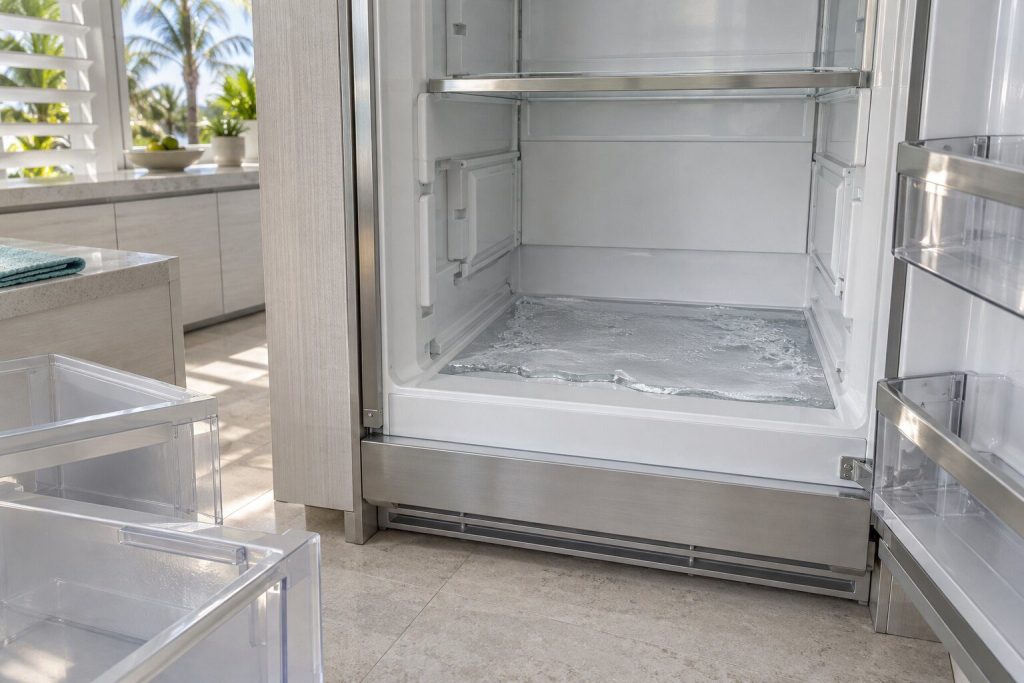
  • A sheet of clear ice lying across the floor of a refrigerator under the lifted-out crisper drawers, meltwater at its edge.
    A slab of ice in the base, or water on the joinery floor

    Water or ice under the drawers

    Ice building under the drawers, or water appearing on the floor of the cabinetry, and on an integrated appliance the second usually arrives before anybody has seen the first. It is one of the few things genuinely worth trying yourself, and we would rather say how than sell a visit for it: the defrost drain channel at the back of the compartment blocks with debris and refreezes, and warm water down it clears most of them. What brings us out is the one that comes back within a fortnight, because that is the drain heater or the path itself rather than a blockage.

    • Worth trying yourself — warm water down the drain channel at the back
    • Back within a fortnight means the heater, not debris
    • On an integrated cabinet the water reaches the joinery before you see it
    What it usually means
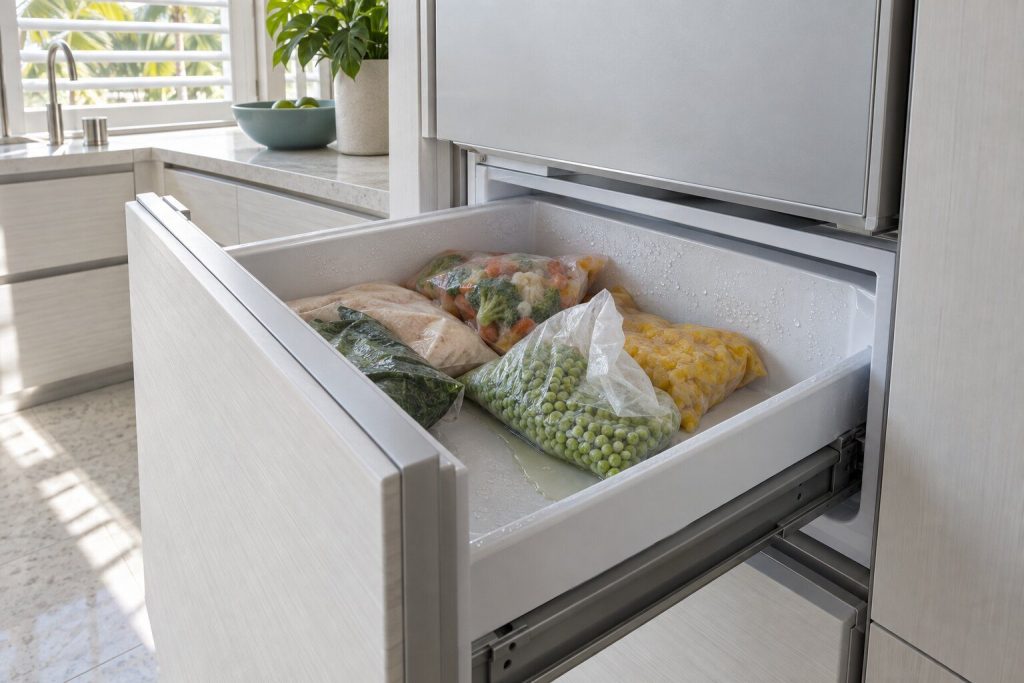
  • An open freezer drawer of soft packets and a bag of peas that has slumped out of shape, the liner damp rather than frosted.
    Running constantly, and the food is soft

    Freezer not freezing

    A cabinet that runs and runs and still will not hold temperature. In this county that has to be separated from a cabinet losing an argument with the room around it, because a freezer in an unconditioned garage or utility room in August is being asked to work far outside its specification and may be perfectly healthy. Telling those two apart is most of the visit, and there is no code on this make to help: the manuals carry problem, cause and solution rows and nothing else.

    • Measure the room, not just the cabinet — a garage in August is the answer often
    • The frost pattern is the reading, and it is quicker than any meter
    • No published codes at all — checked in the manual, not concluded from silence
    What it usually means
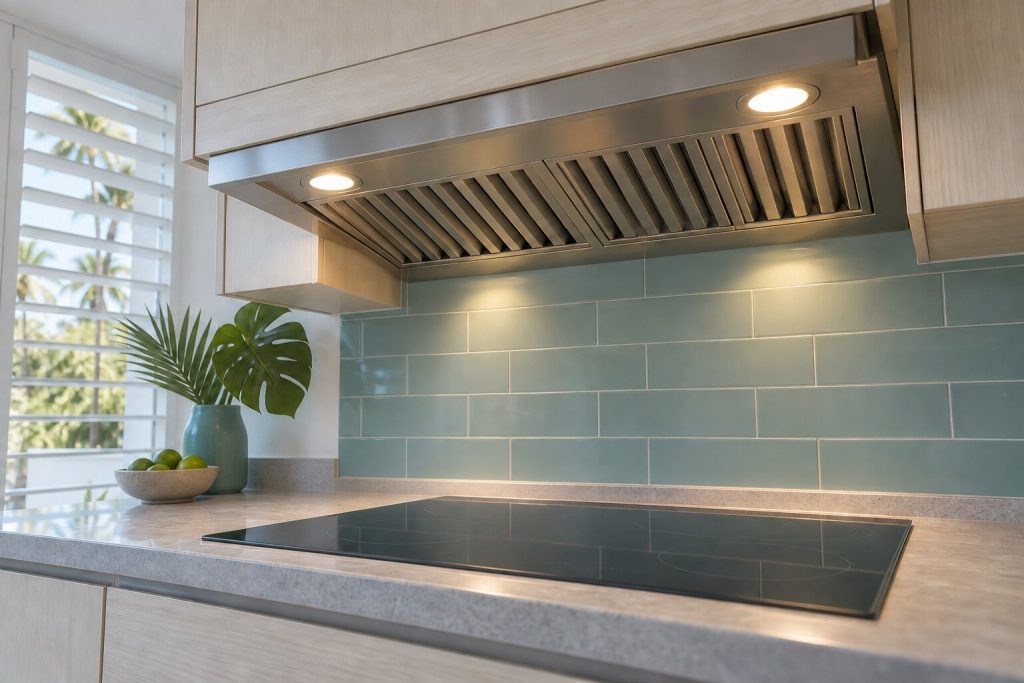
  • Steam from a pan on a cooking surface drifting sideways out into a bright kitchen instead of up into the concealed hood liner running above it.
    It runs, and the steam still goes everywhere

    Range hood not clearing the kitchen

    A hood that sounds like it is working and is not clearing anything. Nine times in ten the duct is to blame rather than the appliance, and the test that proves it takes a minute at the outside vent. On this coast there is a fifth cause the manuals never mention because the manuals mention nothing at all — three hood manuals were read and none of them carries a troubleshooting section — and that is a backdraft damper salted shut, which stops extraction completely while the hood carries on making its usual noise.

    • Test at the outside vent before any part is discussed
    • A salted-shut backdraft damper is the local cause nobody looks for
    • The manuals carry no troubleshooting section at all — three checked
    What it usually means
  • The underside of a concealed hood liner with both lamps lit over an empty cooking surface and the baffle filters completely still.
    The lights come on and nothing moves

    Hood lamps work but the fan does not

    Lamps lit and the motor silent, which is more useful than it sounds: on almost every hood the lamps and the motor sit on different circuits after the switch, so lights working proves the supply is fine and points the whole diagnosis away from it. What is left is the switch or touch strip, the motor and its capacitor. On the concealed liners this make is known for, the touch strip is the common failure in a kitchen where the hood is wiped down every day.

    • Lights working proves the supply and halves the diagnosis
    • Touch strips fail from daily cleaning, and they are an ordinary part
    • The wrong lamp type destroys its own holder in a concealed liner
    What it usually means
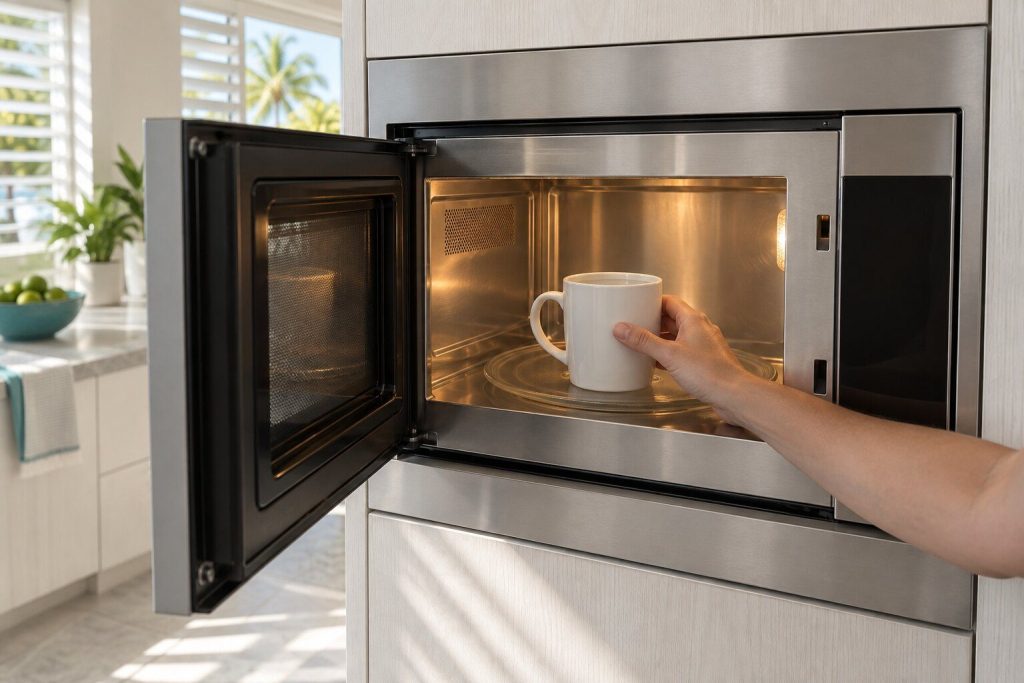
  • A mug of water standing in the lit cavity of a built-in microwave with the door open and a hand resting against the cold side of the mug.
    The cavity runs and nothing gets warm

    Combination microwave hums but does not heat

    A built-in combination cavity that lights up, turns and does nothing to the food. It splits into two questions quickly because the convection side and the microwave side fail independently: if convection heats and microwave does not, the door interlocks and the magnetron circuit are where to look, and the interlocks are far more common because they are wear parts. If neither heats, the supply and the main board come first. A cup of water for sixty seconds settles which of the two you have before anybody drives over.

    • A cup of water for sixty seconds splits the diagnosis in half
    • Three door interlocks in series — one out of agreement stops everything
    • ERROR XX is undecoded in four manuals, so the split is made at the appliance
    What it usually means

Worth saying

7 kinds of machine publish nothing, and we say so

Ovens and microwaves show a string their manuals never decode. Hoods have no troubleshooting section at all. Refrigeration, freezers and ranges are documented with symptom tables and no numbers.

Each of those was read on a page of a manual rather than assumed from a blank display, and that is the difference between this site and one that fills the gap with a table.

Before you book

The questions this page is asked

What does F10 mean on my Asko?

Tell us the appliance and the model and the answer is straightforward. Without them there are four different answers on this badge and no way to choose between them — which is exactly why every page here carries its platform.

Why is my code missing?

Either it belongs to a revision we have not documented, or nothing published decodes it. The dishwasher numbers between F13 and F39 are the clearest example: they are in no consumer manual anywhere and are almost certainly internal. We would rather leave a gap than fill it.

The display just shows Err and two digits.

That is the oven or the microwave, and there is no table behind it. Six oven manuals and four microwave manuals print the same generic line and no meanings. Do the reset the manual asks for, then note the digits, the model and what the machine was doing.

In more detail

How this archive was compiled

Manuals, with page references

Every code here was read off a manufacturer manual — model, page and source recorded against each line. Nothing is inferred from a naming pattern and nothing is carried across from a sister platform because the numbers look similar.

Signals are not codes

18 entries here are signals rather than codes: a display showing something the maker never decodes, or a warning symbol with no meaning table behind it. They are published as what they are, with the sentence the manual actually prints.

Not sure which of these it is?

Tell us what the machine is doing and the model code off its door edge, and we will say which page you are on. Where a diagnostic is the right next step it is from $95, credited toward the repair.

This article is based on:

  • Official manufacturer documentation
  • Internal repair procedures
  • Technician repair history
  • Company quality standards
Call (305) 363-1406